


What Is PET Plastic?
PET (Polyethylene Terephthalate) is a widely used thermoplastic polyester known for its clarity, strength, and lightweight nature. It combines good mechanical performance with excellent processability, which is why PET is found across packaging, engineering components, films, and synthetic fibers.
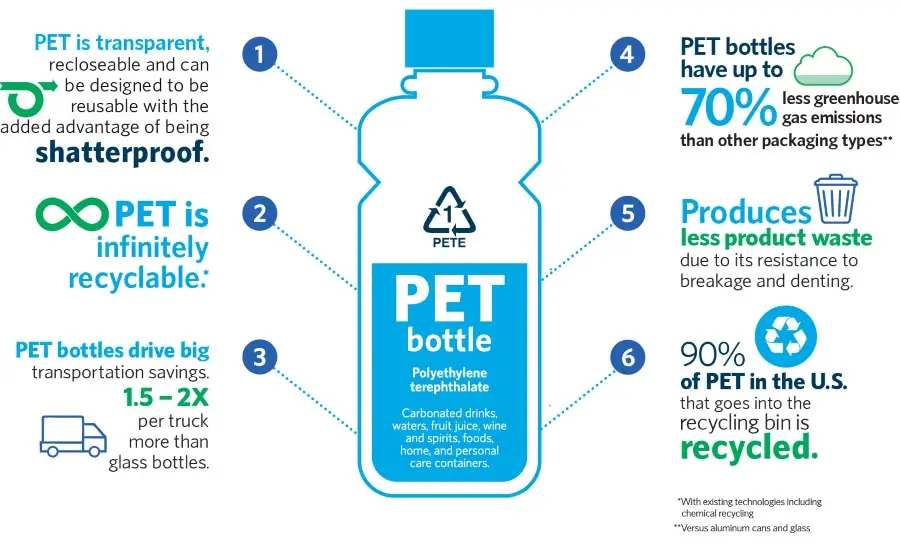
Because PET offers a strong balance between performance, cost efficiency, and recyclability, it has become one of the most important plastics in modern manufacturing.
Key Properties of PET Plastic
For designers and engineers, PET is often selected because it delivers predictable performance in both appearance and structure.
- High transparency: PET naturally provides a clear, glossy appearance, making it ideal for display packaging and transparent parts.
- Balanced mechanical strength: It offers good tensile strength and stiffness, supporting durable and load-bearing applications.
- Thermal performance: PET typically melts at around 250–260°C, with a glass transition temperature near 70–80°C, defining its processing and service limits.
- Low moisture absorption: This helps maintain dimensional stability during molding and long-term use.
- Good barrier performance: PET resists moisture and gas transmission better than many common plastics, which is critical for food and beverage packaging.
- Recyclability: PET is one of the most established plastics in global recycling systems.
Common Types of PET Materials
PET is not a single-form material. Different variants are engineered to meet specific performance needs.
PETG (Glycol-Modified PET)
PETG offers improved toughness and impact resistance while maintaining transparency. It is easier to process than standard PET and is often used for durable transparent housings, protective covers, and packaging.
rPET (Recycled PET)
rPET is produced from post-consumer or post-industrial PET waste. It supports sustainability goals while maintaining acceptable mechanical and visual performance, especially in packaging applications.
APET (Amorphous PET)
APET is rapidly cooled to prevent crystallization, resulting in excellent clarity. It is commonly used in sheets, films, and thermoformed trays where appearance is critical.
PET Fiber
When processed into fibers, PET becomes polyester, widely used in apparel, home textiles, and industrial fabrics due to its durability and resistance to wear.
Typical Applications of PET Plastic
Thanks to its versatility, PET supports a wide range of industries:
- Packaging: Beverage bottles, food containers, cosmetic and pharmaceutical packaging
- Engineering parts: Automotive components, electrical housings, industrial fittings
- Films and sheets: Labels, protective films, printing substrates
- Medical-related uses: Medical packaging and selected device components
- 3D printing: PET and PETG filaments for functional prototypes and end-use parts
PET Blending and Material Modification
In engineering applications, PET is often blended or modified to achieve specific performance targets. By combining PET with other polymers such as PE, PP, PC, ABS, or EVA, manufacturers can improve impact resistance, heat performance, or processing stability.
Successful PET modification usually depends on:
- Clearly defining the target properties
- Ensuring compatibility between blended materials
- Balancing performance improvements with cost and production stability
PET Processing Methods
PET supports multiple mature manufacturing processes, allowing scalable and consistent production.
- Injection molding: Used for precision parts and preforms
- Blow molding: Commonly applied to bottle production
- Extrusion and thermoforming: For sheets, films, and trays
- Melt spinning: For polyester fibers
- 3D printing: PETG is widely used due to its printing stability and toughness
Each processing method influences final part performance, surface quality, and cost efficiency.
PET Compared with Other Plastics
When selecting materials, PET is often evaluated against other common polymers:
- PET vs. PP: PET offers higher clarity and stiffness, while PP excels in flexibility and cost efficiency
- PET vs. PVC: PET is more environmentally friendly due to simpler recycling
- PET vs. HDPE: PET provides better transparency and gas barrier properties
- PET vs. PC: PC offers higher impact strength, but PET performs better in chemical resistance and food-contact applications
- PET vs. BOPP: PET films deliver higher strength and durability, while BOPP focuses on lightweight packaging
Conclusion
PET plastic remains a dominant material because it successfully balances clarity, strength, barrier performance, manufacturability, and sustainability. With variants such as PETG, rPET, and APET, PET adapts easily to packaging, engineering, film, and textile applications.
For manufacturers and designers seeking reliable performance with long-term scalability, PET continues to be a practical and future-ready material choice.
