


Vacuum Die Casting Services | Precision Metal Prototypes
Vacuum Die Casting Services: Metal Prototypes and Low-Quantity Production
- In contemporary production, accuracy, effectiveness, and dependability are never compromised, particularly in the production of high-performing metal parts. Vacuum die casting services have emerged as a critical solution to industries with high tolerances of the parts they need in volume, which are functional and have a low volume. Vacuum die casting has been used in aerospace, automotive, and industrial machinery to provide dimensional accuracy, surface quality, and structural integrity in both prototypes and small production runs.
- At GD Prototyping, we are the vendor of the vacuum die casting of metal parts, and we specialize in the vacuum die casting solutions that will be used in supporting the rapid prototyping, low-volume production, and functional testing. Using state-of-the-art equipment, fine-tuned tooling, and high-grade alloy, we are offering engineering-grade pieces of vacuum die cast that are in place to fulfill the most rigid demands of the industry.
What is Vacuum Die Casting?
Vacuum die casting, sometimes referred to as vacuum-assisted die casting, is an advanced method of metal casting that is a blend of high-pressure die casting and vacuum technology. The vacuum minimizes the gas porosity and air trapping in the molten metal, which makes the die casting precise, components with low defects, and uniform structural integrity.
Vacuum die casting, in contrast to traditional die casting, permits complex geometry die casting components with thinner walls, more complicated internal structures, and more powerful load-bearing components to be produced. It is commonly used in aerospace vacuum die casting, automotive vacuum die casting, and equipment manufacturing.
Basic Procedures of Vacuum Die Casting
Die Mold Fabrication: Precise molds are designed in accordance with the geometry of the metal and components.
- Preparation of Molten Metal: Alloys of aluminum, zinc, magnesium, or copper are melted and then degassed.
- Vacuum-Assisted Casting: The molten metal is pressurized and forced into the die mold as a vacuum removes any air and gases trapped in the mold.
- Curing and Cooling: This process is where the cast part hardens in the mold, retaining its dimensional accuracy and structural integrity.
- Finishing/Post-Processing: Components are deburred, polished, coated, heat-treated, and surface-treated to obtain the desired finish and performance.
The Benefits of Vacuum Die Casting Services
High Precision and Quality
In vacuum die casting, GD Prototyping guarantees precision vacuum die casting components that are on tight tolerances in the case of critical applications. Vacuum environment removes air bubbles and minimizes defects, and enhances surface roughness control (Ra values). The process suits well functional die cast prototypes and load-bearing components.
Complex Geometries Support
Die casting, vacuum type of process, enables the making of complex geometry die casting products with fine lines and thinner walls that cannot be provided with conventional casting. This has been enabled by quick die casting prototyping of complex aerospace, automotive, and industrial parts.
Material Versatility
Most of the metals and alloys that we have to work with include:
- Lightweight, high-strength cast aluminum, vacuum die casting.
- Zinc vacuum die casting services of corrosion resistant parts.
- Die casting of magnesium is vacuum weight sensitive.
- Conductivity and mechanical strength. Die-cast parts made of copper and brass are vacuum die-cast.
- Die castings are alloys of high strength that can be used in the aerospace and automobile sectors.
- Metal castings (engine and turbine) that are heat-resistant.
The correct choice of material will provide the dimensional accuracy of metal components, mechanical strength confirmation, and the structural integrity of cast components.
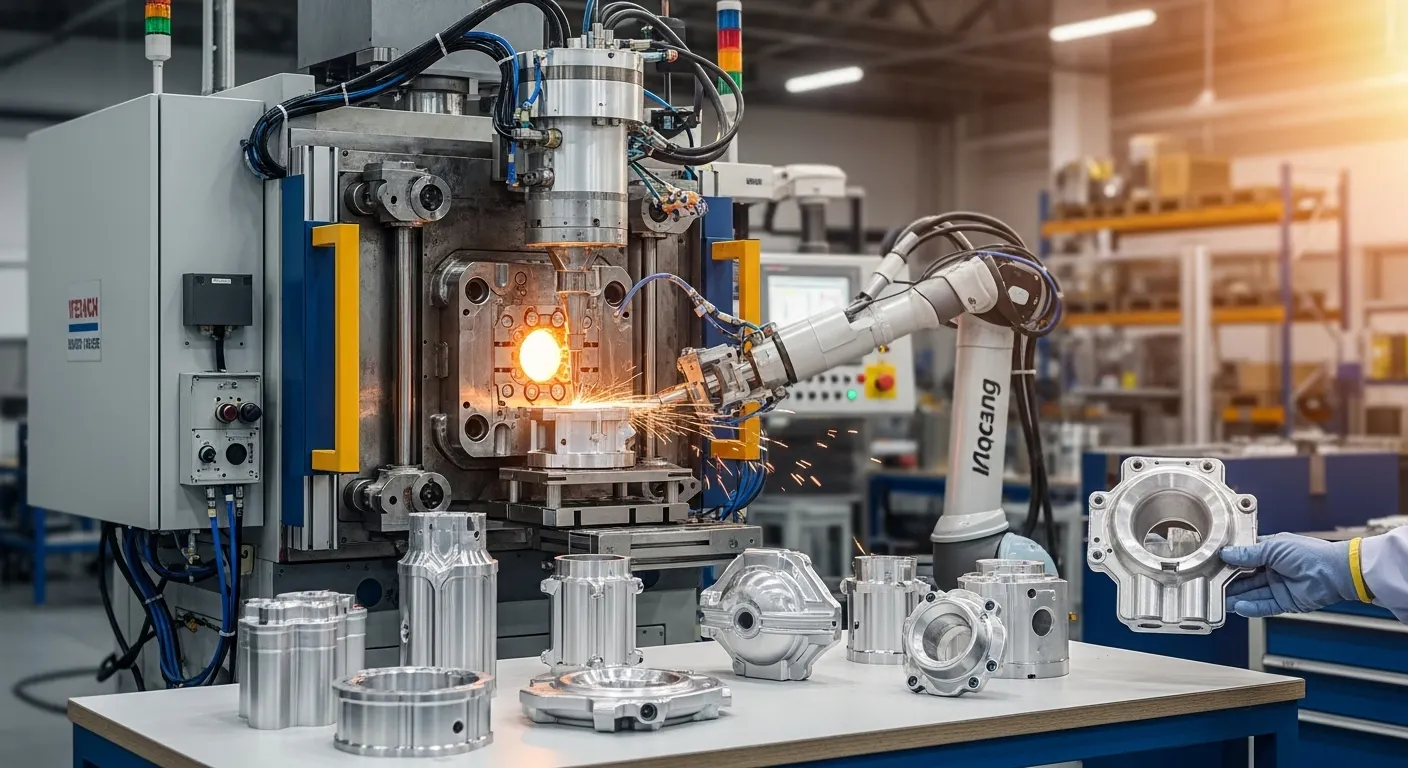
Quick Manufacturing and Cost-Effectiveness
Vacuum die casting is also used in low-volume vacuum die casting and quick prototyping vacuum die casting. It has removed the cost of expensive tooling or long lead times, as compared to traditional production methods, making it cost-effective to manufacture small production runs and prototypes.
Flexibility in Iterative Prototyping
Vacuum die casting promotes prototyping of die casting. Vacuum die casting is ideal in die cast prototyping because engineers can easily make and test prototypes that are functional. It is possible to make changes to the master model and molds within a short period of time, enhancing the product development process.
High-Quality Surface Finish and Post-Processing
The vacuum die casting process produces high-quality vacuum cast components with smooth surfaces. Post-processing methods include:
- Deburring and polishing
- Painting and coating metal objects.
- Die cast components heat treatment.
- Finishing texture and pattern.
- Corrosion-resistant protective coating.
Selection of Material in Vacuum Die Casting
Vacuum die casting requires the use of suitable metals and alloys. GD Prototyping offers:
- Lightweight, Strong, and Corrosion-Resistant Aluminum Vacuum Die Casting: Aerospace and automotive applications.
- Zinc Vacuum Die Casting Services: Perfect when it comes to finely detailed and minor elements with a high level of finish.
- Magnesium Vacuum Die Casting: Lightweight parts of aerospace or automotive prototypes.
- Die Cast Parts, Copper and Brass: The ideal choice of conductivity and durability in industrial or electronic products.
- High-Strength Alloys: Special-purpose load-bearing and heat-resistant components.
The correct material should be used so that the vacuum cast components are functional and comply with dimensional and mechanical requirements.
What is So Special About GD Prototyping in Vacuum Die Casting?
At GD Prototyping, We Provide:
- Bespoke vacuum die casting the way you need it.
- Production or prototype testing of vacuum die casting.
- Engineering-grade quality control administration of professional die casting.
- Vacuum casting services for low volumes to reduce the cost and maximize efficiency.
- More sophisticated finishing facilities, such as deburring, polishing, coating, and heat treating.
By collaborating with GD Prototyping, your team can go directly from concept to functional prototype or small-scale production of high-quality and reliable parts. Find out more about our services: GD Prototyping.
Conclusion
Vacuum die casting services are a disruptive innovation to the industries that require precision, quality, and low-quantity production of metal components. Using a combination of vacuum-assisted techniques, superior tooling, and high-strength alloys, GD Prototyping provides engineering-grade vacuum die cast components that are ready to undergo either functional testing, R&D, or production.
