


Vacuum Casting with ABS Resin | High-Precision Prototypes
What is ABS Resin Vacuum Casting?
Vacuum casting with Abs resin is a low-volume production method which is a duplication of a master model through high-quality silicone molds. The process enables the ABS-like resin vacuum casting parts to be produced with mechanical properties and finishes that are comparable to those of injection-molded parts.
It starts with a master model that is usually produced using CNC machining or 3D printing that engraves finer aspects of the finished component. A flexible mold is created by pouring liquid silicone over this master, with cured liquid silicone which has cured.
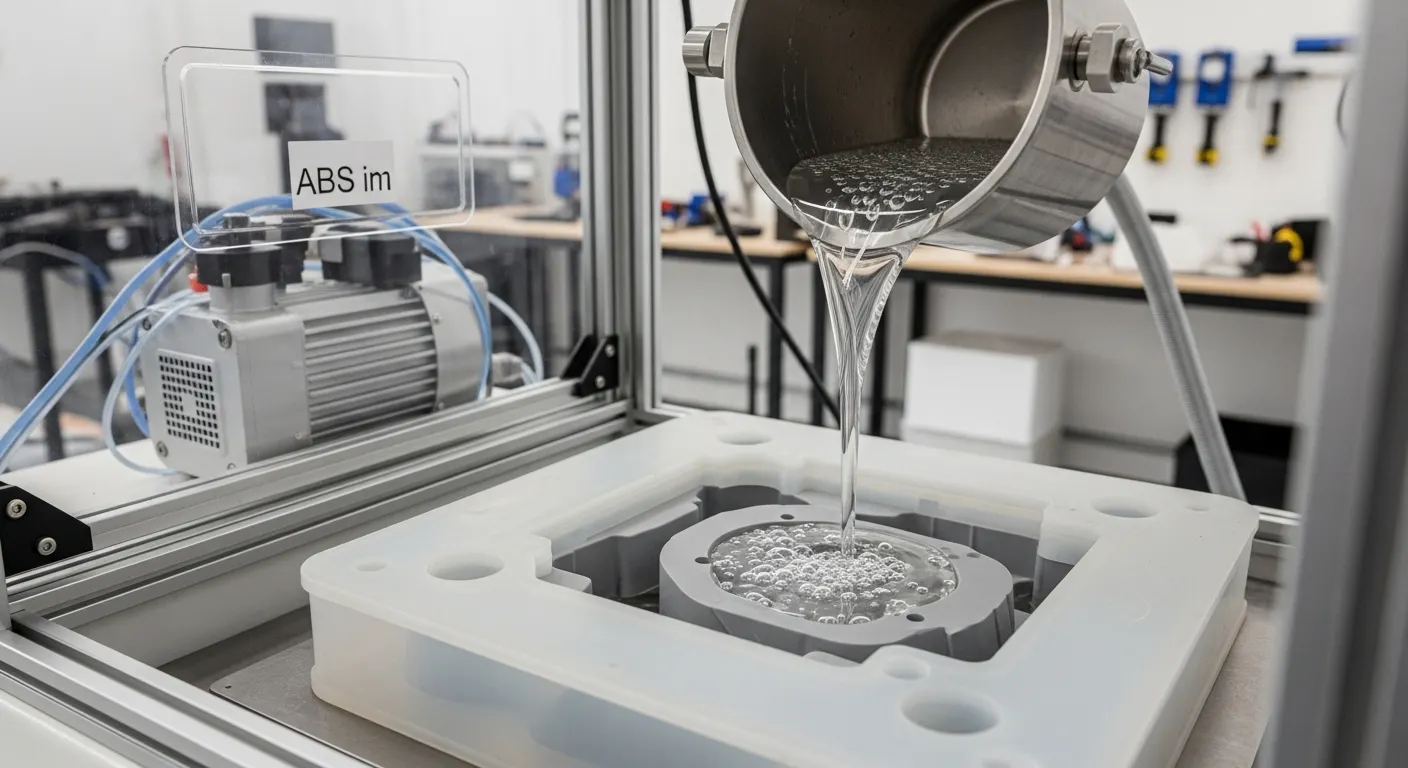
After the mold has been prepared, two parts of ABS-like polyurethane resin are mixed, in which colorants or other fillers may be added to attain the desired aesthetic or mechanical properties. The resin and the mold are then put into a vacuum chamber; a vacuum pump is used to extract the air from the mold cavity and the resin, thus casting the resin without any bubbles.
ABS Vacuum Casting Materials and Properties
Vacuum casting provides parts that are dimensionally stable, strong, and thermally resistant using engineering-grade ABS resin. The thermoplastic ABS alternative resin offers a strong solution where prototypes are needed in terms of fit, form, and functional testing.
Among the important material properties, there are:
Impact Resistance - Resistive mechanical test stresses.
Heat Deflection Temperature (HDT) - Appropriate where there is a high temperature.
Tensile and Flexural Strength - Guarantees structural soundness.
Surface Hardness - Can be post-processed, such as sanding or painting.
Chemical Resistance - Works best in industrial or medical use.
Sloping Finish on Surfaces - Imitates injection-molded appearance well.
Dimensional accuracy - +-0.2 mm according to case size and complexity.
We also have dedicated ABS-like polyurethane resin used in parts that are transparent, flexible, or resistant to high temperature, which means that our team is able to design anything and achieve the best customization in small-volume production orders.
ABS Resin, the Vacuum Casting Process
The ABS vacuum casting method is precise and versatile, and it can enable the engineer to do a rapid process of crafting designs. Here's a step-by-step overview:
Master Model Creation: The master is made by CNC machining or 3D printing, and all the finer details are captured.
Silicone Mold Preparation: A high-quality silicone is deposited on top of the master, forming a flexible RTV mold that is able to reproduce all the contours.
Resin Preparation: ABS-like polyurethane resin is compounded, with or without colorants or fillers, to have the desired mechanical or visual properties.
Vacuum Degassing: The resin and mold would be put in a vacuum chamber to eliminate the trapped air and avoid bubbles.
Casting Under Vacuum: Under a vacuum, the atmospheric pressure is used to fill all the mold features with the resin, creating high-detail parts.
Curing and Demolding: Once the resin has been cured (usually in an hour), the part is removed from the mold.
Post-Processing: Trimming, Sanding, painting, or polishing are possible to produce finishes as good as those of injection-molding.
This is best suited to short-run ABS casting, which is normally 1-25+ cases per silicone cast, depending on the complexity. The standard lead time has been 7-10 working days, and hence is a quick fix when it comes to prototypes and low volumes.
Benefits of ABS Vacuum Casting
Compared to traditional techniques (injection molding or 3D printing), vacuum casting has several benefits:
High Precision: Dimensional variation of +-0.2 mm is used to make certain of accuracy in vital parts.
Low-Volume Production Cost-Effective: This is ideal when a small batch of production is required, and the tooling expense is prohibitive, as is the case with injection molding.
Quick Cycle: Make changes to the master model and manufacture a new mold in less than one day, making design changes faster.
Functional Prototypes: Create mechanically sound ABS prototypes to test the fit, form, and functionality.
Various Finishes: Select between smooth, painted, textured, or clear-polished finishes.
Material Versatility: ABS-like polyurethane resin can be used to make high-strength, impact-resistant, or heat-resistant parts.
Bubble-Free Casting: The use of vacuum degassing provides an unbroken surface.
End-Use Components: Minor groups of parts may act as finished manufacturing products, such as automotive trims or electronic enclosures.
In GD Prototyping, we perform professional ABS vacuum casting service to assure our customers that every part is up to these high standards and that our products will be functional and have an appealing look.
Vacuum Casting ABS Resin Applications
ABS resin vacuum casting is very versatile and thus can be used in many industries:
Automotive Components
- Interior trim pieces
- Dashboard panels
- Functional end-use test prototypes of fit and assembly.
Consumer Electronics
- Enclosures for devices
- Electronic enclosures that need heat-resistant ABS resin.
- Market test and demonstration components.
Medical Devices
- Ergonomic testing prototypes.
- Fit and assembly checking parts.
Industrial Equipment
- Mechanized parts of prototypes.
- Housings of electrical connectors.
- Production of functional parts is limited.
Product Development and Market Testing
- Pre-production samples
- Prototypes of functionalities to be assembled.
- Design verification and market feedback. Rapid design iteration.
Creating high-detailed ABS-like prototypes, companies can cut the lead-time, costs, and implement an efficient test of the products in advance, before making a commitment to large-scale production.
Technical Specifications
ABS resin vacuum casting service would include the following specifications:
Process Accuracy: +-0.2 mm (Depending on size/complexity of the case)
Supplies: Polyurethane resins (rigid, flexible, heat-resistant, transparent)
Surface Finishes: Smooth, painted, textured, or clear-polished finishes.
Batch Runs: 1-25+ cases/ silicone mold.
Mold Type: Detailed reproduction silicone molds of high quality.
Why is GD Prototyping the Best Choice in ABS Vacuum Casting?
We have also employed technical competence, excellent materials, and accurate manufacturing processes within GD Prototyping to produce ABS vacuum casting parts that are above client expectations. Our services include:
- ABS vacuum casting custom service of functional and presentation prototyping.
- Quick iterations and low-volume production, Rapid ABS vacuum casting.
- Protest production on-demand ABS resin manufacturing to lower lead times and costs.
- Control of surface quality and precision to a perfect finish.
Through engineering-grade plastic resin and low-pressure casting methods, we ensure accuracy of dimensions, mechanical integrity, and beauty.
Conclusion
Vacuum casting with Abs resin offers the solution to a flexible, accurate, and economical production of high-quality functional prototypes and limited editions of production. It features accuracy to dimensions within a range of +-0.2 mm, fine finishes of the surface, and customization of material properties suitable for automotive, consumer electronics, medical devices, and industrial usage.
With the adoption of GD Prototyping ABS resin vacuum casting, companies will have the opportunity to enjoy professional, fast, cost-effective prototyping solutions and accelerate the development of new products as well as conduct tests in the market in an efficient manner.
