


Vacuum Casting vs Injection Molding for 20–300 Parts
In product development, there is a challenging phase between the first prototype and full-scale mass production. This is the realm of low-volume manufacturing. A company may need a small batch of 50 units for market testing, or perhaps 200 pre-production parts for certification. For this specific quantity range of roughly 20 to 300 parts, choosing the right manufacturing process is a critical strategic decision. Two powerful technologies dominate this space: vacuum casting and injection molding with rapid tooling.
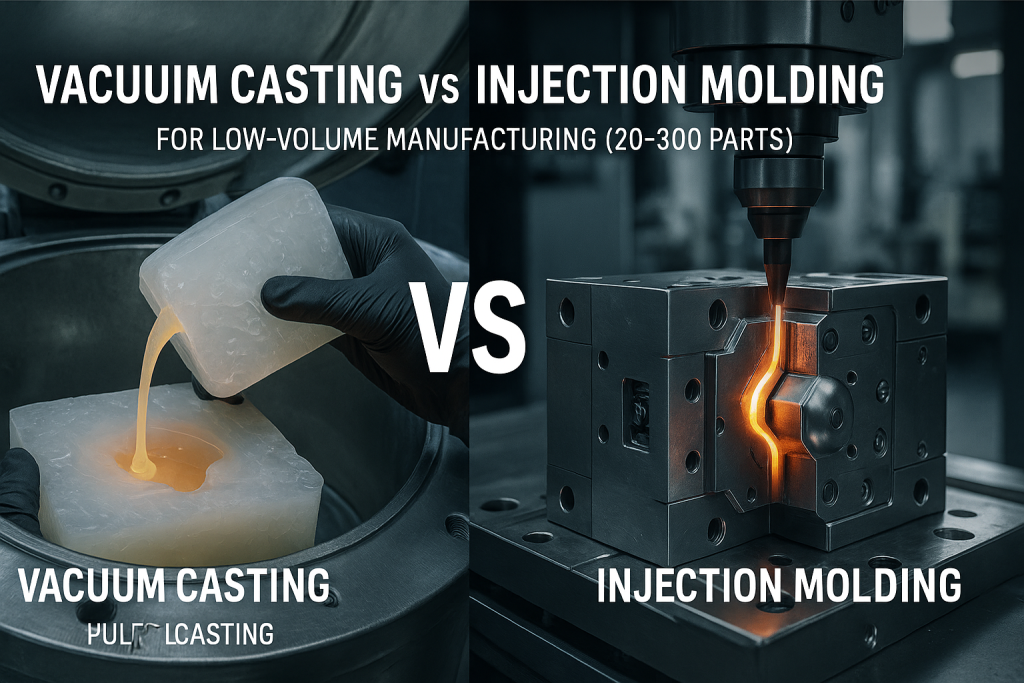
The best choice between these methods is not always obvious. For 20–300 parts, Vacuum Casting is typically faster and more cost-effective due to its inexpensive silicone molds. Injection Molding becomes the better choice towards the higher end of this range (100-300+ parts) if testing with the final production thermoplastic is a strict requirement. Understanding the deep technical and economic trade-offs is key to making the right decision.
As an expert in low-volume manufacturing, GD-Prototyping offers both services. We provide this unbiased, in-depth guide to help engineers, designers, and project managers navigate this crucial choice. This analysis will ensure you select the most efficient and cost-effective process for your specific project needs.
Understanding Vacuum Casting: The Low-Volume Specialist
Vacuum casting is a manufacturing process designed specifically for producing high-quality, short-run batches of plastic parts. It is renowned for its speed, excellent surface finish, and low upfront tooling costs. This makes it a dominant technology for producing parts in the 20 to 300 unit range. The process is a multi-step craft that combines digital precision with skilled handwork.
How Does the Vacuum Casting Process Work?
The entire process revolves around creating a high-quality, flexible silicone mold.
Step 1: Creating the Master Pattern
The process begins not with the final parts, but with a perfect "master pattern." This is a highly accurate, dimensionally perfect replica of the final part. The quality of the vacuum cast parts is directly dependent on the quality of this master. The master pattern is typically created using a high-resolution 3D printing technology like Stereolithography (SLA). The SLA part is then meticulously hand-finished. It is sanded, polished, and painted to achieve the exact surface finish desired for the final products.
Step 2: Making the Silicone Mold
The finished master pattern is suspended inside a casting box. Gates and risers are strategically added. Liquid silicone rubber is then poured into the box, completely enveloping the master pattern. The box is placed in an oven to cure the silicone into a solid but flexible block. Once cured, the mold is carefully cut in half along a pre-determined parting line. The master pattern is then removed, leaving a perfectly detailed, empty cavity in its place. This soft silicone mold is the "tool" for the casting process.
Step 3: Casting the Parts
This is where the vacuum chamber comes into play. Two-component polyurethane casting resins are selected to closely mimic the properties of production plastics. The two components are mixed and then placed inside a vacuum chamber for "degassing." This removes all air bubbles from the liquid resin. The silicone mold is then placed in the chamber, and the degassed resin is poured into the mold. The vacuum ensures that the resin flows into every microscopic detail of the cavity without trapping any air. This eliminates bubbles and ensures a perfect, void-free part. After a curing period, the flexible mold is opened, and the newly formed part is removed. The mold can be reused to produce roughly 20-25 parts before it degrades.
This process, also known as urethane casting, is a versatile and powerful solution for rapid prototyping. To learn more about the fundamentals, you can explore our detailed guide, What is Urethane Casting?
Understanding Injection Molding for Low Volumes: The Scalable Option
Injection molding is the undisputed king of mass-production for plastic parts. It is known for its incredible speed and low cost-per-part at high volumes. However, with the advent of rapid tooling, it has also become a viable option for low-volume production runs.
How is Injection Molding Adapted for 20-300 Parts?
The key adaptation for low-volume production is the tooling. A traditional production mold is made from hardened steel and can cost tens of thousands of dollars. For a run of only a few hundred parts, this is not economically feasible.
The Role of Rapid Tooling
Instead of hardened steel, low-volume injection molding uses rapid tooling. These are molds that are CNC machined from softer, more easily workable materials like aluminum or pre-hardened P20 steel. A rapid tool can be produced in a few weeks, rather than a few months. It is also significantly less expensive than a production tool. While a rapid tool cannot produce millions of parts, it is more than durable enough to handle a run of several hundred or even tens of thousands of components.
The Injection Molding Process
The process itself remains the same as high-volume production.
- Thermoplastic pellets (the exact production material, like ABS, PC, or PP) are loaded into a hopper.
- The pellets are melted and injected under extremely high pressure into the cavity of the metal rapid tool.
- The plastic is held under pressure, cooled by water channels running through the mold, and then solidifies.
- The mold opens, and ejector pins push the finished, solid part out. The entire cycle can take as little as 30 seconds.
Key Characteristics of Molded Parts
Parts produced via injection molding are highly repeatable. Because they are made in a rigid metal mold, the 1st part and the 300th part will be virtually identical. They are also made from the final, specified production thermoplastic. This is a key advantage for functional testing. However, the parts must be designed for the process. This includes adding features like draft angles and maintaining uniform wall thickness.
The Head-to-Head Comparison: A Deep Dive
Choosing between vacuum casting and injection molding for 20-300 parts requires a detailed comparison across several critical factors.
Tooling: Silicone vs. Rapid Tooling
This is the most significant difference.
- Vacuum Casting (Silicone Mold): The tooling cost is extremely low. A silicone mold can be made in a matter of days. Its lifespan is limited to about 20-25 parts per mold. However, new molds can be made quickly from the same master pattern.
- Injection Molding (Rapid Tool): The tooling cost is much higher. A simple aluminum mold can cost several thousand dollars. The lead time to create this tool is also much longer, typically several weeks. However, this single tool is far more durable. It can easily produce thousands of parts, far beyond the 300-part range.
Materials: Polyurethanes vs. Thermoplastics
This is a critical technical distinction.
Vacuum Casting uses two-part thermoset polyurethanes. These are liquid resins that are formulated to closely simulate the properties of production plastics. They can mimic the look and feel of ABS, PC, or rubber. However, they are not the actual production material.
Injection Molding uses the actual production thermoplastics. The pellets loaded into the machine are the same ones that would be used for a run of a million parts. This is the only way to get true-to-production material properties for testing.
Part Quality and Tolerances
Both processes produce high-quality parts, but with different characteristics.
Vacuum Casting is capable of very high accuracy. The initial parts from a new silicone mold are extremely precise, as the silicone captures every fine detail of the master pattern. However, because the mold is soft, it can wear and deform slightly over its 25-shot lifespan. This can lead to minor variations from the first part to the last. The precision of a soft mold is impressive. See our Vacuum Casting Tolerances guide for specifics.
Injection Molding offers superior repeatability. The rigid metal mold does not change or degrade. This means that the dimensional consistency from part to part is exceptional, even across thousands of cycles.
Surface Finish
Vacuum Casting perfectly replicates the surface of the master pattern. If the master pattern is polished to a mirror finish, every cast part will have a mirror finish. This makes it an excellent choice for producing parts with a premium, cosmetic appearance without any post-processing.
Injection Molding's surface finish is a direct replica of the mold cavity's finish. A high-quality, polished steel tool will produce a glossy part. A tool with a textured surface will produce a textured part. Achieving a high-gloss finish requires significant time and cost to be spent polishing the steel mold.
Design Freedom
Vacuum Casting offers greater design freedom for complex parts. Because the mold is made of flexible silicone, it is possible to create parts with undercuts and zero-draft angles. The mold can be flexed and stretched to release these features.
Injection Molding is more restrictive. All features must have a draft angle to allow them to be ejected from the rigid metal mold. Undercuts require complex and expensive mechanisms called side-actions or lifters to be built into the tool.
The Cost and Lead-Time Curves
The economic and time-based relationship between these two processes can be visualized with a crossover chart. This illustrates how the best choice changes with the quantity of parts needed.
Visualizing the Economic Crossover Point
Let's break down the components of this chart.
- The Y-Axis represents the Total Project Cost or Total Lead Time.
- The X-Axis represents the Quantity of Parts, from 1 to 300.
- The Vacuum Casting Curve: This line starts very low on the Y-axis. This reflects the extremely low cost and very short lead time of creating the initial master pattern and silicone mold. The slope of the line is moderately steep. This is because the material and skilled labor cost for each individual cast part is relatively high.
- The Injection Molding Curve: This line starts much higher on the Y-axis. This reflects the significant upfront cost and longer lead time required to design and CNC machine the rapid tool. However, the slope of this line is very flat. This is because the automated injection molding process is extremely fast and efficient, making the cost of each additional part very low.
- The Crossover Point: This is the critical point where the two lines intersect. In terms of both cost and time, this point typically falls somewhere between 50 and 150 parts.
- To the left of this point (lower quantities), Vacuum Casting is the clear winner. It is both cheaper and faster.
- To the right of this point (higher quantities), Injection Molding becomes the more economical choice. Its lower per-part cost overcomes its high initial tooling investment.
Making the Final Decision: A Project-Based Guide
With a clear understanding of the technologies and their economics, you can make a strategic choice based on your project's specific priorities.
Which Process is Right for Your Project?
Use this simple decision framework to guide your choice.
- Choose Vacuum Casting if:
- Speed and time-to-market are the absolute top priorities.
- Your required quantity is on the lower end, typically under 100 parts.
- Your design has complex features like deep undercuts or zero-draft walls.
- You need parts with an excellent, cosmetic surface finish right out of the mold.
- Testing with materials that closely simulate production plastics is acceptable.
- Choose Injection Molding (with Rapid Tooling) if:
- You absolutely must test your design with the final, true production thermoplastic.
- Your required quantity is on the higher end, typically over 100 parts.
- You anticipate needing to scale up to several thousand parts in the near future.
- High dimensional repeatability across the entire batch is your top priority.
For very high volumes, where tens of thousands of parts are needed, neither of these low-volume processes is the right choice. At that scale, the discussion shifts to a different set of trade-offs. You can learn more in our guide comparing Vacuum Casting vs Injection Molding for mass production.
Conclusion
The choice between vacuum casting and injection molding in the 20-300 part range is a strategic decision. It is a classic trade-off between the upfront speed and low tooling cost of vacuum casting versus the scalability and true material properties of injection molding. There is no single "best" answer. The right choice is the one that best aligns with your project's specific timeline, budget, and technical requirements.
Vacuum casting is the undisputed champion for speed at very low volumes. Injection molding with rapid tooling is the bridge to true, scalable production. By understanding the unique strengths of each, you can select the perfect manufacturing path for your product. As an expert in low-volume manufacturing, GD-Prototyping is one of the few partners that can offer unbiased advice and high-quality production in both processes.
