


SLA vs SLS vs MJF: Which 3D Printing Process is Right for You?
Industrial 3D printing has revolutionized product development. It transforms digital designs into physical parts with incredible speed and precision. However, "3D printing" is not a single technology. It is a family of diverse processes, each with unique strengths, materials, and applications. For an engineer or designer, selecting the right technology is a critical decision. This choice will define a part's aesthetic quality, mechanical strength, durability, and final cost. Among the most powerful and popular industrial processes are SLA, SLS, and MJF.
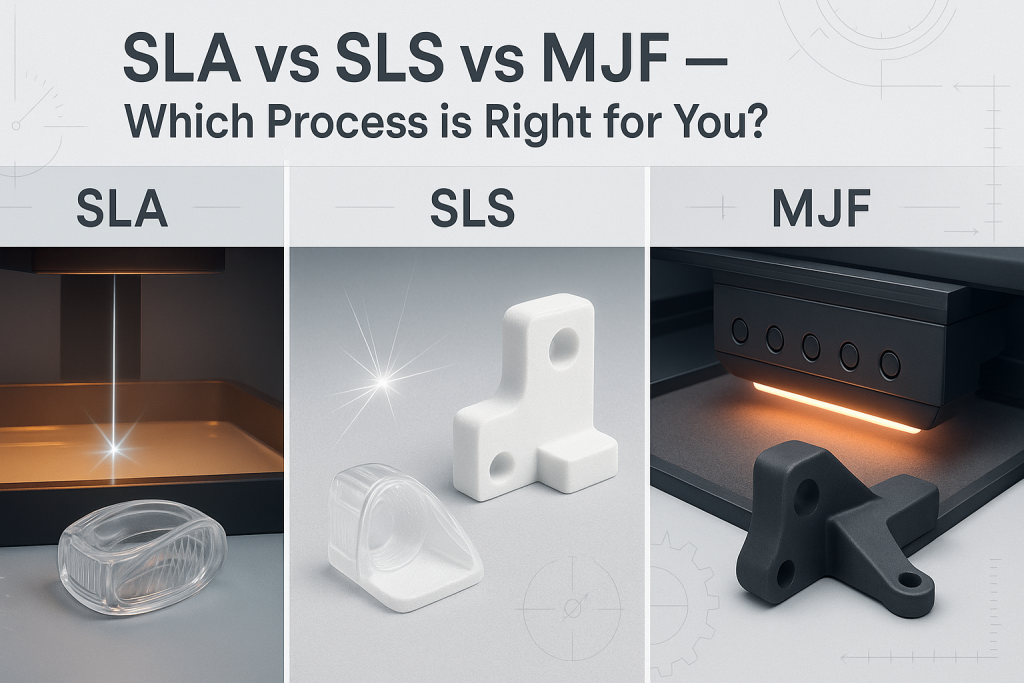
The main difference is that SLA uses a UV laser to cure liquid resin for high-detail parts, while SLS and MJF are powder bed fusion processes that create strong, functional nylon parts. SLS uses a laser to sinter powder, and MJF uses an inkjet array and thermal energy for faster production. Understanding the fundamental trade-offs between these three is key to unlocking their full potential.
As an expert additive manufacturing service with in-house expertise across all three major technologies, GD-Prototyping offers this comprehensive guide. We will provide a deep, technical comparison to help you make an informed decision and select the perfect process for your specific application.
Understanding SLA (Stereolithography): The High-Resolution Specialist
Stereolithography, or SLA, is the original 3D printing technology. It remains the undisputed king for parts requiring exceptional detail and a smooth surface finish. It is a vat photopolymerization process, meaning it builds parts by curing liquid plastic with a light source.
How Does the SLA 3D Printing Process Work?
The SLA process is methodical and precise. It takes place inside a machine containing a vat of liquid photopolymer resin and a build platform.
- The build platform lowers into the vat of resin. It leaves a space equal to a single layer's height between the platform and the liquid's surface.
- A high-precision ultraviolet (UV) laser, directed by a set of mirrors, traces the first cross-section of the 3D model onto the thin layer of resin.
- The UV light instantly cures and solidifies the resin it touches, bonding it to the build platform.
- The platform then lowers again by another layer's height. A recoating blade sweeps across the surface to ensure a fresh, smooth layer of resin.
- The process repeats, layer by layer, until the entire part is solidified and attached to the build platform.
Key Characteristics of SLA Parts
SLA is chosen for its unique aesthetic and precision qualities. Parts produced with this technology have an exceptionally smooth, almost injection-molded-like surface finish right out of the printer. They can capture incredibly fine details, sharp edges, and intricate textures that other processes cannot replicate.
Common SLA Materials
SLA's versatility comes from its wide range of photopolymer resins. Each resin is formulated to deliver specific mechanical properties.
- Standard Resins: Excellent for high-detail prototyping with a smooth finish. They are ideal for visual models and form/fit testing.
- Tough & Durable Resins: These are engineered to withstand higher stress and strain. They are perfect for functional prototypes that require snap-fit features and some degree of impact resistance.
- High-Temperature Resins: These resins have a high heat deflection temperature. This makes them suitable for applications like mold tooling, hot air flow tests, and static parts that will be exposed to heat.
- Castable Resins: These materials burn out cleanly with no ash residue. They are used to create master patterns for investment casting in the jewelry and dental industries.
- Transparent Resins: These resins can produce optically clear parts after post-processing, ideal for lenses, light pipes, and microfluidic devices.
The Post-Processing Steps
SLA parts are not ready for use immediately after printing. They require a mandatory two-step post-processing workflow.
- Washing: The part is removed from the printer and washed in a solvent, typically isopropyl alcohol (IPA). This removes all the uncured liquid resin from its surface.
- Post-Curing: After washing and drying, the part is placed in a UV curing oven. This final cure fully solidifies the part and ensures it achieves its optimal mechanical properties.
Additionally, SLA parts require support structures to anchor them to the build platform and support overhanging features during the printing process. These supports must be carefully removed by hand after post-curing.
Understanding SLS (Selective Laser Sintering): The Functional Workhorse
Selective Laser Sintering, or SLS, is a powder bed fusion technology. It is renowned for its ability to produce strong, durable, and functional parts with excellent mechanical properties. It is a go-to choice for functional prototyping and low-volume production.
How Does the SLS 3D Printing Process Work?
The SLS process takes place in a heated build chamber filled with a thermoplastic powder.
- A thin layer of the powder is spread across the build platform by a recoater blade.
- The chamber is heated to just below the powder's melting point.
- A powerful CO₂ laser, guided by a set of optics, scans the cross-section of the 3D model onto the powder bed.
- The laser's energy selectively sinters (fuses) the powder particles together to form a solid layer.
- The build platform lowers, and the recoater blade spreads a fresh layer of powder on top.
- The process repeats until the entire part is encapsulated within the bed of powder.
Key Characteristics of SLS Parts
The most significant advantage of SLS is design freedom. The unsintered powder in the build chamber acts as a natural support for the part during printing. This means that SLS can produce complex geometries, including internal features and undercuts, without the need for any support structures. Parts have a characteristic grainy, matte surface finish. Their mechanical properties are excellent, with good strength and durability.
Common SLS Materials
While several materials exist, SLS is dominated by one family of polymers: Nylon.
- Nylon 12 (PA12): This is the workhorse of SLS. It is a strong, stiff, and highly durable thermoplastic with excellent chemical resistance. It is the perfect all-around choice for most functional applications.
- Nylon 11 (PA11): Similar to PA12, but with higher elongation at break and better impact resistance. It is also derived from renewable resources (castor oil).
- Composite Materials: These are Nylon powders filled with other materials to enhance their properties, such as Glass-Filled Nylon (for higher stiffness) or Carbon-Filled Nylon (for high strength and light weight).
The Post-Processing Steps
After the build is complete and the powder bed has cooled, the parts must be excavated from the unsintered powder. The primary post-processing step is de-powdering. This is typically done in a bead blasting cabinet, where compressed air is used to remove all the residual powder from the part's surface. After this, SLS parts can be dyed to a variety of colors or put through a vapor smoothing process to achieve a more sealed, semi-glossy surface.
Understanding MJF (Multi Jet Fusion): The Production Powerhouse
Multi Jet Fusion, or MJF, is a powder bed fusion technology developed and introduced by HP. It is one of the fastest and most efficient 3D printing processes for creating functional nylon parts, making it ideal for higher-volume production runs.
How Does the MJF 3D Printing Process Work?
MJF also uses a bed of polymer powder, but its fusion method is unique and layer-based, not point-based like SLS.
- A recoater blade spreads a thin layer of powder across the build platform.
- A carriage with an inkjet array (similar to a 2D paper printer) passes over the powder bed.
- The inkjet nozzles selectively deposit two different agents onto the powder:
- A Fusing Agent: This is a black, heat-absorbent ink that is deposited where the part should be solid.
- A Detailing Agent: This is an inhibiting agent that is deposited around the edges of the part to help create sharp, crisp boundaries.
- A high-power infrared lamp then passes over the entire bed.
- The fusing agent absorbs the infrared energy, heating the powder around it to its melting point and fusing it into a solid layer. The detailing agent and the unsintered powder do not absorb as much energy and remain as a powder.
- The process repeats until the build is complete.
For a direct comparison of the two leading powder technologies, you can see our in-depth SLS vs MJF guide.
Key Characteristics of MJF Parts
Like SLS, MJF parts offer excellent mechanical properties and require no support structures. They typically have a slightly smoother surface finish than SLS parts and more consistent mechanical properties due to the layer-by-layer fusion process. A key characteristic of MJF parts is their color; due to the black fusing agent, all standard parts come out a consistent charcoal grey or black.
Common MJF Materials
The material selection for MJF is also focused on Nylon, with some unique options.
- Nylon 12 (PA12): This is the most common material for MJF. It produces strong, slightly flexible parts with excellent detail.
- TPU (Thermoplastic Polyurethane): MJF is also capable of producing parts from flexible, rubber-like TPU materials. These are ideal for applications like seals, gaskets, and shock absorbers.
The Post-Processing Steps
The post-processing for MJF is nearly identical to that of SLS. The parts are removed from the cooled powder block and then de-powdered, typically through bead blasting, to remove all loose powder. They can then undergo additional finishing steps like vapor smoothing.
The Ultimate Comparison Grid: SLA vs. SLS vs. MJF
This grid provides a high-level summary of the key characteristics and trade-offs between the three technologies.
| Feature | SLA (Stereolithography) | SLS (Selective Laser Sintering) | MJF (Multi Jet Fusion) |
| Technology | UV Laser Curing Liquid Resin | Laser Sintering Polymer Powder | Inkjet Fusing of Polymer Powder |
| Primary Materials | Photopolymer Resins | Nylon (PA12, PA11), Composites | Nylon (PA12), TPU |
| Resolution / Detail | Excellent (Highest) | Good | Very Good |
| Surface Finish | Excellent (Smooth) | Good (Grainy, Matte) | Very Good (Slightly smoother than SLS) |
| Mechanical Strength | Good (Brittle to Tough) | Excellent (Durable, Functional) | Excellent (Durable, Functional) |
| Support Structures | Required | Not Required | Not Required |
| Speed | Moderate | Good | Excellent (Fastest for volume) |
| Cost Per Part | Moderate | Moderate to High | Moderate to High (Often cheaper at scale) |
How to Choose: Analyzing the Critical Trade-Offs
The best process is entirely dependent on your application's most critical requirements.
Resolution and Aesthetics: When Detail is King
If the primary requirement for your part is an ultra-smooth surface finish, sharp edges, and intricate detail, SLA is the only choice. It is the perfect technology for creating high-fidelity visual prototypes, presentation models, and parts that require optical clarity.
Mechanical Performance: When Strength Matters
If your part needs to be strong, durable, and functional, you should choose a powder bed fusion process. Both SLS and MJF produce parts with excellent, engineering-grade mechanical properties. They are ideal for functional prototypes, jigs, fixtures, and end-use production parts that must withstand mechanical stress.
Speed and Production Volume: When Time is Critical
For one-off prototypes, the speed difference may not be significant. However, for low- to mid-volume production runs, MJF is typically the fastest technology. Its layer-based fusion process allows it to print multiple parts nested together in the build volume much more quickly than the point-based laser system of SLS.
Tolerances and Accuracy
All three of these industrial processes can produce parts with a high degree of accuracy. However, there are nuances to each. For detailed specifications on what to expect, it is important to refer to a 3D Printing Tolerances Chart.
Beyond the Big Three: Considering Other Technologies
While SLA, SLS, and MJF represent the leading edge of industrial 3D printing, other technologies exist that may be suitable for certain applications. For prototypes where cost is the absolute priority and fine detail is not required, Fused Deposition Modeling (FDM) can be a viable option. It is important to understand the significant trade-offs in quality and strength, which are detailed in our Resin vs FDM 3D Printing guide.
Conclusion
The choice between SLA, SLS, and MJF is a decision based on design intent. There is no single "best" process; there is only the best process for your specific application. A simple way to remember the choice is:
- SLA for beautiful, high-detail prototypes.
- SLS for strong, functional, all-around parts.
- MJF for fast, production-grade functional parts.
By understanding the fundamental differences in how these technologies work, the materials they use, and the properties they produce, you can unlock the full potential of additive manufacturing. As a one-stop manufacturing partner with in-house expertise across all three technologies, GD-Prototyping is uniquely positioned to help you make the right choice.
