


Rapid Prototyping CNC Machining for Aerospace Applications
The aerospace business requires a very high level of precision, reliability and speed. Since commercial aircraft and satellites to unmanned aerial vehicles to space exploration systems, all members have to be of high dimensional tolerance, material and regulatory standards. Quick prototyping CNC machining has been an important manufacturing solution in this environment where aerospace engineering teams have had to reduce the time taken to develop products without affecting quality.
Why Rapid Prototyping Matters in Aerospace
The development of aerospace products is complex in nature. New designs are commonly related to progressive geometries, lightweight structures, and lightweight materials that need to be verified before production on large scale. The conventional production processes are time-consuming and expensive at an early stage of development. The rapid prototyping methodology has solved these difficulties because it allows engineers to make working components in a short period of time to test, iterate and confirm their functionality.
As opposed to prototypes that are purely visual, CNC-machined aerospace prototypes are usually production-grade like aluminum alloys, titanium, stainless steel, and high-performance plastics. This enables engineers to consider actual mechanical performance and thermal behavior as well as assembling fit in actual operating conditions.
The Role of CNC Machining in Aerospace Prototyping
Manufacturing of aerospace parts still relies on CNC machining as one of the most reliable manufacturing technologies through its precision, reliability and the capability to work with a variety of materials. CNC machining has a number of benefits when it is used in rapid prototyping:
-
Tight tolerances often within ±0.005 mm, suitable for flight-critical components
-
Excellent surface finish, reducing the need for secondary processing
-
Design flexibility, supporting complex geometries and thin-wall structures
-
Material consistency, enabling reliable testing and certification
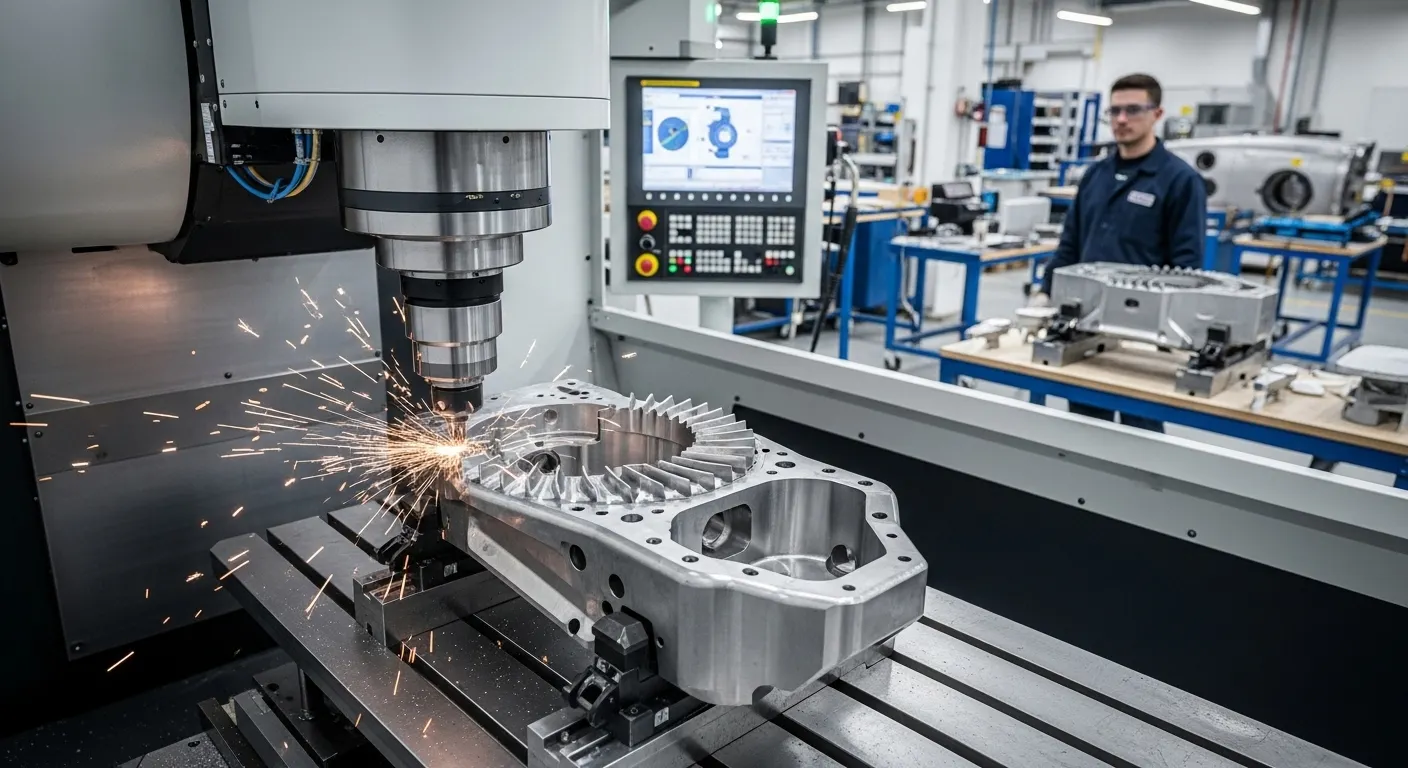
CNC machine Multi-axis machining Aerospace prototyping is especially useful in 4-axis and 5-axis machines. The machines enable these complex contours, undercuts, and compound angles to be made using only one set-up which enhances accuracy and shortens lead time..
Common Aerospace Applications for CNC Rapid Prototyping
The rapid prototyping CNC machining is used in supporting a broad spectrum of aerospace components in various systems and platforms. They are commonly used in:
-
Structural brackets and mounting components
-
Avionics housings and electronic enclosures
-
Engine and propulsion system components
-
Fluid and fuel system parts
-
Interior cabin hardware and fittings
-
UAV frames and lightweight assemblies
These prototypes are often used for functional testing, vibration analysis, airflow studies, and pre-certification evaluations before transitioning to low-volume or full-scale production.
Aerospace Materials Used in CNC Prototyping
Material selection plays a central role in aerospace prototyping. CNC machining supports a wide range of aerospace-approved materials, allowing prototypes to closely match final production parts.
Aluminum Alloys
Aluminum alloys such as 6061, 7075, and 2024 are commonly used due to their excellent strength-to-weight ratio, corrosion resistance, and machinability. They are widely applied in structural and non-structural aerospace components.
Titanium Alloys
Titanium alloys, including Ti-6Al-4V, offer high strength, low density, and outstanding heat and corrosion resistance. CNC machining of titanium is more challenging, but it is essential for aerospace prototypes exposed to extreme environments.
Stainless and Alloy Steels
Stainless steel and high-strength alloy steels are used for components requiring durability, wear resistance, and load-bearing performance. CNC prototyping allows these parts to be tested under real mechanical stresses.
Engineering Plastics
High-performance plastics such as PEEK, Ultem (PEI), and PTFE are used in aerospace applications requiring electrical insulation, chemical resistance, or weight reduction.
Advantages Over Additive Manufacturing in Aerospace Prototyping
Albeit additive manufacturing has become significant in the development of the aerospace sector, CNC machining has unique strengths in most of the rapid prototyping processes.
Part dimensions and surface finish tend to be better on CNC-machined parts. They also remove the fears associated with anisotropic properties of materials that may be subject to 3D-printed parts. In case of prototypes to be used in functional application, CNC machining creates parts with more similarity to the final production parts in strength and reliability.
CNC prototyping and additive manufacturing are often applied simultaneously in most aerospace programs, additive manufacturing to validate the design early and CNC machining to produce functional and pre-production prototypes.
Quality Control and Aerospace Standards
Prototyping of aerospace involves quality management. The CNC machining service providers accompanying aerospace works normally adhere to internationally accepted norms including ISO 9001 and AS9100. These systems guarantee tracking of the processes, control and the uniformity of quality production.
Key quality control practices include:
-
First Article Inspection (FAI)
-
Coordinate Measuring Machine (CMM) inspection
-
Material certification and traceability
-
Dimensional and tolerance verification
-
Documentation and revision control
These processes are essential for aerospace customers preparing for regulatory approval or internal qualification testing.
Reducing Time to Market with CNC Rapid Prototyping
Rapid prototyping CNC machining is characterized by a significant advantage of speed. The current CNC machine with well-developed CAM software, and automated production processes can provide prototypes within days instead of weeks. This fastened schedule enables aerospace groups to locate errors in the design at an early stage, minimize costly redone redesign, and progress without any hesitation to production.
Agile development is also supported with rapid prototyping which allows testing multiple design iterations simultaneously. This strategy is more useful in the high-stakes aerospace markets where the innovation life cycle has been progressively reducing.
Transition from Prototype to Low-Volume Production
Scalability of CNC machining can be considered one of its primary advantages. Very little can be changed about the same processes applied to prototyping, which can be employed to low-volume or bridge production. This helps to reduce risk and provide consistency between prototype and production parts.
In the case of aerospace startups and R&D teams, CNC machining allows an uninterrupted process between concept validation and flight-able parts.
Choosing the Right CNC Machining Partner for Aerospace Prototyping
Selecting a CNC machining partner is a critical decision in aerospace projects. Key factors to consider include:
-
Experience with aerospace-grade materials
-
Multi-axis machining capabilities
-
Documented quality management systems
-
Engineering support and DFM expertise
-
Proven ability to meet tight deadlines
A reliable partner not only manufactures parts but also contributes to design optimization, cost control, and risk reduction throughout the development process.
Conclusion
Rapid prototyping CNC machining for aerospace offers performance in speed, precision and material more than few manufacturing methods can do. It allows aerospace engineers to do validation work, functionality testing and speed up innovation while keeping the high-quality standards demanded by the industry.
With aerospace systems ever shifting into the realm of lighter, more efficient, and more complex designs, CNC rapid prototyping will still be a key building block one that closes the gap between concept and flight-worthy product with high levels of confidence and control.
