


Rapid Injection Molding: The Fast Bridge from DFM to Build-Ready Parts
If you've ever watched a tolerance stack fall apart after the first shots, you know the feeling: meetings multiply, costs creep, and launch dates slide. In 2026, the teams that ship on time aren't simply better at simulation - they're better at getting physical proof earlier. Rapid Injection Molding is the lever that turns Design for Manufacturability (DFM) from a theoretical review into concrete evidence while designs are still flexible and budgets are still protected. By putting production-intent parts on the table fast, it exposes risks where you can still fix them and builds confidence in the choices that matter.
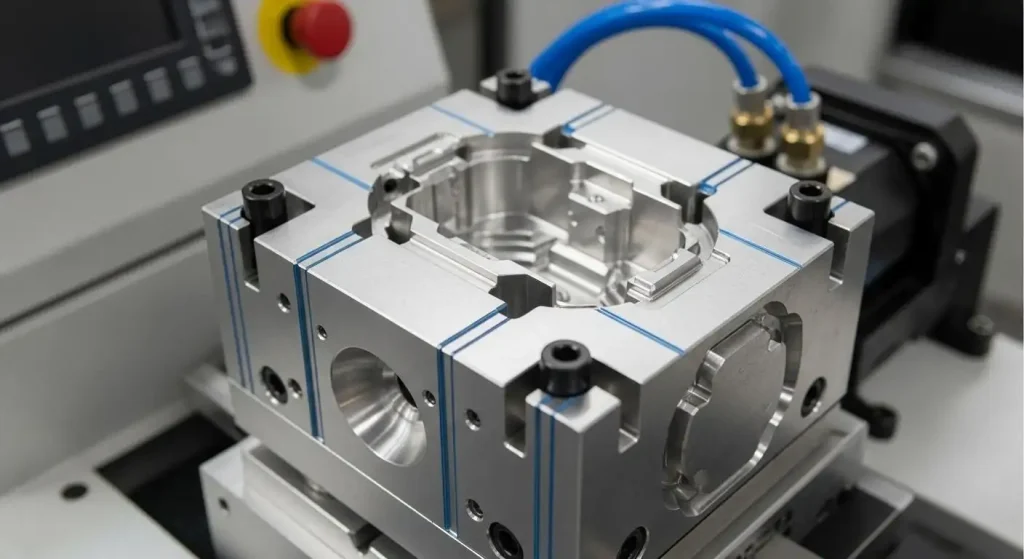
What makes Rapid Injection Molding different isn't just speed. It's the quality of the data you collect in those first shots. Gates, vents, cooling, and packing all behave like they will on your final tool, revealing the weld lines, sink, warpage, and cosmetic realism that no digital model can fully predict. The payoff is shorter design loops, fewer late changes, and a cleaner handoff to scale.
The DFM Pitfalls Most Teams Face - and Why They Persist
• Late surprises: Teams approve drawings without seeing how the chosen resin behaves in the actual flow path. Problems appear only after tooling commits.
• Cosmetic drift: Stakeholders change expectations when they see the first real surface. Textures, gloss, and gate vestige force revisions down the line.
• Tolerance misreads: CAD shows healthy stacks, but cooling and ejection induce shifts - especially across thick/thin transitions or asymmetric rib networks.
• Decision paralysis: Without physical parts, debates don't converge. Meetings get longer; alignment doesn't improve.
Rapid Injection Molding brings tangible parts into these discussions early. Instead of arguing about whether a rib will print through a wall, you hold the part, measure the outcome, and decide in days - not weeks. You validate the process window with the resin you intend to ship, learn how geometry reacts under real packing pressure, and convert assumptions into evidence.
How Rapid Injection Molding Compresses Design Loops
• Validate changes physically: Iterate on molded parts instead of waiting for a full production tool to prove out every tweak.
• Test production-intent resins: Run the actual material through realistic gates and vents to confirm flow, shrink, and cosmetics.
• Anchor alignment with proof: Replace subjective debates with parts everyone can inspect, touch, and measure together.
What to Validate Early - Where the Risk Really Lives
DFM lives in details that don't tolerate wishful thinking. Focus early validation on the features and behaviors that most often derail schedules.
Geometry and Process Checks:
• Wall strategy: Keep thickness consistent across transitions. Where you must vary, verify sink and warpage at the interface - not just in simulation.
• Ribs and bosses: Balance stiffness and flow. Confirm whether rib ratios and boss bases are causing print-through or localized shrink.
• Draft and ejection: Measure ejection force and surface outcomes at the chosen draft. Spot scuffing, drag, or unexpected texture shifts.
• Gate location and vestige: Set gates to achieve balanced fill and good cosmetics. Confirm gate vestige geometry and orientation, and lock the downstream removal approach.
• Venting and weld lines: Define vent sizing and placement to sustain clean fills and eliminate soot/burn. Map weld lines and validate separation from high-visibility surfaces.
• Cooling and repeatability: Measure dimensional stability across cycles, not just a single shot. Log drift to understand production variance.
Material Behavior:
• Filled vs. unfilled: Reinforcement with glass/mineral shifts flow length, shrink anisotropy, and fiber direction. Verify dimension consistency and surface class.
• Elastomers: Pay close attention to flow reach, parting-line detail, and compression set. Validate living hinge life on the final geometry.
• Performance targets: Confirm stiffness, impact, heat resistance, and creep for end-use. Medical: check sterilization tolerance; Auto/E/E: confirm chemical and thermal resistance.
• Aesthetics and feel: Review color, texture, and gloss on molded parts, not color chips. Confirm that the visual standard holds under production-like processing.
How GD Prototyping Turns Speed into Value
As a manufacturer, GD Prototyping uses Rapid Injection Molding to close the gap between CAD intent and production reality. Our approach is centered on production-intent learning, so every early part teaches you something you can carry forward.
• Precision you can bank on: Tight tolerances hold across complex geometries, cutting post-processing and downstream adjustments.
• Material flexibility without regret: Choose from a wide range of plastics, elastomers, and engineered resins to dial in stiffness, impact, and finish before committing.
• Cost-efficient risk removal: Find failures when they're cheap. Convert late-stage surprises into early lessons that don't jeopardize launch.
• End-use ready parts: Run functional, environmental, and assembly tests on parts that look, feel, and perform like production - so certifications and stakeholder sign-offs happen sooner.
• Fast turnaround: Streamlined mold design and build cycles put first shots in your hands quickly. Your team iterates faster and locks DFM earlier.
• Scalable path: Move from prototypes to pilot runs smoothly, validating supply readiness before full mass production.
The result is a clean, traceable DFM process: every iteration informs the final tool, your control plan, and your quality targets. You reduce ambiguity, shorten meetings, and commit with confidence.
Where Rapid Injection Molding Shines in 2026
This method is ideal wherever functional plastic parts must hit both performance and visual standards, and where pilot volumes help de-risk scale.
• Automotive: Clips, ducts, bezels, and under-hood assemblies subject to thermal load, chemicals, and tolerance control. Verify weld line risk, gate vestige quality, and fit prior to hard steel.
• Medical devices: Sterilization-ready housings, handheld tools, and compliant, biocompatible parts. Demonstrate surface integrity and cleanliness with true gate and vent layouts.
• Consumer products: Cases, wearables, and packaging where appearance and tactility are paramount. Employ Rapid Injection Molding to nail textures, gloss, and seam lines early.
• Aerospace and defense: Lightweight, high-strength structures with reproducible quality in severe environments. Evaluate tolerance stability over cycles and across cavities.
• Electronics: Housings, connectors, and shields handling heat and stringent assembly interfaces. Validate warpage and latch fit in the production resin.
When to Choose Rapid Injection Molding
• Design maturity is medium: With unresolved geometry/material/cosmetic risks, build and test parts before committing to a long-term mold.
• Critical dimensions matter: You must validate stack-ups and assembly fit with molded parts, not just metrology on machined surrogates.
• Pilot volumes required: You need dozens to thousands of parts that mimic mass-production behavior to test readiness and gather field feedback.
• Process window clarity: You want the processing envelope documented - fill, pack, cool - so your final tool starts at a higher confidence level.
Shift to long-term tooling only after geometry, resin, and processing windows are proven on molded parts. Rapid Injection Molding is the fastest way to get that proof without overspending or locking in decisions you might regret later.
Your Next Step: DFM That Moves at Launch Speed
If your team is closing in on production, the simplest way to lower risk is to put real parts on the table now. Share your CAD with GD Prototyping and request a DFM review built around Rapid Injection Molding. You'll receive a clear action list covering draft, wall strategy, gating, venting, and ejection, plus material guidance and a practical plan for pilot volumes.
Our commitment is straightforward: better parts, sooner, with fewer surprises. Contact GD Prototyping to schedule a consultation and a DFM-focused quote. Let Rapid Injection Molding translate your design intent into verified performance, and move you from prototype to production with confidence.
