


Prototype Vacuum Casting Service | Vacuum Cast Prototypes
What is a Prototype Vacuum Casting Service?
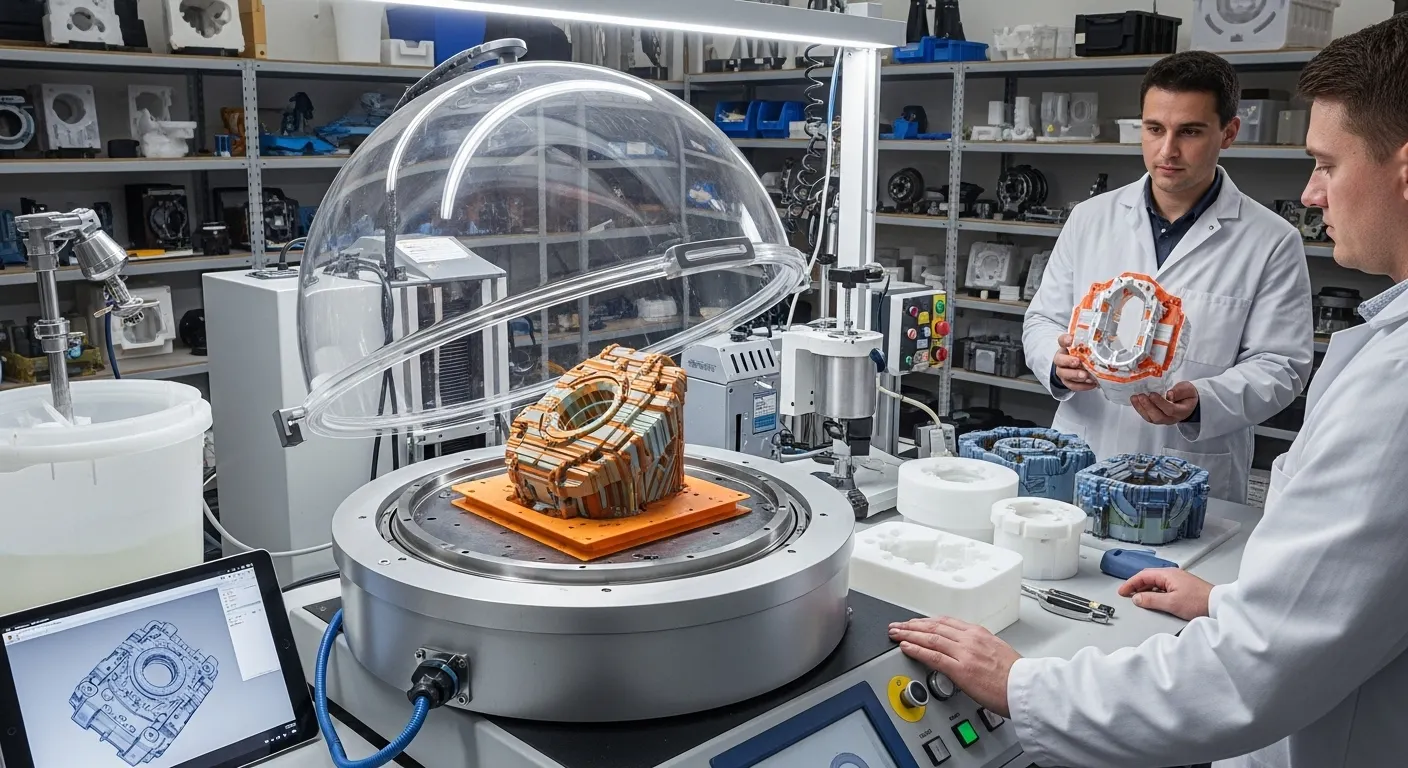
The prototype vacuum casting service is a manufacturing process that creates quality prototype parts by subjecting liquid plastic, silicone, or metal components to vacuum pressure in flexible silicone rubber molds. Trapped air is removed by the vacuum environment, creating smooth surfaces, crisp details, and consistent accuracy of parts.
Vacuum casting, in contrast to injection molding, is tool-less; that is, no expensive molds of the steel type are required. It is ideal as a prototype vacuum casting system, a low-volume, large-scale production, and design tooling.
Vacuum Casting is Mostly Utilized in:
- Manufacture of prototype parts.
- Pre-production sample parts
- Low-volume production parts
- Market testing prototypes
- Prototypes of design validation.
Working Principle of the Vacuum Casting Prototyping
The knowledge of the vacuum casting prototyping process assists in emphasizing the reason why this service is accurate and effective.
Master Pattern Creation
It starts with a master model, which is usually created using 3D printing, CNC machining, and high-precision manual fabrication. This master will be the last geometry, surface texture, and dimensions of the part that is desired.
Silicone Rubber Mold Making
Then, technicians construct a mold box over the master to pour liquid silicone rubber over the box. After curing, the mold is cut up to separate the master, leaving a very detailed cavity behind.
Silicone rubber molds are flexible, strong, and can recreate complicated geometries, undercuts, and thin walls with remarkable precision.
Degassing Under Vacuum
Degassing Liquid polyurethane or plastic materials are subjected to a vacuum before being cast. This action eliminates air bubbles, and it is necessary to reach high precision of vacuum casting and uniform quality of the parts.
Low-Pressure Casting Process
The de-gassed substance is placed into the silicone mold under a vacuum chamber. Even flow of the material is maintained by the vacuum, and this keeps away any voids and scars on the surface. The effect of this is vacuum-cast prototype parts that have great dimensional stability and a smooth finish.
Curing and Finishing
The part is cured, and the finished part is cut off. Finishing can be either painted, polished, textured, or coated, which allows the prototype to be quite similar to a final component of production.
Applicable in Numerous Ways
A product development prototype vacuum casting service has extensive product and application coverage.
Functional Prototyping Tests
Vacuum-cast components are robust enough to be put to real-life functional testing. Before they invest in mass production, engineers are able to check the aspects of fit, form, and performance.
Design Prototypes That are Validated
Vacuum casting is used by design teams to test CAD designs, ergonomics, and compatibility during assembly to ensure that mistakes are identified at an early stage.
Systems Engineering Prototypes
Vacuum casting allows for rapid iteration, and it is simpler to enhance designs by going through several cycles of development.
Pre-Production Sample Parts
Vacuum casting is used by manufacturers to create production prototypes to be shown to the customer, to present to investors, or to be reviewed internally.
Market Testing and Startups
Startups, the prototype vacuum casting service provides an inexpensive means of testing products in the market without the costly tooling.
Why Should it Be a Custom Vacuum Casting Service?
Each product is different in terms of demand. A specialized vacuum casting system enables the manufacturers to customize materials, finishes, and volumes of production based on the requirements.
The advantages of customization are:
- Simple design changes via new master patterns.
- A quick multiplication of molds.
- Tool-less short-run mold production is cheap.
- Vacuum casting High-precision prototype 3D geometries.
Advantages of Speed, Accuracy, and Quality
Quick Turn Prototypes
Vacuum casting has much shorter lead times than injection molding. New molds can be created within days, allowing to cast prototypes quickly and making design changes very fast.
Precision Prototype Parts
Vacuum casting provides high repeatability and tight tolerance casting. Spatial Parts exhibit uniform wall thickness, mechanical precision, and surface detailing.
Production-Quality Appearance
Vacuum cast parts, whether properly finished, have an appearance of quality production, and so can be used in presentations and end-user testing.
Dimensional Stability
Silicone molds are accurate during repeat casts, so the quality of parts can be repeated during low-volume manufacturing batches.
Vacuum Casting as Compared to Other Rapid Prototyping
- Vacuum casting is effective in certain applications as compared to other solutions in rapid prototyping solutions.
- Vacuum casting has a superior surface finish and material consistency as compared to 3D printing.
- It has a greater complexity of the geometry and lower costs in small quantities compared with CNC machining.
- It also eradicates tooling costs and decreases lead time compared to injection molding.
This ensures that vacuum casting is the best bridge manufacturing solution between prototyping and mass production.
Diverse Industries Industrial Vacuum Casting Service
An industrial vacuum casting is offered with a broad spectrum of industries:
Automotive: Components, internal, housings, brackets.
Medical: Enclosures, device prototypes, testing components.
Aerospace: Structural prototypes of lightweight.
Electronics: Casings, connectors, buttons, etc.
Industrial Equipment: Working prototype parts.
Its industrial uses are also extended with the capacity of integrating surface finish vacuum casting, insert molding vacuum casting, and overmolding vacuum casting.
Professional Vacuum Casting Solutions: GD Prototyping
Vacuum casting services at GD Prototyping are created as a way of innovation without holding back. Their crew shares technical know-how and the use of the best equipment to offer vacuum casting services of prototypes that can withstand the requirements of the industry.
Key Advantages Include:
- On-demand prototype vacuum casting service.
- Small batch vacuum casting with a variable output.
- Free choice of material due to functionality and aesthetics.
- Plastic and metal prototype manufacturing.
- Quick service at the expense of quality.
Attention to low-cost production of prototypes also enables GD Prototyping to assist any business in transitioning from an idea to actuality.
Cast Prototype Part Vacuum Finishing
The parts that have been cast in vacuums are very versatile concerning post-processing, which can improve the shape and functionality.
Popular finishing alternatives are:
- Painting and color matching
- Smooth or glossy surface, Polishing.
- Texturing to imitate finishes of injection-molded materials.
- Durability and wear-resistant coating.
These alternatives provide both aesthetic and practical satisfactions to the vacuum cast prototype parts.
When to Select a Casting Service?
A low-volume service should be considered in case:
- The volumes of production are 10 to 500 units.
- A change in design is yet to be anticipated.
- The tooling cost should be reduced.
- It is all about speed and flexibility.
This strategy enables firms to test products before starting with large-scale production.
Conclusion:
A prototype vacuum casting service is the best combination that provides a balance between speed, accuracy, flexibility, and cost efficiency. The synthesis of silicone mold vacuum casting, polyurethane materials, and vacuum-controlled processes allows manufacturers to create functional production-grade prototypes unrestricted by other conventional designs. Vacuum casting is a stable and scalable solution, whether you are doing engineering prototypes, testing new designs, or need to be ready to produce in low volumes. Professional vacuum casting solutions of GD Prototyping give businesses a reliable partner who can provide high-precision results at all levels of product development.
