


Progressive Stamping Die Design | High-Precision Metal Forming
What is Progressive Stamping Die Design?
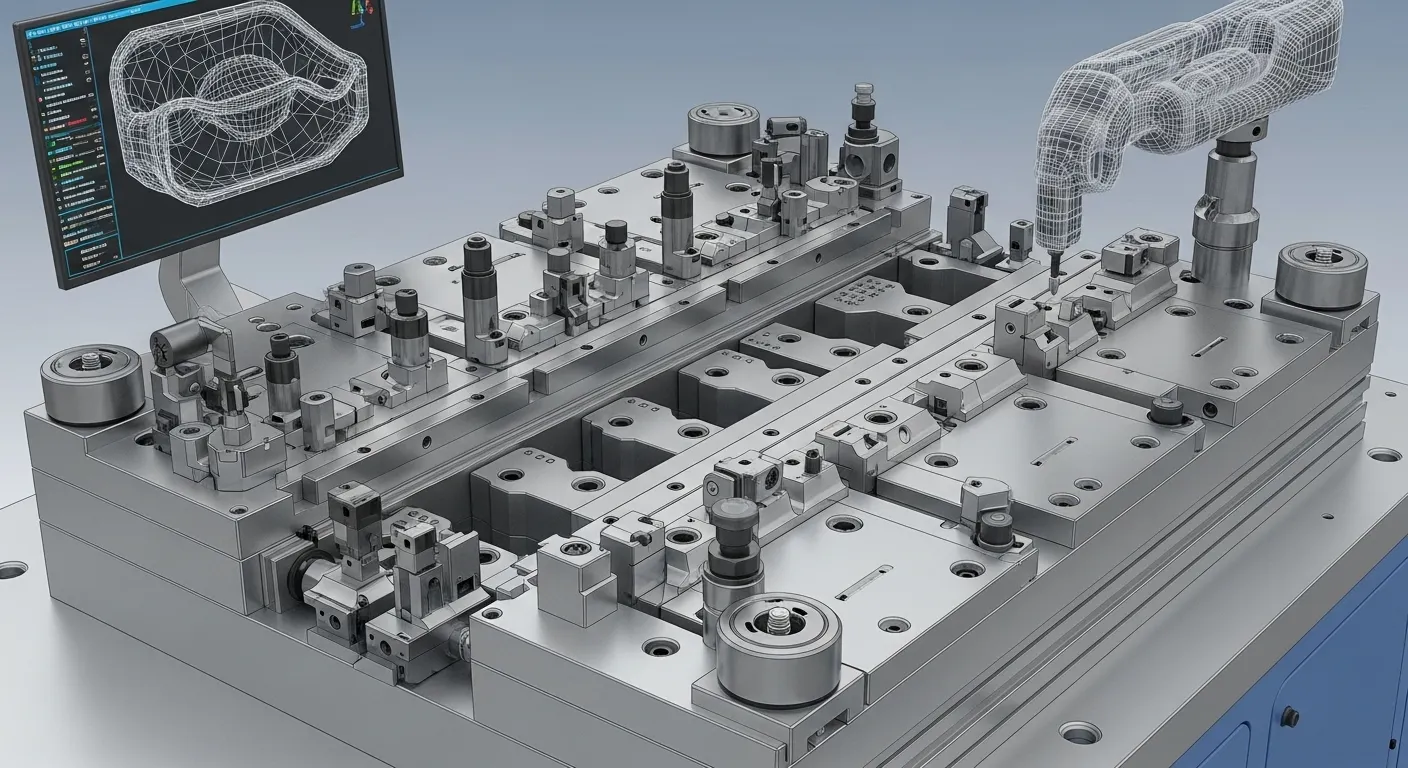
The systematic development of multi-station dies sequentially to shape, cut, or form sheet metal into a final part is referred to as progressive stamping die design. It involves stamping molds and presses to exert pressure on metal blanks, which results in plastic deformation, separation, or forming to attain the required dimensions and geometries.
The common materials used in progressive stamping are steel, aluminum, copper, and many alloys, which give the manufacturers the freedom to choose the best material to use depending on the performance and application of the part.
The most important pros of this approach are as follows:
- Great Efficiency of Production - Can be used in mass production.
- Better Accuracy - guarantees dimensional stability and accuracy.
- Cost-Effectiveness - Decreases scrap and material wastage.
Progressive Stamping Die Design: Precision Engineering of High-Volume Metal Forming
- The progressive stamping die design is one of the main pillars of modern manufacturing, and it allows producing complex metal parts very precisely, efficiently, and with great repeatability. Progressive stamping dies are needed in production to produce high-quality parts on-scale, use materials efficiently, and minimize production costs because of the automotive, electronics, appliances, and medical device industries.
- We are GD Prototyping, and we are focused on the development of progressive stamping die solutions with the assimilation of engineering knowledge, computer simulation, and high-accuracy manufacturing methods to achieve the most challenging needs of industrial companies.
Process of Progressive Die Design
The process of progressive die design consists of several steps, starting with the idea of its creation, through the tooling, and is ready for production. The stages of each make the die to be accurate, running progressive stamping dies, matched material, and speed.
Engineers examine the geometry of parts, the type of materials used, and the volume of production before designing the die. This step determines:
- Adequacy of the gradual stamping procedure.
- The die requires several stations.
- Material behavior of pressure and forming conditions.
At this phase, CAD-based progressive die modeling and virtual strip layout analysis are used to predict the possible problems and optimize the process.
Strip Layout Design
An important part of progressive die layout is the development of strip layout. This is what dictates the movement of the metal strip in each station of the die. Optimization of strip layout guarantees:
- Adequate material usage.
- Minimal scrap
- Dielectrically balanced metal flow.
The biggest part of this step is performed by engineers to determine strip pitch, die clearance, and punch-to-die alignment to maximize accuracy and repeatability.
Die Sequencing and Station Configuration
Multi-station stamping die design needs a keen arrangement of actions to be keenly sequenced: cutting, forming, bending, and punching. This ensures:
- Smooth part progression
- Uniform force distribution
- Loss of wear on die parts.
Guide pillars, bushings, and die alignment systems integration ensure a very accurate registration of the strip, which improves the quality of parts.
Tooling Design and Material Selection
The selection of the tooling material is critical to the production of progressive dies. The choice of tool steels and alloys depends on:
- Part material hardness
- Press tonnage
- Expected production volume
Die set arrangement, punch and die formation, and clearance are calculated in order to have durability and efficiency.
Benefits of Progressive Stamping Dies
- High Production Efficiency
Continuous stamping dies allow the use of progressive stamping dies to produce at a high rate. A progressive die, in contrast to single-station operation, can be operated with more than one operation per press stroke, which is of great benefit in large-scale manufacturing due to the reduction in cycle times and maximization of output.
- High Quality and Precision
Consistent design of stable and accurate die design provides dimensional accuracy and uniform surface finish among parts. Individual components are stamped to very tight tolerances, and progressive stamping is the best choice of stamping when a high degree of accuracy is required in stamping parts in automotive and electronic applications.
- Extensive Material Compatibility
Progressive dies are also flexible, and they can accommodate low-carbon steel, stainless steel, aluminum, and copper, as well as alloys. Such flexibility can enable manufacturers to provide a wide range of industries and applications with material efficiency.
- Scrap Management and Cost-Effectiveness
The process reduces scrap and improves the efficiency of material utilization by maximizing progressive die strip layout. Also, the wear resistance of the die and the issue schedule of appropriate maintenance prolong the tools, enhancing the long-term expenses.
Technicalities in the Design of the Stamping Die in Progressive Stamping
In developing a progressive metal stamping die, several technical factors will dictate success:
- Die Clearance Calculation - This is important in clean cutting with no burrs or deformation.
- Tonnage Calculation of Progressive Die - Ensures that the press has enough force to work.
- Punch and Die Design - Affects the precision of parts and the life of dies.
- Guide Pillars and Bushings - Ensure that moving components are in precise alignment.
- Scrap Management in Progressive Dies - Lessens scrap waste and enhances the efficiency of production.
- Tool Maintenance Planning - aids in avoiding all kinds of unplanned downtimes and in providing some stability in the processes.
By working on these, manufacturers will be able to obtain repeatability of stamping dies, thus continuing to be high-performing in high-speed progressive stamping dies applications.
Uses of Progressive Stamping Dies
Progressive stamping dies are used in a variety of industries:
- Automotive Industry
The automotive parts must be very precise and repeatable. Automotive progressive stamping dies can be applied to body parts, brackets, and structural parts, and guarantee consistency when manufacturing in large-volume production.
- Electronics Industry
Electronics metal stamping dies are used to produce high-accuracy components such as connectors, enclosures, and heat sinks that are thin and precision components.
- Medical Devices and Appliances
The design of stamping dies is used to manufacture parts of washing machines, refrigerators, and HVAC systems. Custom progressive stamping dies are used in medical devices to provide accuracy in components of high dimensional stability.
Reasons to Select GD Prototyping to Stamping Die Progressive Services
In GD Prototyping, our core business is the commercialization of progressive stamping dies that integrate engineering quality, accuracy, and precision production, as well as design technology. Our capabilities include:
- Development of progressive die tooling.
- Rapid progressive stamping operations.
- Planning and simulation of a full progressive die layout.
- Automotive, electronics, and appliance solutions are custom.
Through sophisticated software and our decades of engineering experience, we are making sure that the stamping tool design you have created progressively is more performance, durability, and more efficient.
Conclusion
The progressive stamping die design is a key facilitator of contemporary production that provides high efficacy, precision, and cost-effectiveness. At GD Prototyping, we provide progressive stamping die services end-to-end, so we make sure that your production process is efficient, precise, and in a position to suit to high volume production. We have experience in progressive die tooling, multi-station stamping, and custom die solutions, which is why we should be the right choice for those industries that need precision, reliability, and performance.
