


Precision Prototype Engineering | High-Accuracy Prototype Solutions
What is Precision Prototype Engineering?
The term precision prototype engineering is used to refer to the design and manufacture of prototypes to a high degree of accuracy, tight tolerance, and a high level of surface quality. Precision engineering contrasts with the simple prototyping procedures in that each prototype is produced to be of high quality in regard to the function, as well as mechanical specifications, thus making it appropriate to be used in testing, validation, and industrial use.
The field has an array of technologies, which include rapid prototype engineering, CAD prototype engineering, and high-tolerance prototype engineering, as a result of which a manufacturer can create prototypes that closely resemble finished production parts and operate in the same way.
Major Benefits of Precision Prototype
Precision prototype engineering can provide a product developer with several strategic benefits:
Very High Accuracy and Reliability
Precision engineering prototypes are of a tolerance on a micron scale, which means that all parts fit perfectly when assembled. This minimizes design flaws and facilitates mechanical and electrical prototype testing.
Rapid Development Cycles
With the application of rapid prototype engineering, the companies can cycle through the design process with ease, experiment with many options, and save time-to-market on the newly designed products.
Cost-Effective Production
Precision engineering is economical even in low-volume prototype production as opposed to full-scale production. This is a great benefit, especially to startups and product development teams seeking to test ideas without the high financial investments.
Customizability
Any project may be adapted to certain demands. Prototypes made specifically to fit the project ensure that the materials, tolerances, and designs are made to match the project requirements.
Functional Testing and Validation
Precision prototypes enable functional prototype engineering in the industrial context to have a realistic context of testing the mechanical performance, thermal characteristics, or optical clarity before mass production.
Process of Precision Prototype Engineering
Precision prototype engineering is a multi-process that involves design, production, and quality control as a way of producing high-precision prototypes.
Design and Conceptualization
It is all initiated by a clear product vision. The prototype engineering through CAD allows engineers to develop digital models with accurate specifications. These models are based on the advanced prototyping techniques and take into account the material properties, structural requirements, and production feasibility.
Material Selection
The decision of the correct material is very important in the engineering of the component prototypes. Common materials include:
- Lightweight, durable Aluminum alloys.
- Steel that is stainless and corrosion-resistant.
- High-strength alloys of titanium.
- Plastic engineering of low-weight prototypes with high precision.
Prototyping and Manufacturing
The manufacturing stage uses high-precision prototyping techniques like:
- High accuracy CNC Machining of fine-tolerance parts.
- Complex geometries prototyping in 3D.
- Prototyping in low volumes to aid iterative development.
In GD Prototyping, our Precision CNC Machining has a +-0.005mm processing accuracy and uses 3-axis, 5-axis, and 6-axis CNC machines. This allows both functional prototypes and end-use components to have an industrial-grade finish on their surfaces.
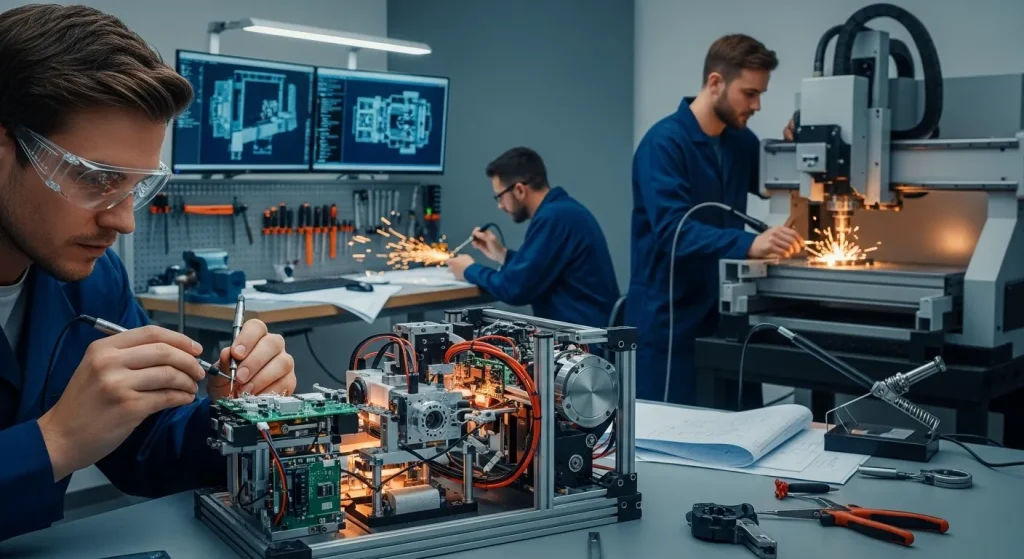
Prototype Engineering: Precision CNC Machining
Accuracy CNC Machining is crucial in the provision of high-tolerance prototype engineering. Key specifications include:
Processing Accuracy: +-0.005 mm accuracy on a micron level.
Axis Setups: 3-axis, 5-axis, and 6-axis CNC machining.
Surface Finish: Provides an industrial quality of fine surface.
Material Range: Materials compatible are aluminum alloys, stainless steel, titanium alloys, and high-temperature alloys.
Capacity Production: Supports low-volume prototyping as well as high-volume production.
Under Precision CNC Machining, GD Prototyping can guarantee the development of each component according to the tightness of tolerances, the functionality of the component in the functional tests, and the best finishes on the parts. CNC machining can facilitate reproducible and repeatable outcomes, whether in the rapid production of prototype products or the full-scale prototype assembly.
Applications
Precision prototype engineering is used in a wide variety of industries and applications:
Prototypes of Product Development
Prototypes serve engineers to test design ideas, assess mechanical functionality, and improve aesthetics before they make a commitment to mass production.
Prototypes of Functional Testing
The engineering of a functional prototype in the industrial application enables modeling of practical stresses, which include thermal, mechanical, and operational tests.
Designing Prototypes for the Engineer
These prototypes are what are required in prototype testing and validation, so as to make sure that the parts are up to the industry standards and also the regulatory requirements.
Prototypical Solutions in the Industries
The precision prototypes are essential in the machinery, automobile, aerospace, and medical device industries, where the prototype parts have high tolerance and thus guarantee reliable performance.
Performance Optimization Prototyping
The prototype design optimization techniques enable engineers to test, refine, and optimize prototypes to be sure that the final products will be efficient, durable, and high-performing.
Advantages of Professional Prototype Engineering
No other services can match the benefits of professional prototype engineering services:
Cost- Effective Prototype Engineering: Minimize the cost of production without having to reduce accuracy.
Traffic Prototype Services: Rush product development cycles.
High-Accuracy Prototype Solutions: Attain micron-deviations and functional dependability.
Robust and Competing Prototypes: Appropriate for stress test and beyond.
Scalable Prototyping Production: Provides single-unit prototyping all the way up to small-scale production.
Optimized Design of Prototypes: Engineers optimize the design to meet functionality, aesthetics, and manufacturability.
Project Prototyping Techniques
The current state of precision prototype engineering incorporates a number of these high-tech methods to improve quality and minimize lead time:
CAD Prototype Engineering - Allows virtual simulation and design testing before production.
High-Precision Prototyping - Guarantees component strict tolerances.
Engineering 3D-Printed Prototyping - Perfect for the preparation of complex geometries and custom components.
Low-Volume Prototype Manufacturing - Facilitates test and design refinement.
Prototype Tooling and Fabrication - Assembles custom molds, jigs, and fixtures to produce quickly, on a repeatable basis.
Industry Applications
Automotive: Dashboard parts, engine cases, and safety-critical parts.
Medical Equipment: Surgical devices, diagnostic equipment, and ergonomic tools.
Industrial Machinery: Working models of mechanical assemblies and tooling.
Consumer Electronics: Long-lasting casings, buttons, and transparent covers in the validation of products.
Using mechanical prototype engineering and functional testing prototypes, manufacturers can be guaranteed that parts are able to perform to the required specifications, regulatory standards, and that parts correspond to end-user expectations.
GD Prototyping: Precision Prototype Engineering Partner
We offer full prototype engineering services at GD Prototyping, such as:
Quick Precision Prototyping Services - Rapid response without compromising the precision.
Prototypes Designed to Be Tested - Function-specific, custom-engineered prototypes.
Industrial Prototype Development - Exceptional machinery, automotive, and aerospace solutions.
Prototype Design and Manufacturing - Complete solutions start at CAD and extend all the way through to production.
The combination of our combination of skillful engineers, using CNC machining, superior prototyping methods, and material mastery, provides prototypes that surpass the results of our work in their performance, accurateness and beauty.
You may indeed require prototype component engineering, prototype assemblies that should be functional, or prototype manufacturing that is low volume, but whatever the case may be, GD Prototyping will see your design go beyond the concept to reality.
Conclusion
Precision prototype engineering is a vital facilitator of contemporary product development. Combining high-precision prototyping, rapid prototype engineering, and advanced CNC machining, the companies are able to cut time-to-market, prove the design quickly, and eliminate expensive manufacturing mistakes.
This is because at GD Prototyping, we are very determined to deliver quality, accuracy, and innovation to every custom prototype engineering project that we undertake. We bring to you prototypes of functional testing, prototypes of industrial testing, prototypes of high quality and durability that speed up the process of product development.
