


Low Volume Vacuum Casting Services | Small Batch Casting
What is Low Volume Vacuum Casting?
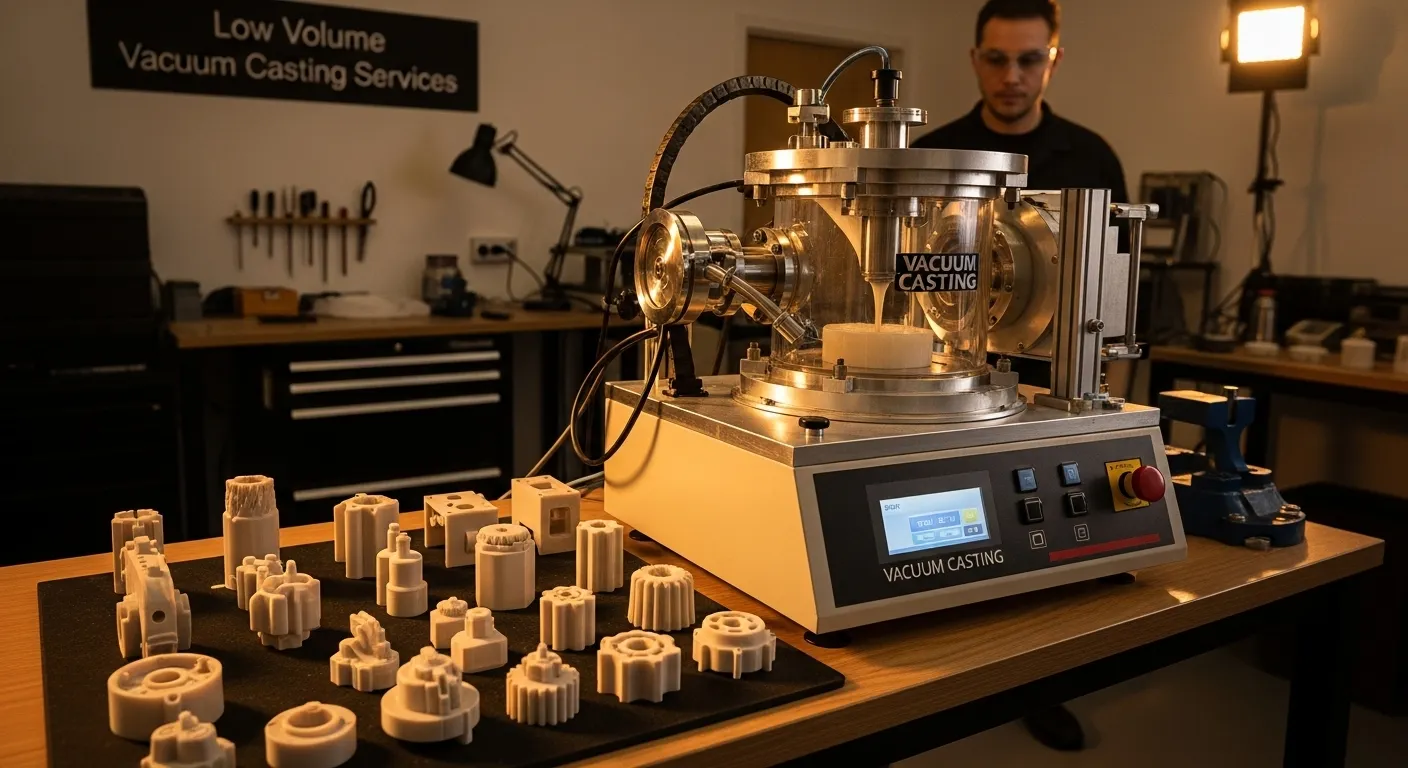
Low-volume vacuum casting services are also known as urethane casting, silicone molding, or polyurethane molding, and are a quick and highly accurate process of making small batch prototypes or small quantities of production parts. A master model is used to start the process and may be generated using 3D printing, CNC machining, or manual crafting.
Having the master ready, technicians createa silicone mold where all fine details of the original design are reproduced. The mold is then filled with liquid plastic, polyurethane, or silicone under vacuum pressure, removing any air bubbles and distributing the material uniformly. This produces parts with good surface finish, size, and functional performance.
The major benefits of vacuum casting are:
- Master models are replicated with great detail.
- Stringent requirements of functional prototypes.
- Capacity to make small batches in large quantities.
- Elasticity to design change.
Materials: Vacuum Casting Low Volume
Resin castings on a low-volume can be made of a variety of materials depending upon application requirements:
Polyurethane Resin Casting: Thermoset polymers with high performance, which are used in lightweight and durable prototypes.
Epoxy and Urethane Prototype Materials: Have heat and structural stability.
High-Strength Metals/Composites: This would be applicable in low-volume metal casting options that require accuracy and robustness.
Casting Tooling; Silicone: Can be reused in several small batches and be the same quality every time.
In GD Prototyping, we blend engineering-grade casting resins and soft tooling vacuum cast in order to achieve tight-tolerance casting resin and viable resin prototypes that can be used in the real world.
Vacuum Casting Process Explanation
The casting procedure of vacuums is a careful one, and every prototype should resemble its design:
Master Model Creation: It is created either through 3D printing, CNC machining, or by hand. This model is used as a reference for all other models.
Silicone Mold Fabrication: Silicone is cast over the master, and complex details and textures are replicated in high-detailed vacuum casting components.
Casting Under Vacuum: This involves pouring the liquid substance into a mold with a vacuum to remove any air that is trapped and cause bubbles and defects.
Curing and Demolding: Materials are cured and demolded at controlled conditions, maintaining dimensional accuracy and surface quality.
Finishing: Cast parts may be polished, painted, textured, or coated to satisfy the functional and aesthetic needs.
Vacuum casting can be used to quickly prototype, and low-volume production can be feasible with this workflow. It is an excellent solution for industries that need small-batch prototype casting or functional vacuum cast prototypes.
Application
Low-volume vacuum casting is common in various industries, where accuracy, quality, and repetitive testing are paramount.
Aerospace
Casting aerospace components are commonly of tight-tolerance and high-performance prototype castings. Vacuum casting is best in the production of:
- Small batch components in turbines.
- Prototypical structural components.
- functional prototypes Light and strong.
The low-volume metal casting alternatives, through which GD Prototyping fabricates small batches of metal components, would allow the company to do so within a short time without sacrificing performance.
Automotive
Custom vacuum casting of prototypes is of great advantage to automotive prototyping:
- Mechanical testing of parts.
- Short batch sizes of complicated parts like brackets or housings.
- Quick feedback on design features to users.
The prototype of our vacuum casting enables the engineer to test parts in a real-world setting before investing in mass production.
Medical Devices
A medical device prototype must be precise, biocompatible, and functionally reliable. With low-volume vacuum casting, it is possible to:
- Surgical instruments, Rapid prototyping.
- Test models are made in low volumes.
- Regulatory and usability prototype of the resin functions.
The small batch silicone molds are enabled by the quick change of master models, making it possible to develop and validate designs through iteration.
Consumer Electronics and Industrial Machinery
Vacuum casting is the best technique to make highly detailed prototype components in consumer electronics, industrial machinery, and specialized equipment:
- High-strength, lightweight components.
- Functional test prototypes that can be repeated.
- Pilot production runs of low volume.
Benefits of Low Volume Vacuum Casting
The use of low-volume vacuum casting services has several distinct advantages compared to traditional manufacturing:
Fast Forwarding and Repeated Revision
The quick vacuum casting services will enhance the speed of the design process through the rapid use of various iterations of the functional vacuum casting prototypes. The engineers are able to revise the master model and make new molds to be used in testing or demonstration quickly.
Cost-Effective Production
Small batch vacuum casting is much cheaper than tooling-intensive processes, such as injection molding, in the event of low-volume prototype production, or in short-run production.
Good Surface Finish and High Precision
Vacuum casting provides dimensional precision in prototypes, tight tolerance casting, and surface finish optimization, and the parts are appropriate for both functional testing and presentation.
Material Versatility
Vacuum casting has a variety of materials to accommodate various performance needs, with polyurethane resin casting in the extreme case, and low-volume metal casting alternatives at the opposite end of the spectrum.
Adaptability in Design Modifications
The silicone molds are easy to update or replace, which facilitates the iterative prototyping process and is flexible to meet changing project needs.
GD Prototyping: Low Volume Vacuum Casting Your Partner
We are GD Prototyping, which offers high-quality vacuum casting services with plastic and metal parts, with a focus on low-volume production casting as a rapid prototype and small batches.
Our Services Include:
- Low-volume vacuum cast services to project specifications.
- Quick prototype casting, which guarantees short lead times.
- Prototypes in resin, functional and high-detailed vacuum casting.
- Staged prototype-to-production casting process to achieve a smooth transition to production.
We emphasize quality, efficiency, and flexibility, which allow businesses to make their ideas become reality without wasting time and money through customary manufacturing processes.
Accuracy and Technical Information in Vacuum Casting
GD Prototyping provides high accuracy GD Prototyping casts with close attention to:
- Tight tolerance dimensional accuracy.
- Optimization of surface finish in terms of both aesthetic and functional quality.
- Reproduction of small batches of prototype quality.
- Testing of vacuum cast prototypes to ensure that they work.
In the case of metal components, our low-volume metal casting alternatives recreate complex designs at a very small fraction of the large-scale production cost.
Conclusion
Low-volume vacuum casting services are a flexible, affordable, and high-resolution technique of making small batch prototypes and small production parts. In either functional vacuum casting prototypes, low-volume metal casting alternatives, or engineering vacuum casting prototypes, this is a way to get tight tolerances, high-Detail replication, and fast design-iteration.
Our custom vacuum casting services at GD Prototyping are based on silicone mold vacuum casting, polyurethane resin casting, and soft tooling vacuum casting to produce parts that are of precise quality in the aerospace, medical, automotive, and industrial fields. Our clients rely on us to deliver ideas to reality in a time and cost-efficient and reliable manner.
