


Low Volume Die Casting Services | Precision Prototypes
What is Low Volume Die Casting?
Low-volume die casting services refer to the manufacturing of metal components in low volume through high-pressure injection into steel molds of the molten alloys. Compared to conventional high-volume die casting, which is optimized for the production of thousands of units, low-volume die casting is devoted to short-run production, and this allows the business to:
- Check designs before large-scale production.
- Manufacture working prototypes and small-run components.
- Keep tolerances and good finishes on surfaces.
- Minim pre-production tooling and material expenses.
By so doing, it is possible to readily test fit, form, and function at a minimal cost and engineering-grade quality.
Low Volume Die Casting Services: Small-Lot, Prototypes, and Precision
- Low-volume die-cast services have come to be an essential part of modern manufacturing, where it is crucial to the company to obtain high-quality metal components without making a large-scale production investment. It can be in automotive prototypes, aerospace components, or consumer electronics, short-run die casting can provide engineers with a chance to test designs, do functional tests, as well as produce small quantities of high-quality parts that will last long. At GD Prototyping, we focus on low-volume die casting solutions, which are fast and accurate, yet cost-effective.
- Our team uses aluminum, zinc, magnesium alloys, and small-scale die-cast elements that are manufactured and have properties similar to those of final production parts. The components are suitable for mechanical validation and functional testing, pre-production testing, and are between prototyping and mass production.
Raw Materials in Low Volume Die Casting
Mechanical performance, weight, and durability are important factors that depend on the selection of material. The typical die-casting service materials used in low-volume die casting services are:
Aluminum Die Casting
- High strength and light weight.
- Outstanding anticorrosive properties.
- Applicable to automotive, aerospace, and consumer electronics.
Zinc Die Casting
- High-dimensional accuracy
- Superior surface finish
- Inexpensive when a small quantity needs to be manufactured.
Magnesium Die Casting
- Extremely lightweight
- Superior mechanical characteristics.
- Best in aerospace, automotive, and medical devices.
Every material has unique benefits in regard to impact resistance, heat tolerance, and dimensional stability, so that die-cast components are subjected to stringent engineering requirements.
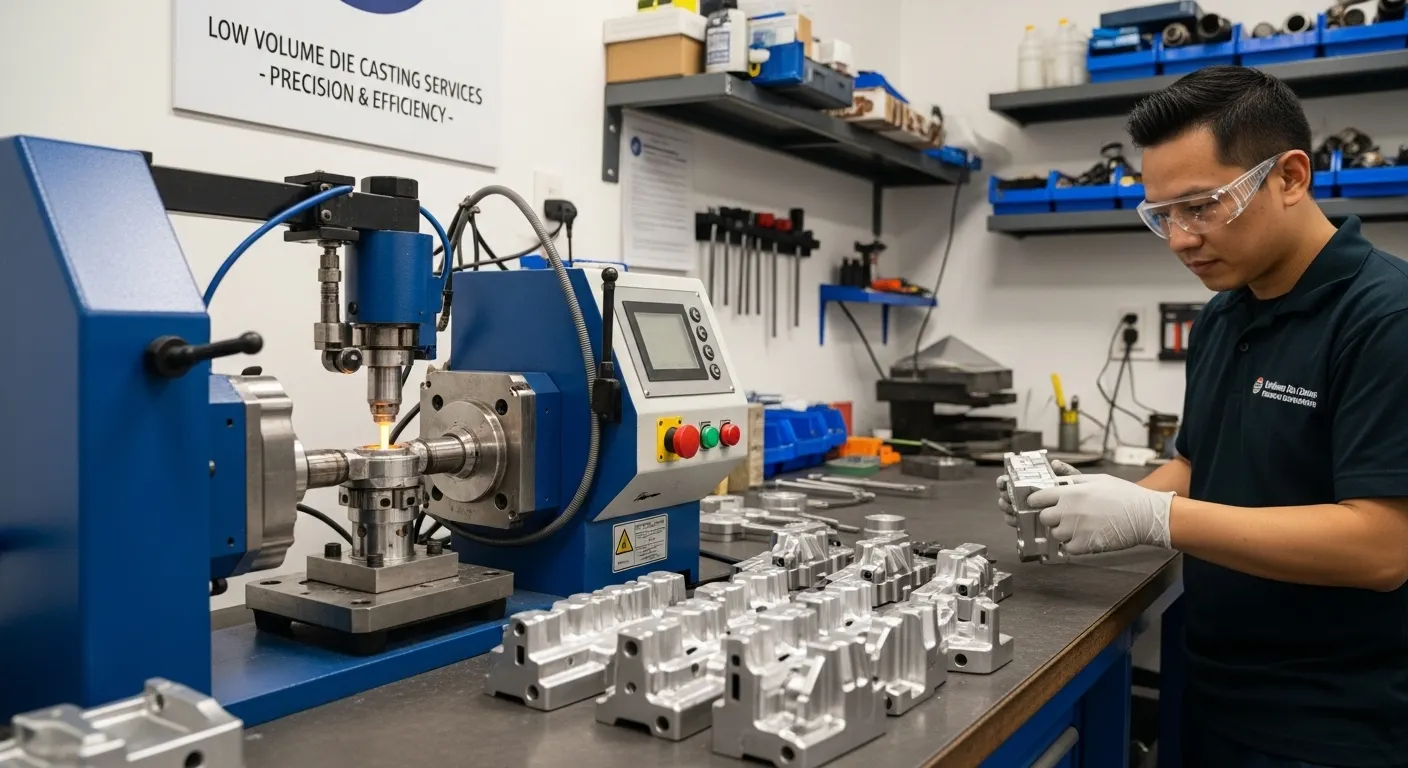
The Low Volume Die Casting Process
The low-volume die casting technique is also very precise and is geared towards small-run and small-batch manufacturing. Here's a breakdown:
Step 1: Molding Preparation and Tooling
It starts with tool-less or low-tooling die casting in which steel or aluminum molds are developed based on small production runs. These molds are designed to make high-precision parts of uniform quality.
Step 2: Alloy Melting
Specified alloys like aluminum, zinc, or magnesium are melted in controlled circumstances in order to ensure uniformity and mechanical characteristics.
Step 3: High-Pressure Injection
High pressure is applied to inject the molten metal into the mold, and the metal fills all the cavities and forms high-tolerance die cast parts.
Step 4: Cooling and Solidification in Control
The parts are then left to cool and harden under controlled conditions, after injection, producing parts with no defects and stable dimensions.
Step 5: Demolding and Post-Process
Once solid, the mold is opened and removed. Depending on the application requirement, post-processing can involve trimming, surface finishing, heat treatment, or coating.
Step 6: Quality Assurance and Inspection
Lastly, every section is checked on dimensional correctness, surface finish, and mechanical functioning, where small-batch die-cast constituents are used to fulfill engineering standards.
Merits of Low Volume Die Casting Services
Die casting in low volumes has many advantages, and it is a great option to use in prototypes and production in small batches:
- High Dimensional Accuracy - Measures fine tolerances on complicated geometries.
- Rapid Prototyping - Shortens design validation and pre-production testing.
- Versatility of Materials - There are aluminum, zinc, and magnesium alloys.
- Cost-Efficient Short-Run Production - Does not require full-scale tooling to be bought.
- Excellent Finishing - Even finishes that can be used in practical and decorative purposes.
- Functional Testing - Mechanical and thermal validation of parts is done.
- Scalable Manufacturing - Strikes the balance between testing the prototype and mass production.
In GD Prototyping, we utilize low-volume die casting with rapid solutions to provide high-quality parts in small batches that are designed and functional.
Low Volume Die Casting Technical Specifications
- Dimensional Tolerance: +-0.05-0.2 mm based on alloy and parts geometry.
- Alloys: Aluminum, zinc, magnesium.
- Batch Size: 10-500 parts per mold in case of short-run production.
- Surface Finish: Smooth, matte, textured, or polished.
- Tooling: Small run, low-cost steel or aluminum molds.
- Lead Time: 715 working days based on the complexity.
These requirements guarantee the accuracy, durability, and readiness of low-volume die casts to undergo functional testing or limited production.
Reasons to Use GD Prototyping to Do Low Volume Die Casting
In GD Prototyping, we offer low-volume die casting, which is precision-based, quality-based, and fast:
- High Dimensional Accuracy: Small tolerances of the complex geometries.
- Good Surface: Finishing- Finished smooth finishes to test or final use.
- Large Material selections: Aluminum, zinc, and magnesium alloys.
- Quick Growth: Prototype lead times are short, and small batches are manufactured.
- Cost-Effective Solutions: Full-scale optimized tooling without investing.
In case of functional prototypes, pre-production samples, or even limited production batches, our group guarantees die-cast engineering-grade parts that satisfy the utmost quality standards.
Conclusion
Low-volume die casting services are a very efficient service that solves rapid prototyping, functional testing, and small-batch production. Companies can spend less time on validation on design, lower development cost, and make parts that can be used in automotive, aerospace, medical, consumer electronics, and industry products with high-strength metals, tight tolerances, and beautiful surface finishes. We have short-run die casting solutions at GD Prototyping, where flexibility, speed, and precision go hand in hand, and therefore, it is easy to fill the gap between prototyping and mass production.
