


Low-Volume CNC Prototype Production | Precision CNC Machining Services
What is CNC Prototyping of Low-Volume Production?
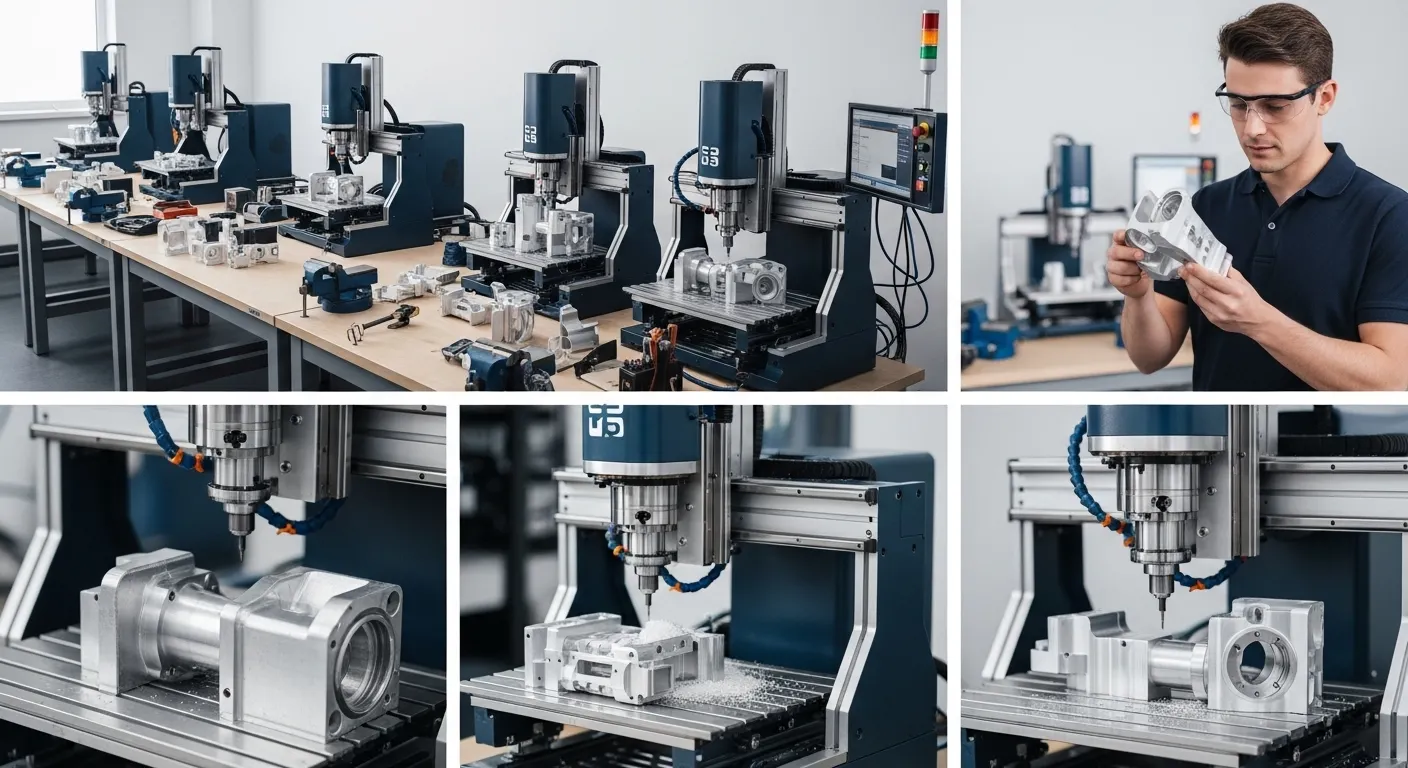
Low-volume CNC prototype production is simply a manufacturing process of small-volume or short-run components that employs the technology of computer numerical control. The quantities of parts made in these portions are in the range of one item to several hundred, so the process is optimally suited to machining prototypes, engineering proof of concept, and bridge manufacturing.
The advantage of CNC-based prototyping lies in the fact that it can provide engineering-grade prototyping that behaves in the same manner as the final production parts. In comparison to additive manufacturing, CNC machining creates parts in which real material properties, strict tolerances, and quality surface finishes are achieved.
This approach can easily be incorporated into a prototype-to-production process, with manufacturers being able to transition relatively effortlessly between early-stage design and production at scale.
Significance of Low-Volume CNC Prototyping
CNC prototyping: Low-volume CNC prototyping is not merely a fad, but a strategic manufacturing tool. The reason business enterprises prefer this approach is that it helps in supporting:
- Accelerated CNC prototyping of design validation.
- High-volume prototype production with zero tooling.
- Small-scale manufacturing before large-scale manufacturing.
- ONC agile production in line with CNC production.
By CNC machining prototypes, the companies are able to perform mechanical fit and functional testing, tolerances testing, and make sure that all the designs meet the performance standards in the real world. Several companies depend on the help of professional providers to investigate the possibilities of professional solutions.
CNC Machining Technologies in Low-Volume Production
CNC prototype machining 3-axis is much more commonly applied to simpler geometries and flat surfaces. It provides a high degree of accuracy on prismatic items and is very cost-effective when it comes to low-volume production.
5-Axis CNC Proto-Machining
Multi-surface, undercuts, and intricate geometry require 5-axis CNC prototype machining flexibility, which is not available elsewhere. It allows single-set-up machining, better surface uniformity, and tighter tolerances, particularly in aerospace and medical applications.
CNC Milling and Turning Prototypes
CNC milling and turning are both needed in many prototype manufacturing processes in CNC. Complicated shapes are processed by milling, and rotating parts are best done by turning, so that maximum material is used and a high degree of precision is achieved.
Computer-Aided Prototyping and Computer-Controlled CNC Machining
Contemporary CAD/CAM CNC prototyping disintermediates digital design and physical manufacturing. CAD models developed by engineers are optimally transformed into toolpaths via CAM software. This approach ensures:
- High-accuracy CNC machining
- Viable repeatable dimensional performance.
- Optimized cutting parameters.
- Reduced cycle times
Digital CNC fabrication allows manufacturers to retain complete control over part tolerances, surface finishes, and part consistency, even in small batch CNC production.
Tolerances, Quality Control, and Precision
The low-volume CNC prototype production requires precision, no compromises. State-of-the-art CNC equipment often attains tolerances of +-0.005 mm, depending on material and geometries.
Key quality factors include:
- Competition CNC prototypes.
- Checking of dimensional accuracy by CMM inspection.
- Machining critical assemblies by tolerance control.
- CNC prototype manufacturing standards that are ISO certified.
These steps will guarantee that all components are functional and regulatory.
Materials in Low-Volume CNC Prototype Manufacturing
Metal CNC Prototyping Materials
The most popular are still aluminum CNC prototype components because of their machinability, strength-to-weight ratio, and corrosion resistance. Six sigma 6061 and 7075 are aluminum alloys that are common in aerospace and automotive prototype parts.
Stainless steel CNC prototypes are incredibly strong, wear and corrosion-resistant, and thus they are used in medical device prototyping as well as in industrial equipment prototyping.
CNC prototype production is normally applied in electrical components, fittings, and decorative parts production because of its conductivity and machinability.
Plastic CNC Prototype Machining
The machining of plastic CNC prototypes is required in cases where the weight reduction, electrical insulation, or chemical protection is needed. Common materials include:
- ABS CNC consumer electronics prototype parts.
- POM / Delrin prototypes of gears and precision mechanisms CNC.
- Wear-resistant components made of nylon.
With these materials, it is possible to conduct functional prototype verification at real working conditions.
Plastic Gear CNC Machining of Low-Volume CNC Production
Plastic gear CNC machining is one of the most specialized uses of low-volume CNC machining, in which precision, noise reduction, and wear resistance are important factors.
Key Industry Applications
Robotics & Automation
Motors, joints, and robot arms are machined with precision gears and provide smooth movement as well as long-term reliability.
Medical Devices
In pumps, surgical equipment, and diagnostic equipment, biocompatible gears are required because pumps, surgical devices, and diagnostic equipment demand precision and cleanliness.
Consumer Electronics
Printers, cameras, and home appliances are supported by high-accuracy gears and provide noisy and reliable operation.
Industrial Machinery
Conveyors and lightweight drive systems use corrosion-resistant gears to guarantee that the equipment is durable in harsh conditions.
Aerospace
Cabin systems and lightweight mechanisms are machined with quiet and high-performance gears, where reliability is crucial.
Validating and Testing of Engineering
Low-volume CNC prototypes enable performance testing of prototypes in a comprehensive manner prior to undertaking mass production. Engineers evaluate:
- Mechanical fit and function
- Load-bearing capacity
- Thermal stability
- Wear resistance
The stage also aids design for manufacturability (DFM), which assists in lowering the cost of production and complexity in the future.
Implementations in Industries
Automotive CNC Prototypes
Automotive CNC prototypes are used to help with high-speed iteration and functional verification of engine parts, all the way to interior assemblies.
Aerospace CNC Prototype Manufacturing
Aerospace is a field that requires high-precision CNC-machined components and demands absolute material traceability and records.
Hit and Miss Medical Prototyping
CNC machining with low volumes is used to guarantee compliance with regulations, material safety, and accuracy of critical healthcare parts.
Consumer Electronics Prototypes CNC
Precision-machined housings, brackets, and internal parts enjoy the benefits of CNC precision and high-end finish.
Industrial Machinery and Robotics
The standard parts of robotics, CNC prototypes, and industrial machine parts are based on precision machining to ensure reliability and durability.
Bridge Production and Agile Manufacturing Solutions
Bridge production machining bridges the space between prototype manufacturing and large-scale manufacturing. It allows companies to:
- Launch products faster
- Test market demand
- Best quality maintenance.
- Avoid tooling delays
Through agile manufacturing solutions, companies are flexible and manage to control costs.
Why Professional CNC Prototype Production Services?
By collaborating with an established manufacturer, it is guaranteed to have access to:
- High-tech multi-axis CNC machining
- Expert material selection
- Robust quality systems
- Quick turnaround CNC services
Professionally known providers such as GD prototyping provide a full range of custom CNC prototype manufacturing services to a variety of industries and applications.
Conclusion:
Small-scale CNC prototype manufacture is not just a technique in manufacturing, but also a competitive edge. The combination of precision engineering, the ability to flexibly produce, and the ability to measure material performance in the real world enables the use of CNC prototyping to enable companies to innovate faster, decrease risk, and introduce better products to the market.
Regardless of whether you are making a prototype component in aerospace, perfecting a medical device, or machining the plastic gears for a robot, low-volume CNC machining services provide the precision, consistency, and scalability that modern manufacturing is looking to achieve.
