


From 2 Weeks to 5 Days: How Low Quantity Injection Molding Speeds Up Your Product Launch
Low Quantity Injection Molding is changing the way companies bring new products to market in 2026. If you've ever waited two months for plastic parts, you know the frustration. The old rule was simple: you either paid a fortune for steel molds and waited forever, or you used fragile 3D-printed parts that broke during testing. Neither option worked well.
That has changed completely. With Low Quantity Injection Molding, what used to take fourteen days can now be done in five. No more missed launch windows. No more expensive delays. Here's how GD Prototyping makes this possible — and why smart procurement teams are making the switch.
Waiting Too Long? Here's What Traditional Molding Really Costs You
Traditional injection molding makes beautiful, strong parts. But the waiting time is painful. Let's break it down:
•Mold making alone takes 4 to 12 weeks: That's just to cut the steel tool, before you even see the first sample part.
•Production adds another 2 to 4 weeks: After the mold is ready, running the parts and shipping them takes even more time.
Market windows close fast. By the time your parts show up, seasonal demand is no longer there, or perhaps your competitor has already put their parts out.
For lean brands, startups, and R&D teams, there just isn't enough time. Bigger companies will take weeks designing and manufacturing the molds. During that time, sales are lost, the cost of storage increases, and the customer base becomes increasingly agitated.
The Trade-off of Low Quantity Injection Molding
Low Quantity Injection Molding becomes a valuable technique with three techniques that shift the focus of the method:
1)Aluminum molds instead of steel
Mold aluminum has a relative softness and easier machineability. A single aluminum mold can be ready in 7 to 10 days, compared to 15 to 20 days for steel. That's nearly half the time.
2)Doing tasks in parallel, not one by one
Smart suppliers like GD Prototyping work on design review, material ordering, and machining at the same time. This saves 2 to 3 weeks on urgent projects.
3)Keeping mold designs simple
By removing complicated moving parts (called side-actions), the mold becomes easier and quicker to build. Simple molds also mean fewer things that can go wrong.
Industry data backs this up. Rapid tooling with aluminum can deliver first parts in 5 to 15 days. For really small runs (under 50 parts), even 3D-printed molds can get you samples in just 2 to 5 days.
Low Quantity Injection Molding vs. Traditional Mass Production: A Simple Comparison
Let's put them side by side so you can see the difference at a glance:
| Feature | Low Quantity Injection Molding | Traditional Mass Production |
| Tooling Material | Aluminum or soft steel | Hardened steel |
| Lead Time | 1 to 4 weeks | 8 to 16 weeks |
| Order Size | 25 to 5,000+ parts | 100,000+ parts |
| Tooling Cost | 2,000to5,000 | 15,000to80,000+ |
| Making Changes | Fast and affordable | Slow and expensive |
Most product teams don't need a million parts on day one. What they really need is the freedom to test, improve, and grow at their own pace. That's exactly what Low Quantity Injection Molding provides.
Save Money Without Getting Stuck with Expensive Molds
Speed is great, but cost matters just as much. Reasons Low Quantity Injection Molding keeps costs low:
Tooling costs decrease by as much as 60%: Hardened steel molds cost a lot more than aluminum or P20 steel molds. Some suppliers report savings of 50% to 90%.
1)No minimum order quantity (MOQ)
Traditional molders often force you to buy 10,000 parts or more just to make it worth their time. Low-volume specialists are happy to run 100 pieces for you.
2)Bridge tooling that grows with you
That aluminum mold you used for your first 500 parts? It can often be upgraded or reused when you're ready for larger runs.
3)No more inventory waste
Order exactly what you need for the next sales cycle. You won't have thousands of parts sitting in a warehouse that might become obsolete after your next design update.
Why GD Prototyping Stands Out for Low Quantity Injection Molding
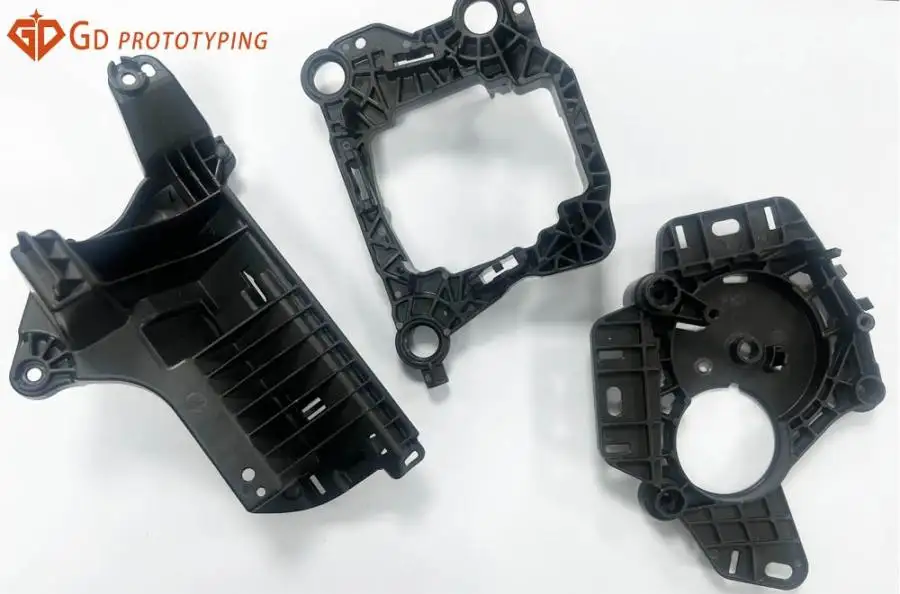
GD Prototyping has built a strong reputation by focusing on one thing: getting you production-grade plastic parts fast, without breaking the bank. It works like this:
•High precision, even at low volumes: Our advanced CNC machines outperform on aluminum and soft steel molds, having a tolerance of ±0.02mm. They reach the same quality of a million-part runs.
•Wide material selection for real-world testing: Are you looking for ABS, polycarbonate, nylon, or a flexible elastomer? GD Prototyping has it. You can test with prototyping materials that are near the same as the final product.
•Fast DFM feedback: Design for Manufacturability reviews take 48 hours, at most, after we receive your CAD file. Literally, every day saved here is a day off of your total time reduction.
Serious quality control for every batch: Additionally, no matter if it's 500 parts or 5,000, each run receives checks and tests.
Who Benefits Most from Faster Turnaround?
Low Quantity Injection Molding benefits:
•Medical devices: Validation testing needs parts to be created with the end goal of regulatory acceptance. Fly through the approval process to litigation and trials.
•Consumer electronics: Compared to other industries, theirs is a time-based game. They must have the ability to have production to market in a matter of days.
•Automotive Suppliers: Pre-production parts are a requirement for fitment testing.
•Aerospace and Defense: Low-volume runs are the norm here. Rapid tooling allows contractors to make service parts without paying for expensive hard tooling that sits unused for years.
How to Get Started
Ready to cut your lead time from weeks to days? Here's what to do:
•Upload your 3D CAD model to a supplier that specializes in low-volume runs.
•Request a clear, itemized quote that separates mold cost, per-part price, and shipping.
•Ask about DFM review turnaround time — this single factor often has the biggest impact on your total schedule.
At GD Prototyping, the entire process is built for speed without sacrificing quality. From DFM review to first samples to full production, every step is designed to get functional, end-use-ready parts into your hands in days — not weeks.
The Bottom Line
Manufacturing has changed. Low Quantity Injection Molding has made production-grade plastic parts accessible to everyone — not just big companies with deep pockets. You no longer have to wait eight weeks or pay $50,000 for a mold. Whether you're launching a brand new product, running a market test, or filling a pilot production order, you can have your parts in five days instead of fourteen.
GD Prototyping brings together advanced equipment, experienced engineers, and a relentless focus on speed. From rapid aluminum tooling to scalable production, every service is built to accelerate your timeline while maintaining the quality your customers expect.
Stop asking “How long will it take?” Start asking “How soon can we begin?”
Frequently Asked Questions
Q: What is the minimum order quantity?
A: Most low-volume specialists will accept orders as small as 50 to 100 pieces. You won't have to commit to ordering thousands of parts.
Q: Do the same materials that are used in mass production have to be used in Low Quantity Injection Molding?
A: Absolutely. You can select from over 100 engineering-grade thermoplastics and thermoplastic polyurethanes; including ABS, PC, Nylon, POM, TPU, and more. These parts will be functionally the same as parts produced from high-volume steel molds.
Q: How do aluminum molds stack up to steel molds?
A: Aluminum molds can produce 1,000 – 10,000 shots. This is ideal for pilot runs, market testing and bridge production. For volumes over that, GD Prototyping can upgrade you to hardened steel tooling.
Q: Are parts produced from Low Quantity Injection Molding inferior to traditionally produced parts?
A: Absolutely not. The finish, the measurements, and the part's performance will be the same in every way. The only differences are the material used to make the tool and how many parts the tool can make before it has to be retired.
Q: How long will it take to get a quote?
A: GD Prototyping can usually provide a DFM and quote within 1 to 2 days of receiving a 3D CAD file.
