


High Pressure Die Casting Service | Metal Casting & Prototypes
What is a High Pressure Die Casting?
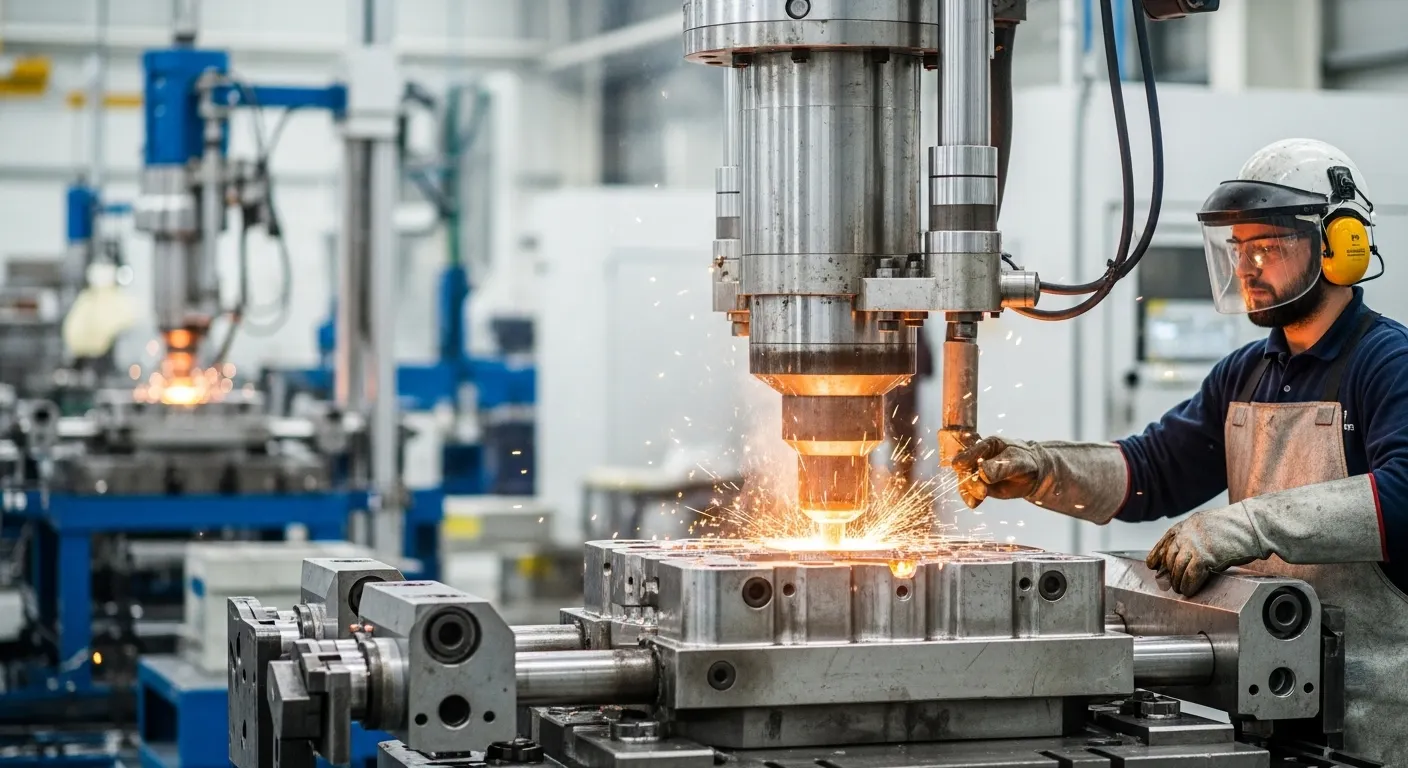
High pressure die casting service is a production process whereby molten metal is forced into a steel mold and die-casted to high pressure, resulting in high precision, repeatable, and high-quality components. This is the best process to use in aluminum, zinc, and magnesium alloys, which provides strength, durability, and fine finishes.
- This is commonly applied to automotive die castings and in the enclosures of electrical and electronic components and structural industrial castings. It is also highly appreciated because of its capability to generate thin-wall castings, multi-cavity molds, and complex geometries, which are hard to produce using conventional casting techniques.
- The metal die casting under high pressure permits the manufacturers to die cast net-shaped parts at low post-processing, so that the parts can be seen to have tight dimensional tolerances and maintain homogeneous quality.
High Pressure Die Casting Service: Accuracy, Credibility, and Industrial Quality
- The current competitive manufacturing environment requires accuracy and efficiency in the manufacturing of metal components of high quality. High pressure die casting service has become one of the surest means of providing the industries with geometries, tight tolerances, and long-life metal components. High-pressure die casting has made it possible to manufacture high-strength, non-corrosive, and light metal components, automotive components, and electrical enclosures, among others, cost-effectively.
- At GD Prototyping, we focus on providing custom high-pressure die casting solutions to combine technical skills, high-level tooling, and a quick production process so that your projects can be transferred between prototype and production without any interruptions.
The Die Casting Process of High Pressure
The die casting process of high pressure is considered to be made of several steps that are precise to build the quality of parts and repeatability:
- Molten Metal Preparation: It involves the heating of metals like aluminum, zinc, or magnesium to the required molten condition. These alloys are well-regulated so that they offer the best flow, temperature, and fluidity.
- Die Casting Molds and Tooling: Die cast metal molds are engineered and made out of steel to endure multiple injections under high-pressure conditions. Multi-cavity molds have the capability of producing a number of the same components at any given time, which increases efficiency.
- High-Pressure Molten Metal Injection: Molten metal is high-pressure forced into the die cavity and fills the fine details, reducing defects. Die casting with thin walls allows it use lightweight and strong parts without structural damage.
- Cooling and Solidification: Once injected, the metal hardens rapidly because of the large thermal conductivity of the steel die, creating precision in its dimensional accuracy and smooth finish on the surface.
- Demolding: After the metal has solidified, the die is opened, and the part is slowly removed to avoid any deformation.
- Post-Casting Machining and Finishing: Parts may also be machined to be surface-treated, anodized, or even coated, depending on their intended use, to give the desired functional and aesthetic properties.
This approach is well known to be high-pressure die-casting, rapid prototyping, and full-scale production, and is a flexible solution to both industrial and OEM needs.
Benefits of High Pressure Die Casting
The use of high-pressure die casting has many benefits:
- Precision and Accuracy: Measure tight dimensional tolerances and uniform part accuracy.
- Complex Geometry Capabilities: Multi-cavity molds and high pressure injection permit complex and thin-walled designs.
- High Surface Quality: smooth, accurate finishes which can be used either aesthetically or functionally.
- Material Effectiveness: low wastage compared to sand casting or solid metal machining.
- Rapid Production: Best suited to low-volume prototyping and high-volume production.
- Scalability: Whether it is a prototype, die casting, or mass production, there is no problem.
- Durability: Mold life and durability are used to guarantee cost-effective manufacturing.
High-pressure die casting is the best option for automobile, aerospace, electronics, and industrial customers because of these advantages.
Use of High-Pressure Die Casting
Die casting services with high pressure are very common in industries because of their accuracy, effectiveness, and flexibility:
Automotive Industry
- Engine parts, housings, brackets, and building parts.
- Light and strong materials for performance and fuel economy.
- Mass production with strict specifications of consistency.
Electrical and Electronics Industry
- Die cast connectors, housings, and enclosures.
- Electronic device-heat dissipating components.
- Consumer electronics: High-precision die castings, aluminum.
Industrial Machinery
- Particular structures and machine components.
- Extra-strong and anti-corrosive components for heavy-duty use.
- Fast development of prototypes and short production runs.
Aerospace and Defense
- Structural elements are lightweight and strong.
- Corrosion-resistant and high-temperature alloys of critical use.
- Optimized geometries of performance.
Consumer Products and Hardware
- Die cast enclosures, housings, and hardware.
- Accurate components that have good aesthetic finishes.
- Low and high-volume production solutions are cost-effective.
The manufacturers can make sure that the parts are accurate, repeatable, and have high-quality finishes in all applications by sourcing custom high-pressure die casting services.
Low-Volume High Pressure Die Casting and Prototype
Prototype high-pressure die casting is beneficial in many industries and is particularly used in testing design, fit, and function before high production. This process allows:
- High-speed design and production with minimal tooling.
- Minimal volume production tests and validation.
- Elasticity of materials to fit the end production alloys.
- Mechanical properties and compatibility of assembly functional testing.
Since it involves low volumes of die cast and high pressure, low-volume high-pressure die casting is especially applied in automotive prototypes, industrial machine components, and electronic enclosures, somewhere between concept and production.
GD Prototyping: Die Casting Partner of Your High Pressure
At GD Prototyping, we offer high-end die casting services (end-to-end):
- Auto, electronics, and industry custom die casting application.
- Test production to optimize design testing
- Precise molds and tooling of small tolerances.
- Finishing and smoothing of the rough and intricate machining after casting.
- Fast high-pressure die casting of fast development cycles.
- Mass manufacturing production scale.
Since we are very proficient in the field of precision high-pressure die casting, our focus is to ensure that all parts are of quality, correct dimensions, and performance.
Conclusion
High pressure die casting service is essential in industries that need precision, durability, and efficiency. This process provides high-strength, thin-walled, and complex components at a high rate and low cost in terms of automotive components, industrial machines, electronic enclosures, and consumer products. At GD Prototyping, we focus on high-pressure die casting services that are custom in nature, develop prototypes, and offer low-volume production and scalable manufacturing.
