


FDM Prototype Printing | Custom 3D Printing Prototypes
FDM Prototyping Prototype: Rapid and High-Precision, 3D Prototyping
- The FDM prototype printing has been a useful product in the contemporary product development scene among engineers, designers, and manufacturers. FDM 3D prototype printing is the most flexible, fast, and precise, allowing companies to transition between concept and functional tests. FDM prototyping is a low-cost, high-performance system, whether you are generating custom FDM prototypes, small batch production parts, or high-performance assemblies.
- Our FDM prototyping service at GD Prototyping comprises the latest additive manufacturing technologies, engineering, and material flexibility to produce high-precision, durable, and useful prototypes that are designed to meet on-demand project requirements.
How to Figure Out FDM Prototype Printing
Fused Deposition Modeling (FDM) prototype printing is an additive manufacturing technology that involves heating thermoplastic filaments and layer-by-layer deposition to produce 3D objects. FDM is capable of complex geometries, fast cycles, and functional testing at low tooling costs, in contrast to traditional subtractive manufacturing.
The main characteristics of FDM printing prototyping are:
- Excellent Precision FDM 3D Printing: Build micron-accuracy prototypes with tight tolerances.
- Material Flexibility: Works with PLA, ABS, PETG, Nylon, and thermoplastics of engineering grade.
- Quick Design Changes: Rapidly make changes to CAD models and prototype with FDM prototyping.
- Functional Testing: Develop long-lasting FDM prototype parts that pass through mechanical and thermal testing.
- Low Volume FDM Prototyping: Eliminate waste and expensive tooling through low-volume FDM prototyping.
GD Prototyping provides dimensional fidelity, a smooth surface finish, and a reproducible outcome on any project by incorporating the use of layer-by-layer FDM prototyping.
The Process of FDM Prototype Printing
The process of FDM includes several steps that guarantee high quality of functional prototypes:
CAD Design and Modeling
All projects begin with CAD-based FDM prototype printing, where engineers can work out the design to meet additive manufacturing. Overhangs, complex features, and internal structures are incorporated easily.
Material Selection
It is important to select the appropriate thermoplastic. Common options include:
- PLA FDM 3D Prototypes: Biodegradable, simple to print, suitable with visual models.
- ABS FDM 3D Printing Prototypes: ABS is strong, heat-resistant, and can be used in functional testing.
- PETG FDM Prototype Components: Resistant and chemically stable.
- Nylon FDM Prototypes: Tough, impact-resistant, and mechanical assemblies.
FDM Printing
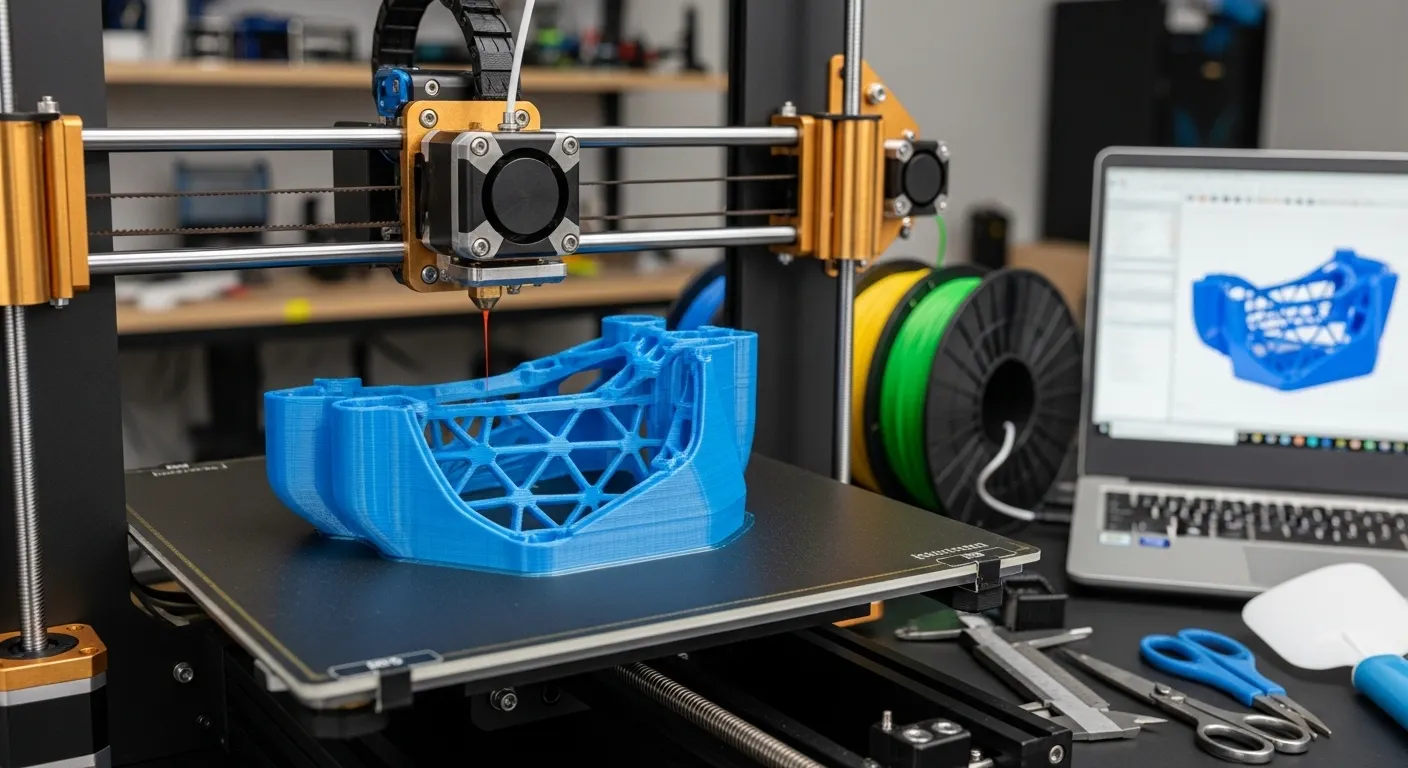
The physical prototype is made using FDM additive manufacturing prototypes whereby the filament is extruded through a heated nozzle and pushed up into the layers. FDM printing can be used in multi-material with a support material or dual-extrusion, and can be used on more complex parts.
Post-Processing
Parts can be sanded, polished, painted, or even annealed after printing to produce the required surface finish and functional properties. Post-processing guarantees high-dimensional accuracy, smooth surfaces, and prototypes ready to be produced.
Functional Testing
FDM prototypes can be tested concerning mechanical strength, thermal performance, and ergonomic fit, so that design validation can be made before full-scale production.
Benefits of FDM Prototype Printing
FDM prototype printing has a set of distinct advantages, which predetermine it as a perfect choice to use in modern product development:
- Speedy Run-Through and Plasticity
Prototyping may require weeks or months using traditional prototyping. In high-speed FDM 3D printing, prototypes can be prepared in a few days, which enables quicker design validation and iteration.
- Cost-Effective Development
FDM minimizes the amount of material scraps, tooling costs, and production costs, which makes it suitable for low-volume FDM prototyping.
- Custom Designs and Complex Geometries
With FDM, elaborate designs, internal channels, and lattice designs that would not have been possible or affordable by traditional methods are now possible.
- Material and Functional Versatility
FDM supports the material and performance needs of your project with high-strength thermoplastic FDM prototyping for lightweight consumer product parts.
- End-to-End Prototyping Solutions
Under GD Prototyping, you get personalized FDM 3D printing services, after printing services, and usable prototypes to test or produce in low quantities.
FDM is recommended when it comes to functional prototypes, engineering-grade parts, and low-volume manufacturing, SLA when it comes to fine-detail visual models, and SLS when it comes to high-strength industrial components.
FDM Prototype Printing Applications
FDM prototype printing is very flexible and applicable in a large variety of industries:
- Automobile FDM Prototype Printing
Automobile FDM prototypes can be used to test form, fit, and functionality of mechanical components, interior fittings, and other parts before an engineer invests significant money in tooling.
- Aerospace FDM 3D Prototypes
Aerospace needs prototypes that are lightweight, highly strong, and accurate. The FDM printing process can be used to create more complex shapes such as brackets, ducting, and housings.
- FDM Prototypes Medical Devices
Surgical guides, ergonomic tests, and functional validation of medical device FDM prototypes can be done with biocompatible and high-precision materials.
- Industrial FDM Prototypes Parts
Industrial FDM prototypes are also commonly used by the designers of factories and equipment to create custom jigs, fixtures, and mechanical components to be tested and optimized in their processes.
- Electronics FDM Prototypes Enclosures
FDM printing enables functional electronics enclosures, enabling quick iteration of design validation, assembly test, and thermal test.
- Prototyping Consumer Product FDM
Before production, designers and startups can make FDM prototypes market-ready to demonstrate ergonomics, aesthetics, and functionality.
Why GD Prototyping to Print FDM Prototypes?
In GD Prototyping, we offer FDM 3D printing services with end-to-end service, precision, speed, and reliability:
- Rapid Prototyping: Converts CAD files into actual, useful components within a short period of time.
- Complex Geometries: Produce complex designs that cannot be done by conventional methods.
- Material Diversity: Extensive selection of thermoplastics, engineering-grade polymers, and multi-material printing.
- Economic Development: Minimize the cost of tooling and setting up.
- Custom Finishes: Sanding, polishing, painting, and texturing.
- Scalability: Single prototypes to small-batch production runs.
Under GD Prototyping, you have the flexibility and speed of accuracy, which assists in speeding up the innovation and minimizing the risk of development.
Conclusion
The FDM prototype printing is revolutionizing product development because it is quickly, accurately, and practically producing prototypes in any industry. Electronics, consumer products, medical devices, aerospace, and automotive FDM offer a low-cost, flexible, and reliable solution to prototyping. GD Prototyping can help you realize your vision by efficiently and accurately producing your vision, whether needed is low-volume FDM prototyping, functional testing, or small-volume production.
