


EV Motor Housing for e-Axle Systems: Design & Manufacturing Guide
The EV Motor Housing is no longer simply an aluminum enclosure around the stator and rotor. In an integrated e-Axle, it becomes part of the drivetrain architecture, carrying structural loads while controlling bearing alignment, thermal transfer, sealing, vibration, and interfaces with the gearbox and power electronics.
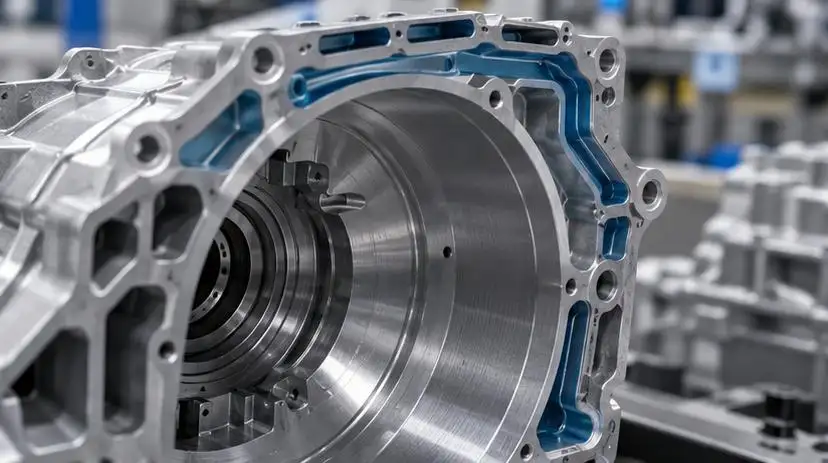
From a manufacturing perspective, this changes how an EV Motor Housing should be designed. Geometry that performs well in CAD must also be castable, machinable, inspectable, and leak-tight.
At GD Prototyping, we view EV Motor Housing development as a combined design-and-manufacturing problem rather than a single-process exercise.
What Does an EV Motor Housing Do in an e-Axle?
Conventional motor housings are designed to support electric motors. EV Motor housings, on the other hand, can perform additional functions, including:
• Locating stators and rotors and bearing systems.
• Providing interfaces to the reduction gearbox.
• Accomommodating vehicle and drivetrain system mounts.
• Incorporating cooling system jackets or passages.
• Providing sealing surfaces for lubricants.
• Coordinating the alignment of bearing and shaft assemblies.
• Managing system and component vibration.
• Energy conversion system interfaces.
The integration of these functions in a single housing reduces the number of separate components in a given system. However, there is an increase in design and manufacturing risk with regard to dimension and tolerance.
| Design Area | EV Motor Housing Requirement | Manufacturing Impact |
| Bearing system | Accurate coaxial alignment | Precision boring and datum control |
| Cooling circuit | Efficient heat removal | Casting integrity and leak testing |
| Gearbox interface | Stable shaft positioning | Flatness and perpendicularity |
| Structural ribs | High stiffness at low mass | Tooling and filling complexity |
| Sealing faces | Reliable fluid containment | Surface finish and flatness control |
Why is Aluminum Dominant for EV Motor Housing?
In the construction of EV Motors, aluminum alloys offer a good combination of relatively high specific strength compared to iron and copper based alloys, combined with good thermal conductivity, corrosion resistance and workability.
But, choosing aluminum alloys presents only part of the design problem. Consideration must also be given to:
Wall Thickness
Thin walls reduce the amount of material required to make a part, however, localized sharp changes in sectional thickness can also cause thermal and shrinkage defects in castings.
Rib Design
Adding stiffeners in the form of ribs can alleviate localized high stresses in a casting, but can also introduce thermal and shrinkage defects.
Thermal Expansion
An EV Motor Housing operates across changing temperatures. Bearing bores, sealing surfaces, and shaft relationships must remain functional after thermal expansion.
For this reason, lightweighting should never be separated from structural and dimensional analysis.
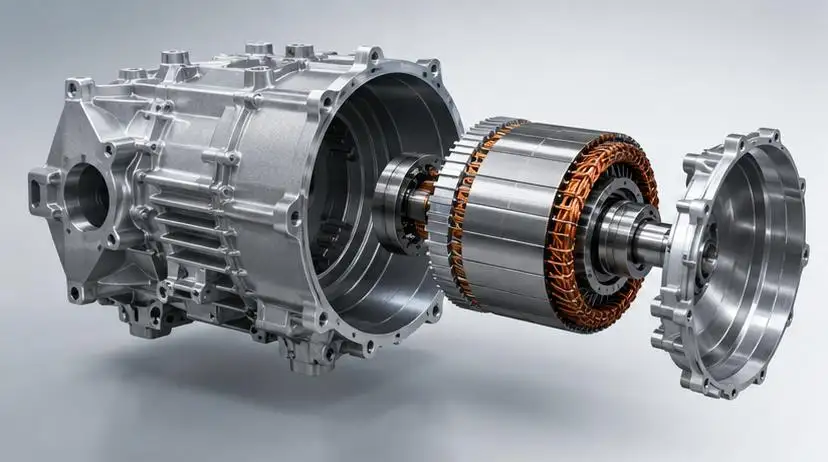
Cooling Channels Are Becoming Part of the Housing Architecture
Thermal management is one of the most important design drivers in modern EV Motor Housing development.
A liquid-cooled housing may incorporate a circumferential water jacket around the stator. The objective is to minimize the thermal resistance between the motor heat source and coolant.
Key design variables include:
• Coolant-channel cross section
• Flow distribution
• Pressure loss
• Wall thickness between stator and coolant
• Local hot spots
• Sealing strategy
• Casting feasibility
A more complex cooling circuit does not automatically produce better thermal performance. Narrow or irregular channels may improve packaging but make casting, cleaning, inspection, and leak control more difficult.
The cooling system therefore needs to be developed together with the EV Motor Housing manufacturing process.
Where EV Motor Housing Manufacturing Becomes Difficult
For high-volume production, aluminum high-pressure die casting is commonly considered because it can create thin walls, ribs, bosses, and complex near-net geometry.
The challenge is controlling defects in critical regions.
Porosity
Gas porosity and shrinkage porosity are particularly important when an EV Motor Housing contains:
• Coolant passages
• Bearing seats
• Threaded holes
• Sealing surfaces
• Deep machined features
Machining can expose subsurface porosity that was not visible on the as-cast surface. A casting that appears acceptable before machining may therefore fail leak or sealing requirements afterward.
Distortion
Large, thin-wall housings can distort during solidification, heat treatment, clamping, or machining. Datum strategy and machining sequence must account for this behavior.
Tool Access
A highly integrated EV Motor Housing may contain deep bores and closely spaced features that limit cutter access. These issues should be identified during DFM rather than after tooling is complete.
Why CNC Machining Remains Critical
Die casting produces the near-net geometry, but precision functions are usually generated or finished by CNC machining.
Typical machined features include:
Bearing Bores
Bearing locations influence rotor and shaft alignment. Diameter, roundness, position, and coaxiality may all be critical.
Gearbox and Motor Datums
Interface surfaces establish the positional relationship between the motor and reduction gear system.
Sealing Surfaces
Coolant and lubricant sealing areas may require controlled flatness and surface finish.
Threaded and Mounting Features
Bolt-hole position affects assembly alignment and load distribution.
A typical production route is therefore:
Casting → Datum Establishment → Rough Machining → Precision Boring/Milling → Deburring → Cleaning → Inspection → Leak Testing
The final accuracy of an EV Motor Housing depends on the complete process chain, not simply on the capability of the CNC machine.
Critical EV Motor Housing Characteristics
There is no universal tolerance specification for every motor housing. Requirements depend on motor architecture, bearing arrangement, housing size, operating temperature, and OEM standards.
Still, several characteristics deserve particular attention.
| Feature | Typical Control |
| Bearing bore | Diameter, roundness, coaxiality |
| Housing datum | Flatness and perpendicularity |
| Gearbox interface | Position and orientation |
| Sealing face | Flatness and surface roughness |
| Cooling circuit | Pressure integrity and leakage |
| Bolt pattern | True position |
| Stator location | Diameter and concentricity |
For engineering prototypes, these relationships should be validated before production tooling is finalized.
Prototype First or Go Directly to Die Casting?
It is not always the case that the best starting point for producing EV Motor Housings is investing in production tooling.
Housing prototypes machined by a CNC can help engineers evaluate:
• Shaft and Bearing alignment
• Stator insertion
• Gearbox and other components coupling
• Housing orientation and mounting
• Sequence of final assembly
• Means for sealing
• Means for inspecting
Though a CNC machined billet housing may not manifest all the features of a die cast part, it can help identify assembly and other related problems.
A reasonable and typical developmental approach would be:
CAD >> DFM >> CNC Prototyping >> Functional Test >> Tooling & Die >> CNC Machining >> Inspection >> Limited Production Run
Designing an EV Motor Housing for Manufacturing
Lastly, incorporating the views of end users (i.e. the EV Motor Manufacturers) at various stages of the design and development of the housings early on helps optimize the process.
Before releasing the design, engineers should review:
• Is wall thickness reasonably uniform?
• Can critical bores be accessed by cutting tools?
• Are machining allowances sufficient?
• Are functional datums clearly defined?
• Can cooling passages be manufactured and inspected?
• Are sealing surfaces accessible for machining?
• Can the component be clamped without distortion?
• Can critical dimensions be measured reliably?
• Could casting porosity intersect machined surfaces?
These questions often determine whether an elegant CAD model becomes a stable production component.
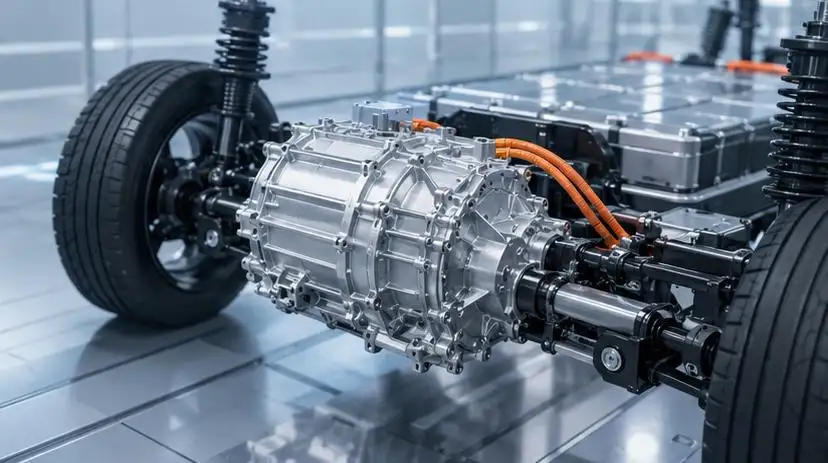
From EV Motor Housing Design to Physical Validation
As integration of e-Axles increases, the EV Motor Housing has to meet more exacting requirements in terms of dimensional, structural, and thermal design. It also has to be manufactured using innovative techniques.
In the development of new products, it is often helpful to be able to create functional prototypes early on to verify design decisions. This reduces the level of uncertainty in the design and aids in the decision making process before tooling is made for final part production.
GD Prototyping specializes in both prototype and production manufacturing of automotive and electrical vehicle components. GD Prototyping can help you manufacture low volumes of your EV Motor Housing or other E-Axle or drivetrain components. You can also use GD Prototyping for an evaluation of your prototype needs.
FAQs
Q1. Can GD Prototyping manufacture EV Motor Housing prototypes?
Yes. GD Prototyping provides CNC machining, rapid prototyping, die casting, and low-volume manufacturing services that can support EV Motor Housing development and validation.
Q2. Can GD Prototyping CNC machine an aluminum EV Motor Housing?
Yes. GD Prototyping offers 3-axis, 4-axis, and 5-axis CNC machining for aluminum and other engineering materials, making it suitable for complex EV Motor Housing prototypes and low-volume parts.
Q3. Why use CNC machining for an EV Motor Housing prototype?
CNC machining allows engineers to validate bearing bores, mounting interfaces, sealing surfaces, and assembly geometry without investing in production die-casting tooling.
Q4. Can GD Prototyping support low-volume EV Motor Housing production?
Yes. GD Prototyping specializes in rapid prototyping and low-volume manufacturing, including CNC machining and low-volume die casting.
Q5. Does GD Prototyping provide die casting for EV Motor Housing projects?
GD Prototyping offers high-pressure die casting, gravity permanent mold casting, and rapid tooling options for aluminum and other cast alloys.
