


DMLS vs CNC Machining for Metal Parts: A Complete Guide
When creating high-performance metal parts, engineers have two dominant technologies at their disposal. They can start with a solid block of metal and carve it into shape, or they can build the part from scratch, layer by microscopic layer, from a bed of fine metal powder. These two methods—subtractive CNC machining and additive DMLS 3D printing—represent fundamentally different approaches to manufacturing. The choice between them is one of the most critical decisions in product development, impacting a part's geometry, performance, cost, and lead time.
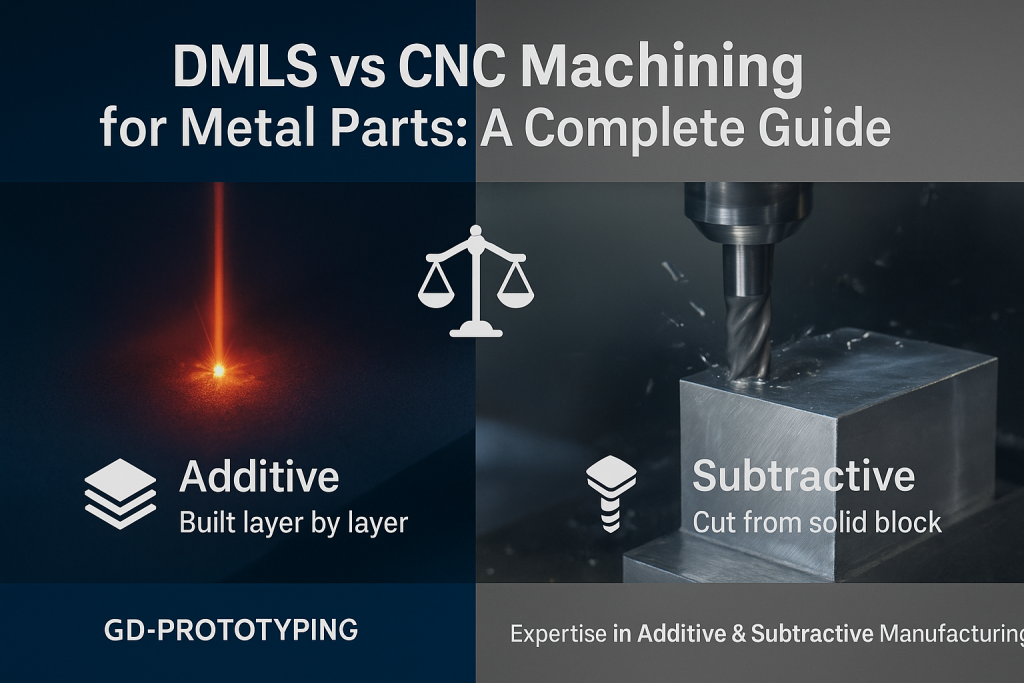
The fundamental difference is that CNC machining is a subtractive process that cuts away material from a solid block, while DMLS is an additive process that builds a part layer-by-layer by fusing metal powder with a laser. CNC excels at precision and strength for traditional designs. DMLS excels at creating complex geometries that are impossible to machine.
As an expert manufacturing partner with in-house capabilities in both advanced CNC machining and Direct Metal Laser Sintering (DMLS), GD-Prototyping provides this comprehensive guide. We will explore the technical details, strengths, and limitations of each process. This will empower you to make an informed decision for your specific application.
Understanding CNC Machining: The Subtractive Standard
CNC (Computer Numerical Control) machining is the benchmark for precision metal manufacturing. It is a subtractive process, meaning it creates a final shape by removing material from a larger piece of stock, known as a billet. It is renowned for its accuracy, repeatability, and ability to produce parts with excellent mechanical properties.
How Does CNC Machining Create Metal Parts?
The process begins with a 3D CAD model of the final part. A CAM programmer uses this model to generate toolpaths, which are then converted into G-code. This code directs the CNC machine's every move.
- A solid block of metal is securely clamped into the machine.
- A cutting tool (like an end mill or a drill bit) is loaded into the machine's spindle.
- The spindle spins at high speed, and the machine precisely moves the tool or the workpiece along multiple axes.
- The cutting tool systematically removes material, carving the final shape out of the solid block.
- This process continues, sometimes with multiple tool changes, until the net shape part is complete.
Key Characteristics of CNC Machined Parts
Parts produced via CNC machining are valued for their superior material properties and precision.
- Excellent Strength: Because the part is carved from a solid, wrought billet of metal, it retains the material's original grain structure and strength. This generally results in stronger, more durable parts compared to additive methods.
- Tight Tolerances: CNC machining is an extremely precise process. It can achieve very tight dimensional tolerances, often within a few hundredths of a millimeter.
- Smooth Surface Finish: The process can produce a very smooth and consistent surface finish directly from the machine, which can be further improved with light polishing.
Common CNC Materials
A major advantage of CNC machining is its compatibility with a massive range of well-understood engineering materials.
- Aluminum Alloys: (e.g., 6061, 7075) for a great balance of strength, weight, and cost.
- Stainless Steels: (e.g., 304, 316, 17-4 PH) for corrosion resistance and strength.
- Titanium Alloys: (e.g., Ti-6Al-4V) for an exceptional strength-to-weight ratio and biocompatibility.
- Superalloys: (e.g., Inconel) for high-temperature applications.
The Limitations of Tool Access
The core constraint of any subtractive process is tool access. The cutting tool needs a direct, physical line of sight to the surface it is machining. This makes it impossible to create complex internal features, deep and narrow channels with sharp corners, or enclosed lattice structures.
Understanding DMLS: The Additive Innovator
Direct Metal Laser Sintering (DMLS), also known as Selective Laser Melting (SLM), is a powder bed fusion additive manufacturing technology. It builds metal parts from the ground up, layer by layer. This approach completely redefines what is possible in terms of geometric complexity.
How Does DMLS 3D Print Metal Parts?
The DMLS process takes place inside a sealed build chamber filled with an inert gas to prevent oxidation.
- A recoater blade spreads an extremely thin layer of fine metal powder (typically 20-60 microns) over a build platform.
- A powerful, high-precision fiber laser, guided by a set of scanning mirrors, traces the first cross-section of the 3D model onto the powder bed.
- The laser's intense energy completely melts and fuses the metal powder particles together, creating a solid layer.
- The build platform lowers by one layer's thickness, and the recoater blade applies a fresh layer of powder.
- The process repeats for thousands of layers, fusing each new layer to the one below it, until the final part is fully formed within the powder bed.
Key Characteristics of DMLS Parts
DMLS parts are known for their complex geometries and good mechanical properties.
- Unmatched Design Freedom: DMLS can produce parts with intricate internal channels, organic shapes, and optimized lattice structures that are impossible to manufacture with any other method.
- Good Strength: The properties of DMLS parts are similar to those of a cast metal part. While typically not as strong as a wrought part from CNC, they are fully dense and suitable for demanding functional applications.
- Near-Net-Shape Parts: The process builds the part to its near-final shape, which can significantly reduce material waste compared to machining a complex part from a large block.
The Critical Post-Processing Steps
DMLS parts require several mandatory post-processing steps.
- Stress Relief: The intense heating and cooling cycles of the process create internal stresses in the part. The entire build plate must be heat-treated in a furnace to relieve these stresses and prevent warping.
- Support Removal: DMLS parts require support structures to anchor them to the build plate and support overhanging features. These supports are solid metal and must be removed using wire EDM, CNC machining, or manual tools.
- Surface Finishing: The as-printed surface of a DMLS part is rough and matte. It often requires secondary processing like bead blasting, tumbling, or precision machining to achieve a smooth finish or tight tolerances.
Common DMLS Materials
DMLS works with a growing range of weldable metal powders.
- Stainless Steel (316L): Excellent for corrosion resistance and biocompatibility.
- Aluminum (AlSi10Mg): A lightweight alloy good for prototyping and heat exchangers.
- Titanium (Ti64): The premier choice for high-strength, lightweight, and biocompatible parts.
- Inconel (IN718): A nickel superalloy used for high-temperature and high-stress applications in aerospace and energy.
The In-Depth Comparison: DMLS vs. CNC Head-to-Head
The decision between DMLS and CNC machining involves a detailed analysis of several key trade-offs.
Geometric Freedom: The Deciding Factor
This is the most significant difference. DMLS excels at geometric complexity. It can create parts with features that are simply impossible for a cutting tool to reach. This includes:
- Complex internal cooling channels for conformal cooling in mold tools.
- Topology-optimized, organic shapes that minimize weight while maximizing strength.
- Fine, intricate lattice structures for medical implants or lightweighting.
CNC machining is limited by tool access. However, for features that it can access, it is extremely precise. It is the superior choice for high-precision holes, flat sealing surfaces, and prismatic features.
Mechanical Properties and Part Strength
CNC machined parts are generally stronger than DMLS parts made from the same alloy. This is because CNC starts with a wrought billet of metal that has a uniform, forged grain structure. DMLS parts have a microstructure that is more similar to a high-quality casting, which can result in slightly lower tensile strength and fatigue properties. DMLS parts can also exhibit some anisotropy, meaning their strength can vary slightly depending on the build direction (X, Y vs. Z).
Tolerances and Accuracy
CNC machining is the clear winner for precision. A high-end 5-axis CNC machine can hold dimensional tolerances that are an order of magnitude tighter than what is possible with DMLS out of the printer. While DMLS can produce accurate parts, achieving very tight tolerances (tighter than +/- 0.1 mm) almost always requires a secondary machining step on critical features.
Surface Finish
CNC machining produces a much smoother surface finish. A standard machined finish is significantly smoother than the best possible as-printed DMLS finish. DMLS parts have a rough, matte texture due to the nature of the fused powder particles. If a smooth, polished, or very low-friction surface is required, a DMLS part will need extensive post-processing.
Speed and Lead Time
The answer depends heavily on the part's complexity and the quantity.
- For a single, highly complex prototype, DMLS can often be faster. The machine can start building directly from the CAD file with minimal programming. A CNC part might require extensive programming and custom fixture creation.
- For simpler parts or any production quantity, CNC machining is dramatically faster. The material removal rates of a CNC machine are much higher than the build rates of a DMLS machine.
Material Waste and Sustainability
DMLS is a more efficient process in terms of material usage. It only uses the powder required for the part and its supports. The unused powder in the build chamber can be recycled into the next build. CNC machining is a subtractive process and can be wasteful for complex parts, sometimes turning more than 90% of an expensive block of titanium into chips. However, these chips are highly valuable and are almost always collected and recycled.
The Break-Even Chart: Analyzing Cost vs. Quantity
The cost comparison between DMLS and CNC is not linear. It is highly dependent on the quantity of parts being produced. This relationship can be visualized with a break-even chart.
DMLS vs. CNC: Finding the Cost Break-Even Point
Let's break down the components of this chart:
- The Y-Axis represents the Total Project Cost.
- The X-Axis represents the Quantity of Parts.
- The DMLS Cost Curve: The cost for DMLS starts very low. There are no expensive setup costs, custom fixtures, or complex CAM programming required for a single part. However, the cost per part is relatively high and constant, so the line has a steep, steady slope.
- The CNC Cost Curve: The cost for CNC starts much higher. This initial "startup cost" includes the significant time required for a skilled machinist to set up the machine and for a programmer to create the toolpaths. However, once this is done, the cost to produce each additional part is relatively low. This gives the line a much flatter slope.
- The Break-Even Point: This is the critical point where the two cost curves intersect.
- To the left of this point (lower quantities), DMLS is the more economical choice.
- To the right of this point (higher quantities), CNC machining becomes the more economical choice.
For higher volumes, other processes also become viable. See our guide on Vacuum Casting vs Injection Molding for more options.
Making the Right Choice for Your Application
The best process is the one that meets your design intent in the most efficient way possible.
When Should You Choose DMLS?
Choose the additive innovator, DMLS, when:
- Geometric complexity is the primary driver. Your part has features that cannot be machined.
- You need internal channels, conformal cooling, or lattice structures.
- You are using topology optimization to create a lightweight, organic design.
- You need a single, complex prototype very quickly.
- Part consolidation is a goal (turning an assembly of multiple parts into a single printed one).
When Should You Choose CNC Machining?
Choose the subtractive standard, CNC machining, when:
- High precision and very tight tolerances are the most critical requirements.
- Superior material strength and fatigue life are essential.
- A very smooth surface finish is needed directly from the process.
- The geometry is relatively simple and can be created with cutting tools.
- You are producing quantities ranging from a few parts to mass production.
- Cost at volume is a major consideration.
For polymer parts, a similar decision exists between additive and other processes. Learn more in our SLA vs SLS vs MJF guide.
Conclusion
DMLS and CNC machining are not truly competing technologies; they are powerful, complementary tools in the modern manufacturing landscape. DMLS offers unparalleled freedom to create the previously impossible. CNC machining delivers unparalleled precision, strength, and scalability for more traditional designs. The future of advanced manufacturing lies in harnessing the strengths of both, sometimes even on the same part, where a DMLS part is post-machined to achieve critical tolerances.
Understanding the fundamental differences between additive and subtractive manufacturing is key to successful product development. At GD-Prototyping, our team of experts is fluent in both technologies. We can provide unbiased, data-driven advice to help you select the perfect process to meet your part's requirements and your project's budget.
