


Die Casting Vs Sand Casting: Advantages & Applications
What is Die Casting?
Die casting is a high-pressure metal forming process in which metal molds, often known as dies, are reused. During high-pressure die casting, molten metal is forced to fill the mold cavity with pressures of between 1,500 and more than 25,000 psi. This high pressure guarantees high filler of the mold, less porosity, and high consistency of the casting.
Key Features of Die Casting
- Hardened steel reusable metal moulds.
- High-dimensional accuracy
- Very high-quality surface finish.
- Tight casting tolerances
- Perfect for the casting technique of mass production.
Die casting, especially aluminum alloy casting, zinc alloy casting, and magnesium casting are also an important part of die casting processes, and thus is a foundation of automotive die casting vs sand casting arguments.
Die Casting Vs Sand Casting: Technical and Practical Comparison in Modern Manufacturing
Few comparisons of Die casting vs sand casting are as significant when the manufacturers have to make the crossroads of the production decisions. These two metal casting processes mold automotive engine blocks to fine industrial parts, but their applications, cost, strength, and limitations are vastly different. The selection of the appropriate casting is not just a technical choice; it has a direct bearing on the performance of the product to be cast, the volume of production at which the method is suitable, the quality of the surface finish, the quality of the dimensional accuracy, and the overall efficiency in the manufacturing process.
What are Metal Casting Processes in Current Manufacturing?
Metal casting processes still lie at the core of industrial production since, by the use of molten metal, it is possible to fabricate complex geometries with great efficiency. Die casting and sand casting are the most commonly used forms of industrial casting because of their flexibility in non-ferrous and ferrous casting.
- In its simplest form, casting uses molten metal and pours it into the mold, or injects it into the mold, where it cools down, solidifies, and makes the shape that it wants. The differences between the casting technologies in die and sand casting are, however, in the materials of the molds, level of pressure, efficiency of the cycle time, and tolerances that can be achieved.
What is Sand Casting?
Sand casting is based on expendable sand molds, which are usually silica sand mixed with binders. Unlike die casting, each mold is destroyed during casting, so there is unbelievable flexibility in the size and form of parts.
Types of Sand Casting
- Green sand casting
- Dry sand casting
- Shell molding
The green sand casting process is particularly popular because of its cheapness and flexibility. Sand casting is the preferred method of iron sand casting operation for large parts of the industry and small-scale production.
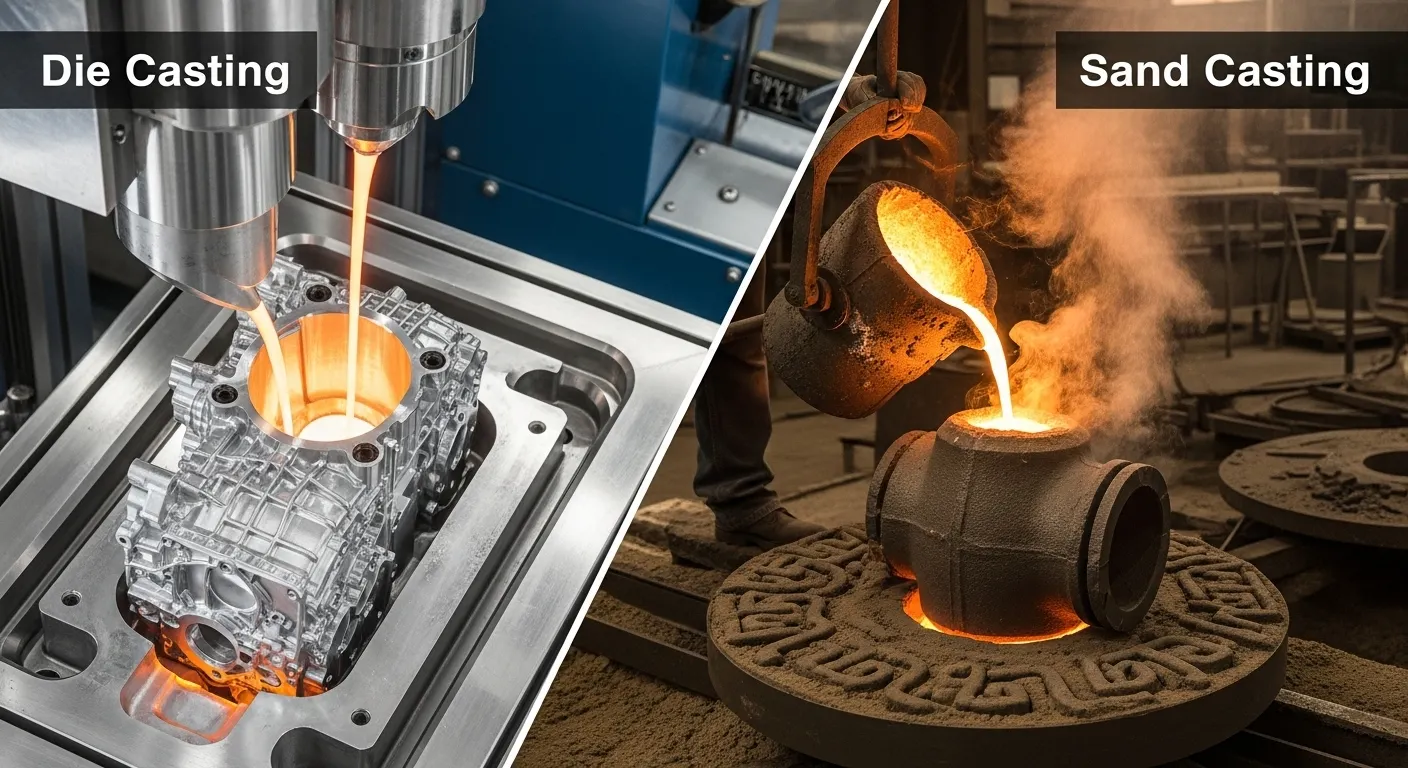
Die Casting Vs Sand Casting Process Comparison
The comparison of a clear sand casting and die casting process helps to understand the reasons why these two processes are used to meet the needs of production.
- Mold Preparation
Die casting involves reusable metal molds, having a high startup cost but with predictable results in thousands or even millions of cycles. In sand casting, the tooling is cheap, and the per-unit cost of production is high because of the disposable molds.
- Molten Metal Injection
Die casting makes use of injecting molten metal under high pressure, which guarantees filling of the cavity fully in even thin-wall components. Sand casting is based on the principle of gravity, which restricts the complexity and the ability of the thin section.
- Cooling and Solidification
Die casting at high rates yields smaller grain structures, which add to better mechanical strength. Sand casting has slow cooling, and this may lead to coarse microstructures.
- Die Casting and Sand Casting Cost Analysis
Die casting vs sand casting cost is one of the most significant issues for manufacturers. Die casting is very expensive in terms of tooling, with the steel die being machined, but it is much cheaper at large volume since it is possible to generate units quickly, and less work is required in post-processing.
Comparison of Mechanical Properties and Strength
In the comparison of die casting and sand casting strength, the former has more favorable mechanical properties than the latter because cooling is more rapid and less porous. Components are improved in terms of tensile strength, fatigue, and impact performance.
Although sand casting is suitable for most of the usages, it tends to exhibit more interior defects unless stringent measures on porosity and quality are utilized.
Surface Finish and Dimensional Accuracy
Die casting has the best quality of surface finish and casting tolerances, which usually removes the necessity of the massive machining process. That is why it is best in the precision castings compared to sand castings, where aesthetics and fit are important.
Sand casting has a rougher finish and larger tolerances that can be machined, but gives more design freedom.
Volume Suitability Production
Compare two methods, die casting and sand casting, in terms of production volume:
- Die cast technology is most appropriate in terms of mass production, which is usually more than 50,000.
- Sand casting promotes low-volume production and custom casting of metals.
Aluminum Die Casting and Sand Casting
Die casting is dominant in automotive and electronic industries compared to sand casting in terms of light weight feature, high accuracy, and repeatability. Sand casting is also applicable to large aluminum parts, with tooling costs being prohibitive.
Comparison of Zinc, Magnesium, and Iron Casting
- Die casting vs sand casting Zinc die casting advantages over sand casting include the low melting point of zinc and high fluidity.
- Lightweight aerospace and automotive components are better made using magnesium die casting compared to sand casting.
- The iron sand casting process is still considered predominant because iron cannot be die cast due to its high melting temperature.
Conclusion
Knowledge of the differences between die casting and sand casting will enable manufacturers to match the capabilities of the processes to the objectives of products. When applied with contemporary processes such as prototype injection molding and quick tooling, businesses can make development smoother, decrease the risk, and speed up time to market. Through effective cost, accuracy, volume of production, and material consideration, businesses can comfortably choose the best manufacturing solution to apply in today's competitive world. Visit GD Prototyping.
