


Die Casting Vs Injection Molding: Applications Guide
What is Die Casting?
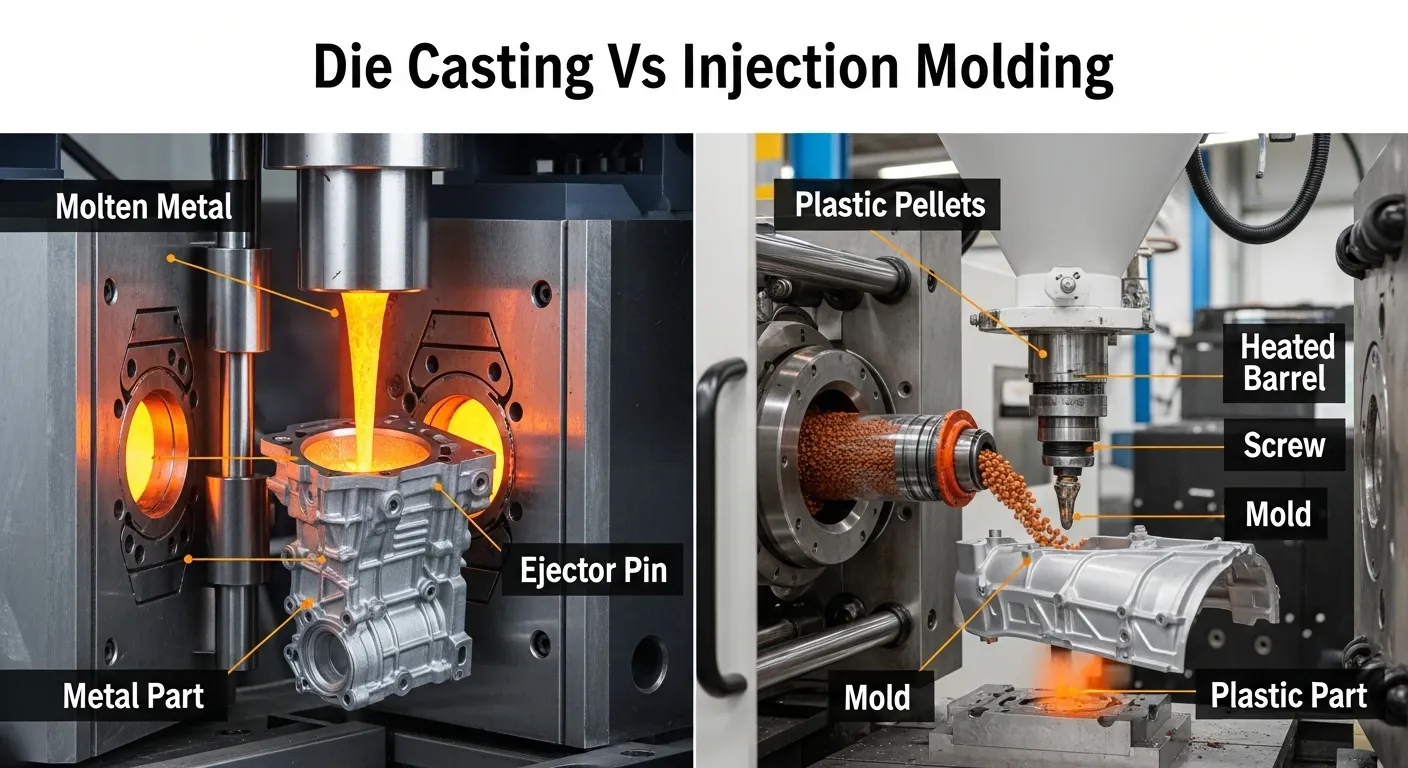
Die casting is one of the metal forming processes that utilizes high pressure to pour melted metal into an already hardened steel mold (die). The process allows outstanding dimensional accuracy, a high level of surface finish, and high structural integrity. Common materials include:
- Aluminum die casting
- Zinc die casting
- Magnesium die casting
Die casting at GD Prototyping can be used to accomplish rapid prototyping as well as large-scale production runs, therefore, delivering metal parts that are precise and of high quality to industry standards. Die casting is the best choice in the long-term production because of its expert tooling and die design, controlled cooling and solidification, and high quality standards.
What is Injection Molding?
Injection molding is a process of plastic molding in which a blend of melted material is placed in a mold, onto which the material is injected and allowed to solidify. This injection molding process uses thermoplastics, which provide favorable geometries and thin-wall parts and maintain small tolerances.
Common materials include:
- ABS plastic molding
- Polypropylene Injection Modeling.
- Engineering-grade thermoplastics
The injection molding excels at high-volume production, providing repeatability, scalability, and per-unit low-cost production when the tooling has been finished.
Differences in Tooling and Mold Design
Tooling has a definitive role in both processes. Differences in tooling and mold design affect the lifespan, cost, and economics of production.
Die Casting Tooling
- Durable moulds to be used in production.
- Aluminum inserts are capable of delivering 20,000 shots within a short time.
- Tooling of production is up to 100,000 shots.
- Multi-cavity molds increase the production per cycle.
Injection Molding Tooling
- Reduced the cost of initial tooling plastics.
- Superior shrinkage control.
- Uniformity of wall thickness of the flexible walls.
- Overmolding and multi-material designs are suitable.
At GD Prototyping, lead times are as brief as 1-2 weeks in the case of rapid tooling and reliability in the case of mass production in the use of production tooling.
Die Casting Vs Injection Molding Materials
Die Casting vs. Injection Molding Materials Injection molding materials are plastics that are remodeled in an injection molding process, meaning they are reshaped by heating and pressure. They are plastics that undergo remodeling in an injection molding process, or in other words, remodeled through heating, pressure, and pressure. The debate on die casting vs injection molding materials is very simple: metal and plastic.
Die Casting Materials
- Aluminum (lightweight, resistance to corrosion)
- Zinc (good surface finish)
- Magnesium (strength-to-weight ratio is high)
Injection Molding Materials
- ABS (impact resistance)
- Polypropylene (resistance to chemicals)
- Plastic design (thermal stability)
The selection is based on mechanical strength comparison, heat resistance, and the use requirements.
Comparison of Strength, Durability, and Performance
In the comparison between the advantages of die casting and injection molding, performance characteristics are important.
Die Casting Strength
- High-quality structural integrity.
- High wear resistance
- High-quality corrosion resistance.
- Strong thermal stability
Injection Molding Strength
- High impact resistance
- Lightweight components
- Design flexibility
- Reduced power usage per part.
Die casting tends to prevail in the case of automobile parts and aerospace components. Injection molding is more prevalent in consumer electronics housings and in medical device components.
Precision, Tolerances, and Surface Finish
Accurate production demands very thin margins and reliability.
- Die casting finishes are smooth metallic, and finishes are ready.
- The injection molding offers high quality of cosmetics.
- They both subscribe to dimensional accuracy at an industrial standard.
Die Casting General Tolerances
The real tolerances are based on geometry, material, shape of the mold, and casting conditions. Expectations are directed by the industry standards, except when stated to the contrary in design files.
Comparison of the Production Volumes
- Low-volume production: Quick- die casting tooling, injection molding.
- High-volume production: Both are good, but injection molding usually prevails in terms of cost per unit of plastic.
- Automation and repeatability are advantages of the mass production manufacturing techniques.
There is a significant efficiency improvement in multi-cavity molds as well as a unit cost reduction in both processes.
Die Casting Advantages
- The outstanding power and stamina.
- High-quality finish on the surface.
- Large consistency of production.
- Long-term mold lifespan
Minimized time wastage: Injection Molding minimizes time wastage because of its fast production speed. Reduced wastage of time: Injection Molding reduces time wastage due to its high rate of production.
- A broad assortment of plastics and processes that are stable and reliable.
- Distribution of complicated geometries and thin walls.
- Lower energy usage per part
Die Casting Applications
- Automotive parts
- Industrial machinery parts
- Aerospace components
- Heat-resistant housings
The Use of Injection Molding in the Industry
- Housing of consumer electronics.
- Medical device components
- Precision plastic parts
- Light structure elements.
In the case of die casting versus injection molding of automotive components, metal strength may give the final decision.
Tailor-Made Production and Selection of Suppliers
The decision of custom die casting or injection molding lies in the design of the parts, volume, and performance requirements. The suppliers of reliable die casting vs injection molding include design support, prototyping, finishing, and mass production under a single roof.
At GD Prototyping, full die casting is provided with:
- Mold design
- Prototyping
- Precision casting
- Finishing
Conclusion
There is no universal winner in the debate of Die casting Vs injection molding. Rather, the most optimal manufacturing procedure is based on the choice of materials, strength goals, cost goals, and quantities of production. Die casting is unsurpassable when you require high-strength metal parts of superior surface finish and production reliability for long-term usage. When your project requires lightweight plastic components, a flexible design, and a high volume of production at a low cost, then injection molding is the more intelligent option. The knowledge of the comparison of manufacturing processes enables superior decision-making, improved quality of products, and business success over the long term. Visit GD Prototyping.
