


Die Casting Prototypes | Custom Metal Prototype Solutions
Modern Day Precision Metal Solutions
Speed, precision, and reliability are needed in the dynamically changing world of manufacturing. Die casting prototypes have become a major solution for engineers and product designers who require quality metal parts within a short time. These models can be used to do functional testing, design verification, and test performance prior to investing in the full-scale production of the product, thus narrowing the gap between theory and actual production.
In GD Prototyping, we have been providing new casting prototypes that are both advanced in technology, high-quality materials, and quality workmanship to allow businesses to be more innovative and confident in faster innovations.
What Do Die Casting Prototypes Consist of?
A die casting prototype is a piece of metal that is formed by pressing the alloy of molten metal into a molding cavity made of steel under high pressure. This is in contrast to other traditional casting technologies, which only attain complex geometries, tight tolerances, and high surface finishes.
These pilot types are of great importance as they are used to copy the mechanical qualities of the end production parts so that the companies can test the strength, durability, and functionality of the parts in real-life situations.
The advantages of using die-cast prototypes are:
- Proper reproduction of production components.
- Complex geometries with no costly tooling.
- Floating surfaces to be used in functionality and aesthetics testing.
- Economical validation of small batch production or small volume runs.
Benefits
Creating a prototype through partnering with a service that provides custom die casting prototyping has several benefits compared to the conventional methods of prototyping:
Close Accuracy and Stability
Designers can now obtain fine tolerances and repeatable quality with the more advanced high-pressure die casting prototypes needed in automotive, aerospace, and other industrial equipment.
Capabilities of Functional Testing
Mechanical strength, thermal, and wear resistance can be tested using functional metal prototypes before the final production. This minimizes mistakes and expensive corrections.
Rapid Design Iterations
The high rate of die casting prototyping allows several iterations within a short cycle time, so that the engineers can optimize their designs without a huge initial investment.
Cost-Effectiveness
The minimal production of custom die casting prototypes in low volumes reduces the costs and yet produces high-quality and functional parts to be used in testing and validation.
Die Casting Hand-Lost Technologies
In the case of modern die casting prototypes, a range of high-precision processes is implemented, each being specific to the material, part geometries, and performance requirements.
Prototypes of High-Pressure
The process presses molten metal into steel molds under high pressure, forming dense, dimensionally accurate. It suits die casts of aluminum and zinc alloys with complicated features as prototypes.
Prototypes of Gravity
The molten metal enters the mold by gravity to form bigger parts that have uniform mechanical properties. This is mostly applied when large industrial and automotive components require low-volume production.
Hot Chamber Prototypes
Hot chamber die casting is perfect with zinc and magnesium alloys and enables a short cycle time and the ability to reproduce complex designs.
Prototypes for Cold Chamber
Applied to aluminum and copper alloys, cold chamber die casting results in less corrosion on the machinery and permits high-strength, heat-resistant components.
Prototypes of Vacuum Die Casting
It is a process that minimizes air entrapment and porosity, which leads to well-built prototypes that are of high quality. Die casting prototypes used in aerospace and medical devices can be done using vacuum die casting.
Machine Finishing and Surfacing
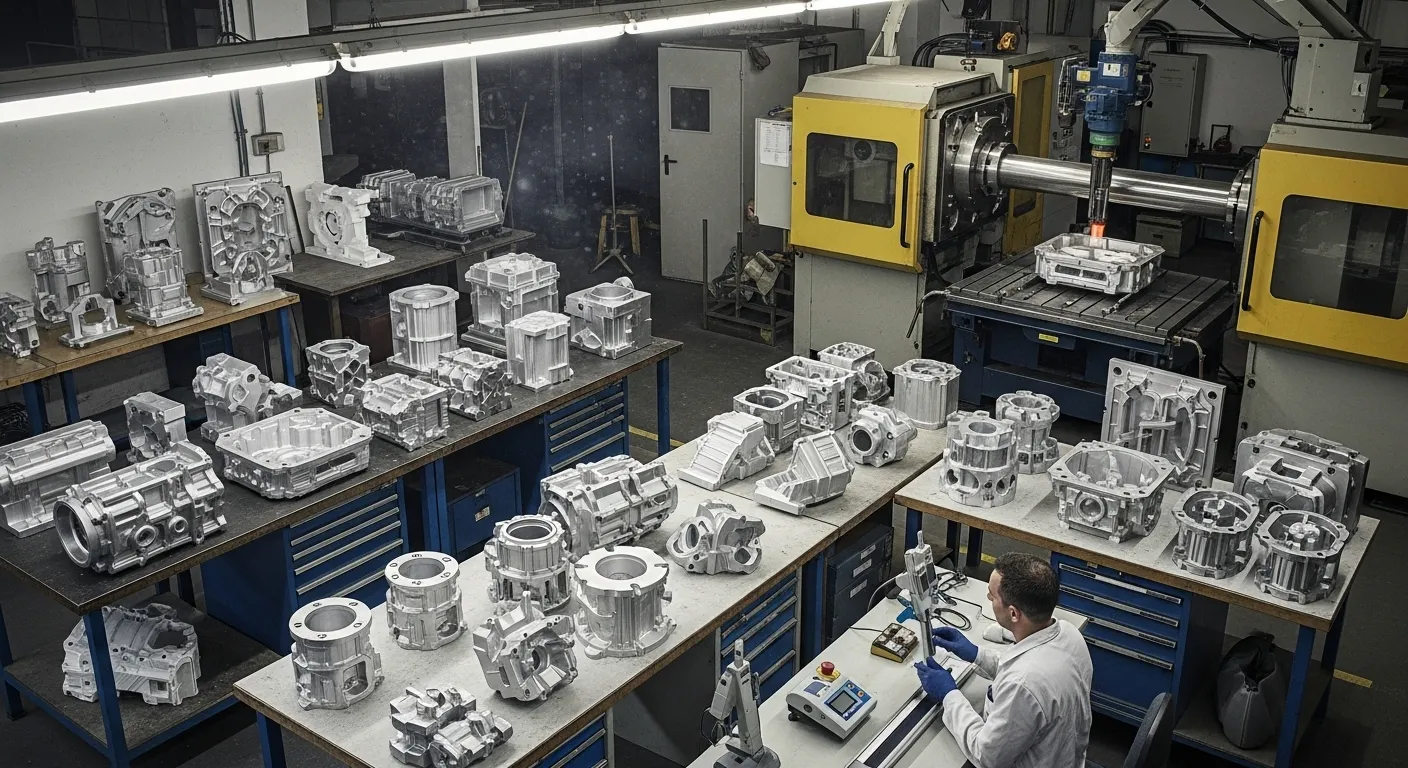
Once cast, prototypes may be subjected to CNC machining to achieve dimensional accuracy, and surface finishing processes can be done to polish, anodize, plate, or paint the prototype. Prototypes made of heat-treated die cast can also be used where strength or thermal resistance is of importance.
Materials
The selection of the appropriate material can be especially important to the functioning and the success of your prototype. At GD Prototyping, we offer:
- Die Castings are lightweight, strong, corrosion-resistant, automotive, aerospace, and consumer electronics.
- These are highly preferred in complex designs and detailed finishes on the surfaces and are mostly used in small mechanical parts and enclosures.
- Lightest, yet highly stiff prototypes are ideal in handheld electronics or aerospace parts.
- Conductive and thermally efficient, it should be used in electrical and energy processes.
- Versatile, non-corrosive, medical, industrial, and high-strength.
Such materials are used to support high-strength metal die cast prototypes, corrosion-resistant die cast prototypes, and lightweight die cast prototypes, enabling engineers to use the most suitable variant of each type.
Designing and Development of Die Casting Prototypes
Design and development are essential in the manufacture of high-quality die casting prototypes. GD Prototyping involves the integration of die casting mold prototype design, optimization of the process of casting, and prototype tooling and mold fabrication to provide accuracy, efficiency, and functionality.
Some of the important design and development processes are:
Die Casting of Products: The prototypes are checked to respond to the desired mechanical and functional requirements.
Functional Prototype Testing: Checking performance during operational requirements.
Design for Manufacturability (DFM) Die Casting: Making parts easier to make and with fewer defects.
Iteration and Validation of Prototypes: Rapid improvement of designs, depending on the results of the tests.
Rapid Die Casting Prototyping: Reducing the time-to-market without compromising on quality.
Such measures will ensure that the die casting prototype components are thoroughly tested before proceeding to full-scale production.
Applications
These prototypes are popular in the industries in terms of their versatility, accuracy, and reliability:
- Prototypes in Automotive Die Casting.
- Housing engine, brackets, and structural parts.
- Fuel-efficient and performance parts.
- Aircraft and defense system high-strength and lightweight components.
- Critical application, structural, and functional prototypes.
- Die-Cast Prototypes of Consumer Electronics.
- Heat-dissipating components, casings, and connectors.
- High-quality, wearable, and smartphone gadgets, as well as laptops, wearable electronics, and smartphones.
Die Cast Prototypes in Industrial Equipments
- Components of heavy-duty machines.
- Enclosures and housings of wear resistance.
- Die Prototypes of medical devices.
- Surgical instruments/medical devices: Biocompatible, highly accurate components.
- Die Cast Prototypes-Energy/ Electrical
- Housings, connectors, and enclosures: Conductive and long-lasting parts.
Why Use GD Prototyping to Prototype?
At GD Prototyping, we are in the business of providing custom die casting prototypes that provide a balance of speed, accuracy, and reliability. We have high capabilities such as:
- Complex geometry, high-dimensional accuracy.
- High-quality surface testing in terms of functionality and aesthetics.
- Large material selection, such as aluminum, zinc, and magnesium alloy.
- Quick product development cycles.
- Low-volume production cost-effective solutions.
- Scaleable production between prototype test and mass production.
Having over 30 years of experience in metal die cast prototypes, we have many parts that are functional, reliable, and ready to produce.
Conclusion
Die casting prototypes in contemporary manufacturing are essential in the verification of designs, performance optimization, and anticipating mass production. Through precision die casting of items, the use of superior materials, and skilled engineering, the enterprises can innovate faster and with less risk and cost.
In the automotive industry, aerospace industry, consumer electronics, medical instruments, or in industrial equipment, GD Prototyping has the skills, technology, and flexibility to make your idea a high-quality working prototype.
Discover our die casting prototype services now and realize your ideas in metal components with no apprehension or imprecision.
