


5 Trends Shaping Custom Plastic Parts Manufacturing in 2026
Manufacturing custom plastic parts isn't the only field experiencing disruptive changes. There's a shift occurring throughout the industry. The injections molding process manual practice and error methodology is changing toward data and AI-driven molding processes. The injection molding machine market is projected to grow between $7.4B and $14.6B by 2026. The global market of contract manufacturing is predicted to grow between $26.6B in 2025 and $35.8B in 2032. For engineers and designers staying abreast of shifts in the industry is required to maintain a competitive advantage. The following outlines lists the trends we can expect by 2026 and the supporting insights.
1. AI Automation of Plastic Workflows: Replacing the Outdated Manual Workflow
The use of artificial intelligence has moved from being a buzzword in the trade shows to being a core expectation in the making of custom plastic parts.
The industry is moving away from trial and error methods and towards AI systems which, in real-time, analyze the data of a workflow to suggest or automatically make the necessary adjustments.
In practice, this means the following:
• The real-time monitoring of parameters: AI systems are able to analyze over 1,000 parameters and flag data issues that would be impossible for a human to identify.
• The self-control of a workflow: The first of the autonomous injection molding cells are now functional and self-control the molding process to create parts of high quality and precision.
• The self-control of a workflow: The first of the autonomous injection molding cells are now functional and self-control the molding process to create parts of high quality and precision.
• Intelligent Maintenance: AI systems, through the analysis of data from workflow systems and machine learning, are able to predict the required parts and recommend maintenance before failure of the system occurs.
• Intelligent first-shot recommendations: AI has enabled the automation of the suggestion for the first-shot and the optimization of the Design of Experiments (DOE). This advanced technology has proven to reduce trial shots and increase yield to above 98% with minimal effort.
Setup times reduced, production quality more consistent, lower scrap rates. Not using AI equals falling behind competitors using these tools.
2. Digital Twins: Bridging the Gap Between Virtual and Real
Digital Twins are the newest and one of the most advanced form of tools used in custom plastic parts manufacturing – By year 2026, the variance between the virtual and the actual will be almost non-existent.
The future looks like this:
• Process Simulations Become Immersive: With the use of virtual reality, digital twins of injection molding machines are now more than just 2 dimensional drawings. Now, machine performance and optimizations can be viewed as a simulation of a smart factory.
• Manufacturing with Zero Defects: Integrated virtual models now combine automated separation of injection molded parts with a digital twin of the process and are used to detect manufacturing defects as they are happening.
• The Future of Digital Twin Simulations: How operators train, and the time it take to do so, is rapidly improved as virtual simulations of injection molding machines and their associated controls are used to teach operators the effects of control input in a simulated environment.
• Shrinkage and Warpage: Digital twin simulations of injection molding can incorporate advanced artificial intelligence to help predict changes to the material state and assist the designer choose the optimal state of the material to reduce defects.
For those in custom plastic part manufacturing, digital twins mean improved time to validate design improvements, reduced safety concerns for improving the manufacturing process, and reduced costs.
3. Sustainable Materials and Circular Manufacturing
More than any other factor, sustainability appears to be shaping the direction of innovation. Evolving technologies are resulting in new, more effective methods for recycling and the introduction of bio-based materials that are altering how we design and select materials for manufacture, as well as the manufacture itself.
What is changing?
• Bioplastics. Applications of bioplastics will expand. Innovation in sustainability will positively effect performance by 2026.
• Biobased materials: Production systems utilizing renewable resources (sugarcane, cornstarch, algae) will be more popular. These materials can satisfy demands for toughness, barrier protection, and thermal resistance of various applications. Some biobased materials demonstrate a potential to be produced and disposed (incinerated) with up to 91% less CO₂ than traditional plastics.
• Recyclate: Manufacturers are maximizing performance by directly injecting 30%-50% low-cost or recycled materials into their product cores.
Foam injection molding utilizing recyclates: A team can optimize haptics and design for recyclability while utilizing recyclate in a foam injection molding process that uses thermoplastics.
For the custom plastic parts manufacturing industry, new material options and new design considerations for recyclability are able to fulfill mounting environmental restrictions without sacrificing part performance.
4. Lightweighting and High-Performance Materials
Plastic parts need to be stronger, and lighter for more efficient performance. The custom plastic parts manufacturing industry is innovating to meet these changing demands. Weight, performance, and efficiency have become extremely important in the automotive, aerospace and consumer electronics industries.
Recent innovations:
• Microcellular Foaming Technology: This technology offers a one-step, scalable solution for manufacturing applications. It combines heat-and-cool molding and microcellular foaming, and results in premium surfaces, high-fidelity replication, and significant flow length and weight reductions.
• Structural Foam Injection Molding: This processes combines a thermoplastic resin and a foaming blowing agent. The result is a part with a solid, strong, light skin and a foamed core with no weight penalization.
• High-Performance Thermoplastics: Custom plastic components are replacing traditional metal parts and are becoming a significant part of the overall weight of modern vehicles.
• Multi-Materials Injection Molding: This technology provides the capability of molding multi-functional parts.
Lightweight plastic parts can change the pricing and create new opportunities in the market for things like electric vehicle battery casings and parts for the aerospace industry.
5. Smart Factory Integration and Industry 4.0
The factory of tomorrow will be completely automated and interlinked with a heavy dependence on data. By 2026, the custom plastic components industry will have integrated all previously separate technologies and robotic systems.
The key elements of a smart factory will include:
• IIoT platforms for real-time data: The Industrial Internet of Things (IIoT) will open platforms for real-time data, energy, and predictive maintenance that will monitor entire production lines.
• Flexible automation cells: Injection molding machines of any brand will be able to accept automation cells that can be adapted to the production line and added to as requirements change.
• Integrated robotic solutions: A modern injection molding system and a 6-axis or SCARA industrial robot will provide a complete system for molding and decorating in one step.
• Lights-out manufacturing: Rapid, lights-out changeovers will allow production to continue during unattended shifts.
Integration of smart factory technologies will give custom plastic parts manufacturers greater output, better quality, lower costs, and greater ability to meet changing customer requirements.
How GD Prototyping Connects to These Areas
At GD Prototyping these five areas are the basis of providing custom plastic parts manufacturing services daily.
• High-precision injection molding: We focus on custom injection molded prototypes and low-volume production runs with high precision, tight tolerances, and repetitive accuracy within complex design frameworks. We have the capability and technology to meet our customers' quality and production needs.
• Material flexibility at scale: We have the ability to process many different types of plastics, elastomers, and engineered resins (including biobased and other high-performance materials). This allows our customers a high range of material options tailored to their needs and application.
• Cost-Effective Prototyping: Our design methodology, consistent across both low and high volume production, leads to the most functional, production quality parts in the market.
• Rapid Response Time and Scalability: We offer a single prototype or low volume production across a variety of services in automotive, medical, consumer, aerospace, and electronic fields.
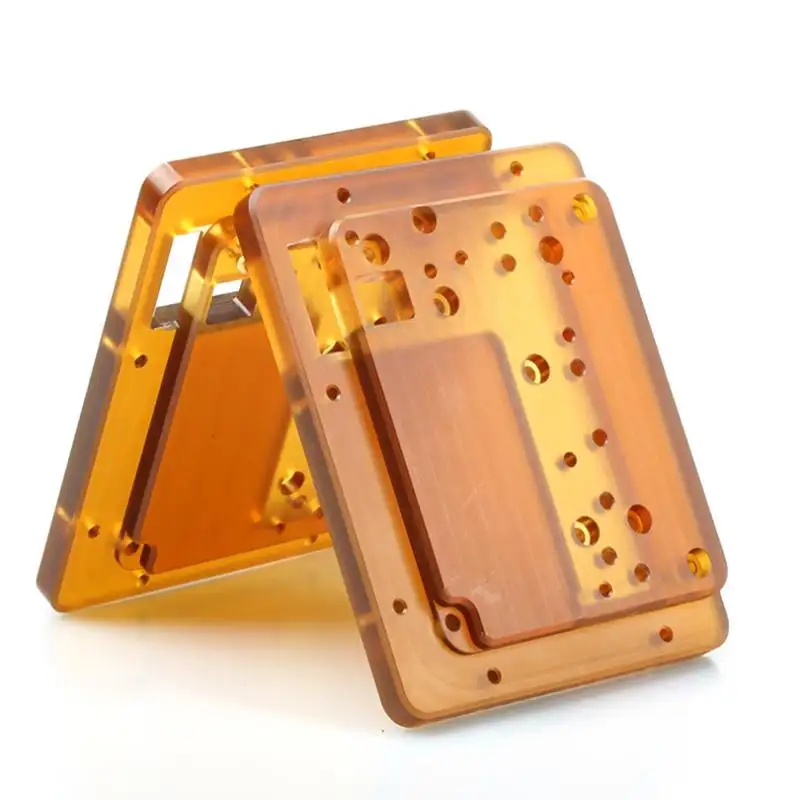
• Transparent and Optical Prototyping: There are many methods for making transparent and optical components. The production of optical components can be done using 3D printing, vacuum casting or CNC machining. For transparent components, we enhance the surface finish with coatings that are both anti-reflective and mirror finishes.
Closing Words
The future of manufacturing plastic parts will incorporate digital twins, smart factories, advanced lightweighting, and manufacturing with sustainable materials. The future of manufacturing will remove a lot of the unknowns regarding manufacturing and improve the design and manufacturing integration with further gains in efficiency and productivity. The companies that want to win the future will be the ones collaborating with the best manufacturing companies now, like GD Prototyping.
FAQs
Q1: What is custom plastic parts manufacturing?
A: This type of manufacturing produces plastic parts that are made to customer specifications, usually through one of several manufacturing processes like injection molding, CNC machining, or 3D printing.
Q2: What plastic manufacturing trends do you see for 2026?
A: Trends will likely include digitally-driven process control, digital twins, sustainable materials, smart factories, and lightweighting.
Q3: AI and injection molding. How are they related?
A: The use of AI in injection molding allows for the autonomous control and adjustment of parameters as well as the performing of predictive maintenance. This significantly decreases scrap rates and the number of defects.
Q4: Are sustainable plastics as good as the traditional ones?
A: A number of bio-based and recycling plastics are on par with or perform better than traditional plastics with regard to mechanical performance.
Q5: What fields use custom plastic the most?
A: The fields that use custom plastic the most are automotive, medical devices, consumer electronics, aerospace, and lighting.
