


Custom Medical Plastic Parts Manufacturing: How to Select Medical-Grade Polymers
Polymer selection in Custom Medical Plastic Parts Manufacturing is not simply a choice between PC, PP, PEEK, or another familiar material family. Two resins with the same polymer name may use different additives, colorants, fillers, processing aids, or stabilization systems.
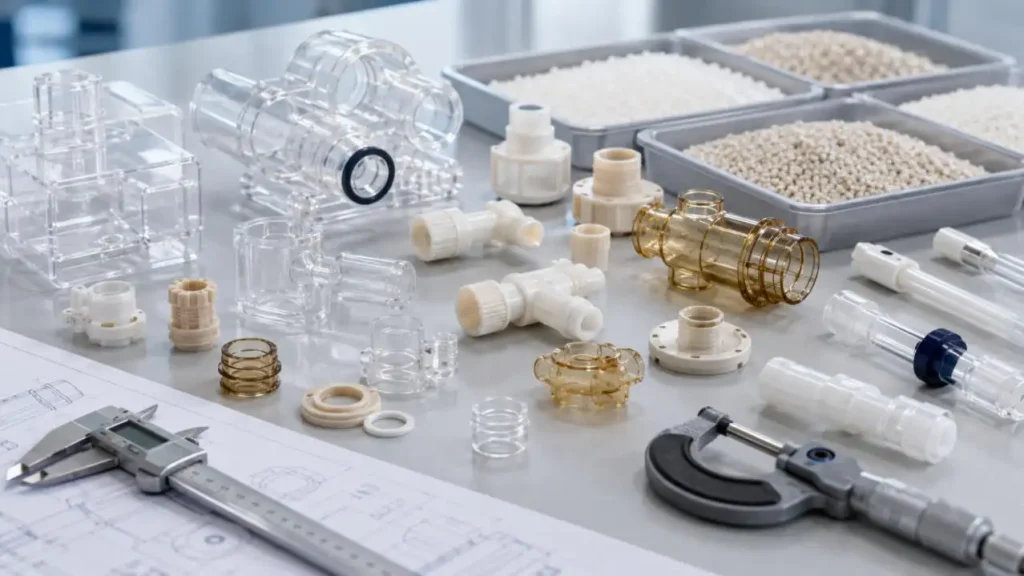
A material may perform well during initial assembly testing but discolor, become brittle, warp, or lose dimensional accuracy after steam, radiation, chemical cleaning, or repeated sterilization. For this reason, medical polymer selection must combine regulatory risk, functional performance, manufacturing behavior, sterilization compatibility, and documentation.
Selecting a polymer for custom medical plastic parts manufacturing begins with the device's body-contact conditions and sterilization method. Engineers should then compare mechanical strength, chemical resistance, dimensional stability, processing behavior, traceability, and grade-specific biocompatibility documentation before validating the final manufactured and sterilized component.
What Is "Medical-Grade Polymer"?
"Medical-grade" does not automatically mean "FDA-approved." Regulatory authorities evaluate the finished medical device according to its intended use, patient-contact category, processing history, cleaning, assembly, packaging, and sterilization.
A responsible material review should cover four levels:
| Review level | Information to confirm |
| Polymer family | PC, PP, PPSU, PEI, PEEK, POM, PA, TPE, or TPU |
| Exact resin grade | Manufacturer, grade number, color, filler, and reinforcement |
| Supplier documentation | TDS, SDS, CoC, ISO 10993 data, USP Class VI data, and change-control policy |
| Final-device validation | Machined or molded part after cleaning, assembly, packaging, and sterilization |
A healthcare-grade resin may have supporting biological evaluation data, but this does not automatically establish the biological safety of the final device. ISO 10993-1:2025 continues to place biological evaluation within the broader medical-device risk-management process.
Step 1: Define the Medical Application
Before selecting a polymer for Custom Medical Plastic Parts Manufacturing, engineers should define how the component will be used.
Some questions of interest are:
• Is this part in direct or indirect contact with the patient?
• Will this part come into contact with skin, mucosa, blood, tissues, fluids, drugs, or other potential pathways?
• Is the expected contact transient, short-term, long-term or permanent?
• Is the part disposable or reusable?
• How many cleaning and sterilization cycles is this part expected to endure?
Functional requirements should also be converted into measurable engineering values.
| Requirement | Data to specify |
| Mechanical performance | Impact, bending, fatigue, torque, and snap-fit cycles |
| Temperature | Operating, cleaning, storage, and sterilization temperatures |
| Chemical exposure | Alcohol, disinfectants, lipids, medication, and detergents |
| Optical performance | Transparency, color stability, and fluid visibility |
| Dimensional control | Holes, seal grooves, threads, fits, and GD&T |
| Production volume | Prototype, validation batch, low volume, or mass production |
Step 2: Compare Medical Polymer Families
No single polymer is suitable for every medical component.
| Polymer | Main advantages | Important limitations | Typical processes |
| Medical-grade PC | Transparent Impact resistant, dimensionally stable | Yellowness and cracks from stress and radiation need assessment | CNC machining, injection molding |
| Medical-grade PP | Cost-effective, low density, chemically resistant | Lower stiffness, dimensionally less stable | Injection molding |
| POM | Very low friction and wear resistant, precise | Grade and sterilization suitability need to be assessed | CNC machining, injection molding |
| PA/Nylon | Tough, strong, and wear resistant | Dimensions may change due to moisture absorption | CNC, SLS, MJF, molding |
| PPSU | Repeated steam and high impact resistant | Expensive, both material and processing costs | CNC machining, injection molding |
| PEI | Dimensions stable at high temperature. | Amber coloration, less compatibility | CNC machining, injection molding |
| PEEK | Very high strength, heat and chemical resistant | Very expensive, over specified in many cases | CNC machining, injection molding |
| Medical TPE/TPU | Overmolding applicable flexible, soft-touch | Compression set and extractables need assessment | Injection molding, overmolding |
Polycarbonate for Transparent Components
Some Healthcare-grade Polycarbonate can undergo Ethylene Oxide (EtO) and steam sterilization at 121°C. Melt Volume Rate of 19 cm³/10 min and shrinkage of 0.5–0.7% can be used for thin wall components.
Designers must evaluate the contacts of chemicals, imbedded stresses, radiation and/or E-beam induced color changes, severe mechanical loads, sharp edges, and optical transparency of the material for an extended period of time.
PPSU and PEI for Reusable Devices
Data for PPSU indicates that it should easily allow for repeated use in medical applications with a steam cycle of 134°C for 18 minutes. It should also allow for 100 cycles of Ethylene Oxide sterilization, 200 cycles of vaporized hydrogen peroxide, and a gamma exposure of 40 kGy.
PEI has a glass transition temperature of around 217 °C and excellent high temperature dimensional stability. PEI is typically more rigid, while PPSU is preferred when repeated steam sterilization is coupled with a need for impact toughness.
These supplier values are reference data. Actual components must be tested after processing, cleaning, assembly, and sterilization.
PEEK for Demanding Applications
Unfilled PEEK typically has a density near 1.30 g/cm³, a melting point around 343°C, a glass-transition temperature of approximately 143–150°C, a tensile modulus near 4,000 MPa, and yield strength around 98 MPa.
These properties support high-load, high-temperature, and chemically demanding parts. However, PEEK should not be the default choice for ordinary housings or low-load disposable components.
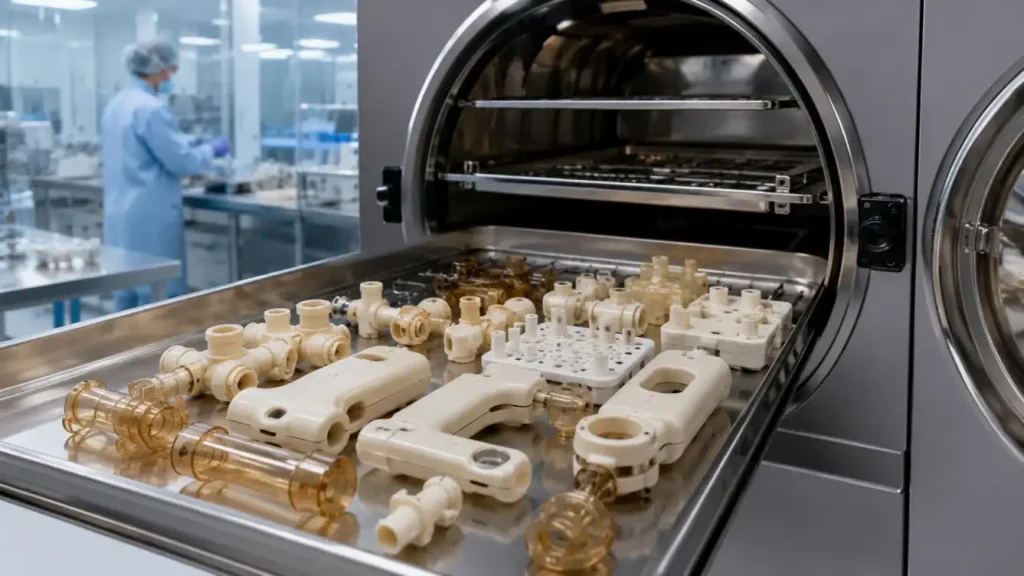
Step 3: Match the Polymer to Sterilization
Sterilization compatibility is central to Custom Medical Plastic Parts Manufacturing.
| Method | Main material concern |
| EtO | Residual absorption, aeration time, and packaging interaction |
| Steam | Hydrolysis, warpage, cracking, and dimensional change |
| Gamma | Yellowing, embrittlement, and impact-strength loss |
| E-beam | Dose distribution, color change, and mechanical degradation |
| VHP | Oxidation, surface change, and stress cracking |
The correct question is not simply whether a polymer "can be sterilized." Engineers must define temperature, dose, exposure time, cycle count, and the performance that must remain after treatment.
Step 4: Consider the Manufacturing Process
In Custom Medical Plastic Parts Manufacturing, material performance is influenced by machining, molding, drying, thermal history, additives, finishing, and sterilization.
CNC machining can create prototypes for testing and can also create features like seal grooves or threads. Dimensions on PC plastics can change if the heat and pressure during machining are not controlled.
GD Prototyping can do three-axis and five-axis machining on many engineering plastics. Their CNC machining can create parts with tolerances of ±0.05 mm and a surface finish of Ra 0.2 μm depending on the material and the geometry.
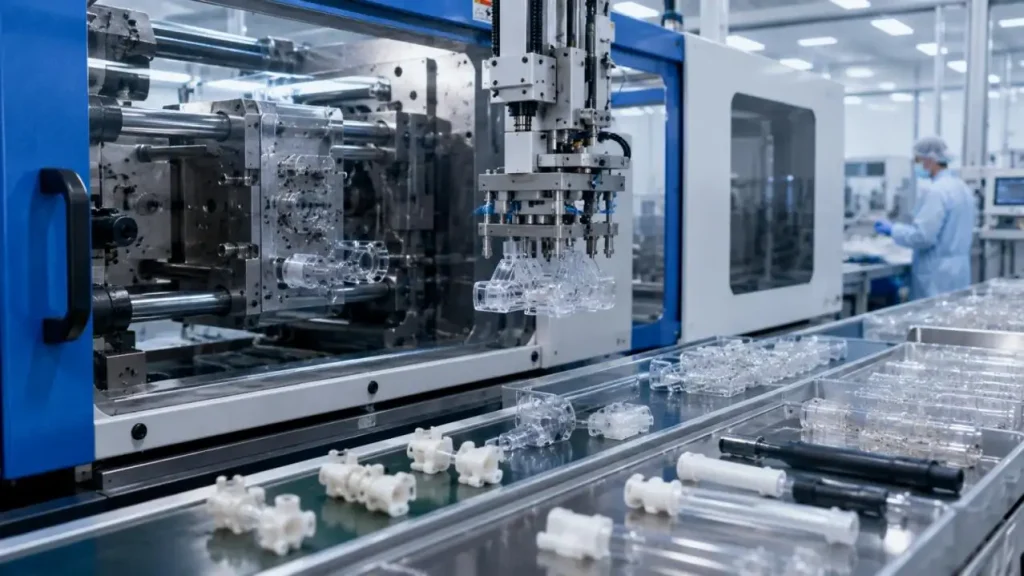
In injection molding, a stable design is when a part can be made in the thousands and the design can be considered final. Engineers will need to consider many factors to control the final part, like molding conditions, the design of the gate, the packing of the mold, and the control of the cooling rate.
For many techniques, like vacuum casting and SLA, SLS, and MJF, the limitations and dependence on prototype-grade plastics should be considered before using them for assembly and design validation.
Step 5: Confirm Documentation and Traceability
An RFQ should describe the final product in detail regarding:
• The grade of the resin and the manufacturer
• Reinforcements and additives
• Biocompatibility and sterilization with temperature and time exposure
• Critical measurements with the means of inspection
• Surface finish and optically clear requirements
• Quantity of prototypes and production units
• CoC with a traceability and material report
Common RFQ errors are to mention only "PC" or "PEEK," think that supplier test reports mean that the devices are approved, forget to consider severe and repeated sterilization, and have a large gap of tolerances for the prototypes and final products, ignoring dimensions changing due to thermal differences and mold design.
How GD Prototyping Supports Polymer Validation
GD Prototyping supports custom medical plastic parts manufacturing through CNC machining, 3D printing, vacuum casting, injection molding, DFM review, and low-volume production.
Its capabilities allow engineering teams to compare materials and production processes before committing to hard tooling. One-on-one project support, a target response time within 12 hours, an in-house machine shop, and 24/7 production scheduling can support projects from a single prototype to pilot production.
GD Prototyping does not replace the medical-device manufacturer's regulatory or biological-safety responsibilities. Instead, it can manufacture parts according to the specified resin grade, drawing, validation plan, inspection requirements, and traceability needs.
Closing Words
Successful custom medical plastic parts manufacturing requires the resin grade, sterilization method, manufacturing process, dimensional requirements, and validation strategy to be selected together.
Share your drawings, intended application, target polymer grade, sterilization method, critical tolerances, and required quantity with GD Prototyping. Its engineering team can review manufacturability, compare suitable prototyping and production processes, and help establish a practical path toward low-volume validation and larger-scale manufacturing.
FAQs
Q1. What engineering plastics does GD Prototyping offer for medical use?
GD Prototyping works with a number of engineering plastics including PC, PP, POM, PA6/PA66, PTFE, PEEK, PPS, PEI, PVDF, HDPE, UHMWPE, and glass-fiber reinforced polymers. When placing an order, customers should fully describe the material by specifying the resin manufacturer, grade, color, filler, and all associated required documentation.
Q2. Does GD Prototyping offer Custom Medical Plastic Parts Manufacturing?
Absolutely. GD Prototyping offers Custom Medical Plastic Parts Manufacturing via CNC machining, injection molding, 3D printing, and vacuum casting. Each of these techniques can be utilized for design verification, functional prototypes, and low-volume validation production. Additionally, these techniques can be used for the later stages of production based on the materials selected and requirements of the project.
Q3. Will GD Prototyping suggest a medical-grade polymer?
GD Prototyping can provide feedback on requirements for manufacturability based on the part geometry, operating conditions, exposure to sterilization and chemicals, tolerance levels, and quantity to be produced. However, the final selection and qualification of the medical grade polymer rests with the medical device manufacturer.
Q4. What should be included in an RFQ for medical plastic parts?
An RFQ should include 2D drawings and 3D CAD files, resin, quantity, critical tolerances, surface finish, sterilization method, type of exposure to chemicals, inspection and testing requirements, and any required documents regarding the material. If applicable, the RFQ should also include body-contact conditions and the number of expected use cycles.
Q5. What are the CNC tolerances for medical plastic parts from GD Prototyping?
For suitable conditions GD Prototyping mentions definable CNC machining capabilities down to ±0.05 mm and surface roughness of Ra 0.2 μm. Actual CNC machining tolerances for medical plastic parts are affected by the choice of polymer, part geometry, wall thickness, the position of features, moisture absorption, and thermal expansion. It is also relevant to consider the metrology technique when determining CNC machining tolerances.
