


Consumer Electronics 3D Prototypes | Rapid 3D Printing
What are the 3D Prototypes of Consumer Electronics?
- Consumer electronics 3D prototypes are physical models representing electronic products in the development process, which are made with additive manufacturing. These prototypes can be low-tech proof-of-concept or more advanced electronics prototypes that contain PCBs, wiring, sensors, and user interfaces.
- The consumer electronics prototypes may be produced by 3D printing directly off of CAD files, unlike in traditional manufacturing, where molds and tooling are costly and, in many cases, not reusable. The method enables designers to work with form, fit, and functionality early in the development process. It also encourages quicker decision-making as well as more sophisticated end products.
Key Advantages Include:
- Accelerated learning schedules.
- Lower upfront costs
- Improved design accuracy
- More flexibility in customization.
Why Rapid Prototyping is Critical to Consumer Electronics
Consumer electronics Rapid prototyping Rapid prototyping applies digital technologies in the design and manufacture of prototypes in a fast and efficient way. Through CAD software and automated fabrication, engineers can quickly convert digital ideas to physical parts in a few days rather than weeks or months.
- One of the essential motives of this process is 3D printing, which eliminates the use of molds or complicated machining arrangements. This radically reduces lead times and allows repeated cycles of product improvement and refinement without a corresponding cost or time increase.
- The idea of rapid prototyping at GD Prototyping makes the initial stage of the development process simple, as it provides teams with the ability to check on functionality, test out ergonomics, and carry out real-world testing prior to having to commit to mass production.
Rapid Prototyping Service of Electronics 3D Printing
An electronics development needs unparalleled flexibility, which is provided by a professional 3D printing rapid prototyping service. Designers can produce complicated forms, elaborate enclosures, and finer internal designs which would have been quite hard -or impossible- to accomplish through traditional production.
Supported Technologies
The consumer electronics 3d prototypes products are based on several sophisticated 3D printing technologies:
- SLA (Stereo lithography): It is well-suited to electronics prototyping with smooth surface finishes.
- SLS (Selective Laser Sintering): The perfect choice in high strength impact resistant electronic casings.
- DMLS (Direct Metal Laser Sintering): This is utilized in metal components, heat sinks, and structural components.
- FDM (Fused Deposition Modeling): Low-cost and rapid at the early stage of electronics prototyping.
Technical Specifications
- Layer Resolution: 25-200 microns (process-dependent)
- Tolerance: +-0.1 mm to +-0.3 mm
- Supported Materials: Plastics, resins, composites, metals.
- Volume of Build: 1000 mm (depending on the material)
- Final Finish: Sanding, painting, polishing, plating, and anodizing.
The abilities allow prototype production of electronics to be both accurate and scaled down.
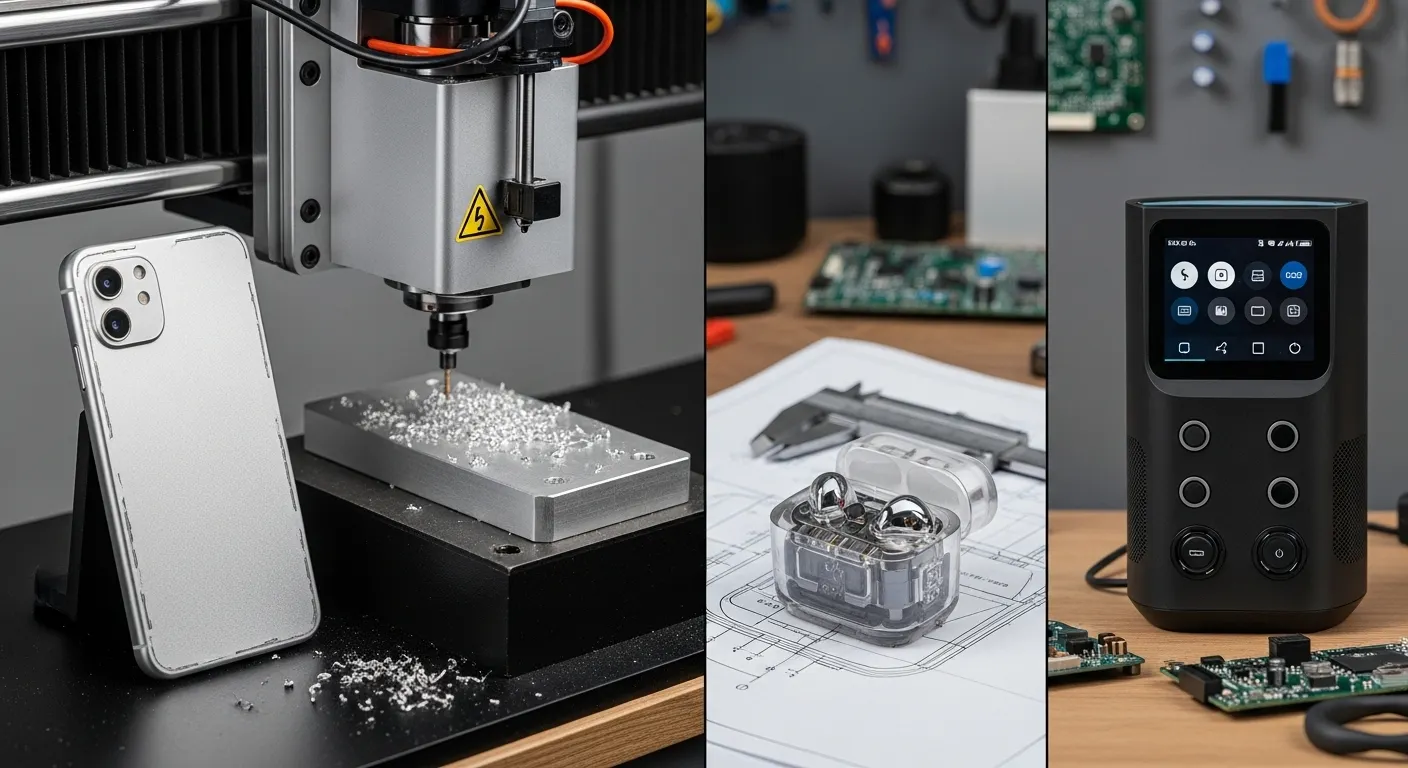
PCB Housing and Electronics Prototyping 3D Printing
Enclosure development is one of the most important designs prototyping of electronic products. An improperly designed enclosure may affect the usability, heat dissipation, EMI shield, and performance in general.
Electronics enclosure prototyping enables the designer to test:
- Ergonomics and user comfort
- Component fit and alignment
- Ventilation and thermal behavior.
- Disassembling and assembly processes.
PCB housing 3D printing, the layouts of internal parts can be easily changed to fit design alterations. This aids the testing of design validation models of electronics, whereby PCBs, connectors, and mounting features are all accurate even before final agreement on the production tooling is reached.
Material and Performance Concerns
The choice of material is a crucial component of the development of working electronics prototypes. Developed additive manufacturing promotes a multifarious performance-based material.
Common Material Options
- Heat-resistant electronic prototype materials are used in high temperatures.
- Portable devices Lightweight plastic enclosures of electronics.
- Durability testing of the prototype enclosure is impact-resistant.
- Electronic plastics are to be flame-resistant to achieve safety standards.
- Electronic enclosures to reduce interference are EMI safe.
These materials are used in combination with full-scale surface finish prototypes to allow functional testing and presentable models.
Multi-Material and Ultra-Precision Electronics Prototyping
Current additive manufacturing of electronics aids in multi-material electronics prototyping, where flexible components, rigid housing, and clear parts can be printed in one assembly.
This approach enhances:
- Functional integration
- Realistic user testing
- Rapid hardware iteration
Electronics 3D printing can also have high precision to guarantee tight tolerances, important in compact consumer devices, as millimeters count.
Proof of Concept to Pre-Production
Prototypes used in the development of a product are proof-of-concept prototypes that are used to verify core concepts early, whereas pre-production prototypes are used to bridge the gap between development and manufacturing.
This transition always involves:
- Design-manufacturing (DFM) electronics analysis.
- Electronics prototype production for low volume.
- Assembling and testing functionality.
- Design validation, which is market-ready.
Bridge manufacturing of electronics products allows small printing of products using 3D printing, and then full-scale tooling is implemented afterward.
Uses of Consumer Electronics 3D Prototypes
- Smart Devices and IoT
IoT consumer device prototyping and smart device 3D printed prototyping enable quick testing of the connection, sensors, and casings.
- Wearable’s
The prototyping of wearable electronics emphasizes ergonomics, weight reduction, and durability, which means that 3D printing is just the solution.
- Audiovisual Electronics
Since 3D printed prototyping is used in audio devices such as headphones and speakers, electronics prototyping can also be done in 3D printing, which allows acoustical testing and cosmetic finishing.
- Home and Smart Appliances
Rapid enclosure prototyping and enclosure prototyping Rapid enclosure prototyping and functional integration are helpful in home appliance electronics prototyping and smart home electronics prototyping.
- Mobile Accessories
Cases, mounts, and charging solutions can enter the market very quickly with mobile accessory 3D prototypes.
Electronics Workflow CAD-to-Prototype
CAD-to-prototype electronics workflow simplifies the development process through the connection of the digital design to the fabrication. CAD software can be modified and printed within hours, which allows the application of continuous improvement and feedback.
This technique of digital fabrication aids:
- Rapid product development in consumer electronics.
- Reduced material waste
- Better coordination among groups.
Why Use Professional Consumer Device Prototyping Services
The combination of an experienced consumer device prototyping services provider is accurate, fast, and scalable. Not only is printing provided, but also engineering expertise, material experience, and finish choices are provided by a professional electronics prototype service provider.
Advanced equipment, professional guidance, and the services of end-to-end electronics product development all assist in fast turnaround electronics prototypes at GD Prototyping.
Conclusion
The consumer electronics 3d prototypes have relegated the way products are imagined, tested, and introduced. Companies can now afford to be creative and competitive by integrating fast-electronics prototype production, high-quality materials, and high-precision 3D printing technologies. Bringing wearable electronics, IoT products, or the next wave of smart products to life? Custom 3D printing of electronics will give you the flexibility and speed to thrive in the current challenging market. Visit GD Prototyping.
