


Composite 3D Printed Prototypes | Lightweight & Custom Solutions
What are Composite 3D Printed Prototypes?
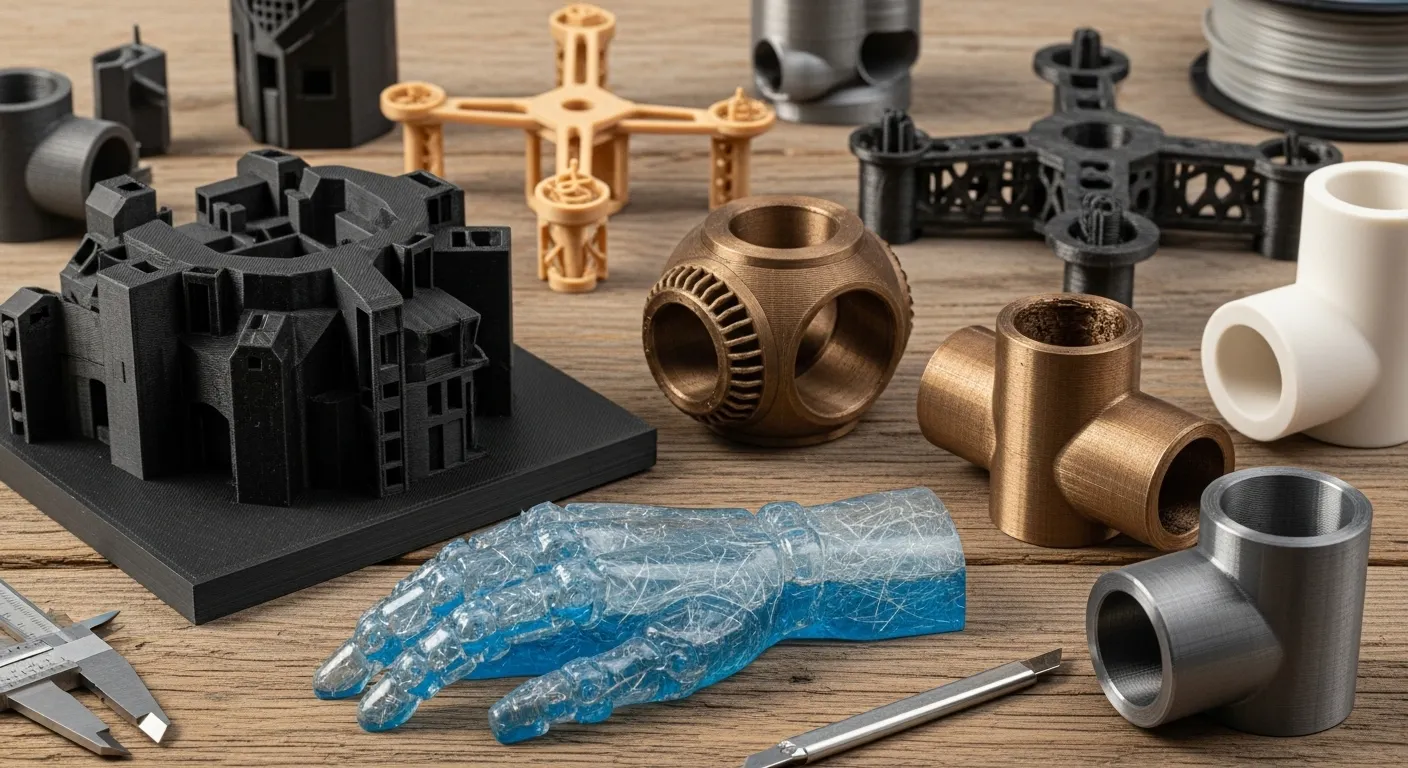
Composite 3D printed prototypes are composite additive-manufactured parts, which may include carbon fiber reinforced polymer (CFRP), Kevlar, or glass fiber material. They can be constructed in layers, such as the traditional manufacturing, to enable the creation of complex geometry composite 3D printing designs that would have been otherwise impossible or expensive to manufacture through conventional machining.
Using 3D printing with thermoplastic composite and multi-material printing of composites, engineers are able to design prototypes that are more than just lightweight and strong, yet highly functional, which makes it possible to test mechanical characteristics and structural integrity of the product and verify the design early on.
Benefits of Composite 3D Printed Prototypes
The composite 3D printed prototypes have many advantages compared to the traditional approaches to prototyping:
High-Strength Performance:
Fiber-reinforced 3D printed components will provide the prototypes with high tensile strength, impact resistance, and durability, meaning that they can be used in actual performance.
Lightweight Components:
Lightweight composite 3D printed prototypes are offered by materials such as carbon fiber 3D printing prototypes. These are lightweight components that are useful in aerospace and automobile applications where weight savings are paramount.
Complex Geometry Capability:
Topology-optimized composite 3D prototypes may include complex internal lattices, hollow components, and integrated components that can simplify the process of assembling the prototype.
Rapid Prototyping:
Rapid prototyping of composite material will speed up the development cycles of products and enable numerous cycles to be made without the expensive tooling transitions.
Cost Efficiency:
Cost-efficient composite 3D printed samples save material waste and manpower, more so in low-volume or custom manufacturing batches.
Adjustable Material Characteristics:
With the choice of particular fibers, resins, or polymer blends, designers can generate high-performance 3D printed composite materials to meet particular mechanical, thermal, or chemical needs.
Materials
The selection of a suitable material is an important step towards maximizing performance. GD Prototyping deals with numerous high-performance thermoplastic composites and fiber-reinforced polymers:
Carbon Fiber Reinforced Polymer (CFRP): CFRP is ideal in aerospace and automotive composite 3D prototyping, offering lightweight and high tensile strength.
Glass Fiber 3D Printed Prototypes: Provides strength and dimensional stability of industrial machinery composite 3D components.
Kevlar-Reinforced 3D Printed Parts: Impact resistance of UAV and drone composite 3D prototypes.
High-Temperature Composite 3D Printed Components: Thermal stress resistance to aerospace or automotive.
Lightweight Polymer Composite Prototypes: inexpensive and easy to use as a method to prototype and test quickly and easily.
Uses of the Composite 3D Printed Prototypes
Several industries are changing their prototyping approaches and using composite 3D printed models to offer functional, lightweight, and highly precise components:
Aerospace
Aerospace composite prototypes 3D printing allows engineers to test flight-ready products, including airframes, UAV components, and satellite structures, using aerospace-grade 3D printed composites that have great strength-to-weight ratios.
Automotive
Automotive composite 3D models save weight of the vehicles without compromising on the safety and durability, and are ideal in engine parts, chassis parts, and custom panels.
Industrial Machinery
The 3D parts made of industrial machinery enable the quick manufacture of useful prototypes of the equipment that can be assembled, and their tooling and mechanical testing.
UAV and Drones
UAV and drone composite 3D prototypes, Lightweight Continuous fiber 3D printing prototypes. UAV and drone composite 3D prototypes are the best in terms of flight performance and endurance.
Medical Devices
The prototypes of medical devices manufactured by composite 3D printing allow the production of anatomical, lightweight, and sterilizable surgical tools, prosthetics, and orthotics.
Robotics
The 3D printed components of robotics are advantageous due to a lightweight yet high-performance design, allowing for the lack of waste of space on the robotic arm, frame, and structural support.
Design and Engineering Issues
To create good composite 3D print prototypes, one needs to know material behavior and process constraints:
Complex Geometry Composite 3D Printing: Enables complex structures such as internal lattices and conformal structures.
Thin-Wall 3D Printed Prototypes: Designed with a high degree of weight minimization and structural integrity.
Dimensional Accuracy of Composite 3D Printing: Essential to functional testing and assembly.
Topology-Optimized Composite 3D Prototypes: The prototypes are less weighty and use less material, and the performance remains the same.
CAD-to-Print Workflow of Composite Prototypes: This allows design iteration and manufacturing accuracy to be improved.
Quality and Compliance
Our ISO-qualified 3D printed composite prototypes and 3D printed parts that are flight-ready are subject to intense tests, such as non-destructive testing (NDT) to identify conformity with industry standards. This ensures that it is a high-performance composite 3D part that can be applied in aerospace, automotive, and medical applications.
Incorporation of Metal Materials 3D Printing
We also offer 3D printing services of metal materials to enhance your prototypes, in case you need them. Through metal 3D printing, stable prototypes and final components are also possible in stainless steel, titanium, aluminum, Inconel, and cobalt chrome. The fabrication by layer-by-layer produces high-strength, temperature-resistant, and corrosion-resistant components, which find use in hybrid prototyping, in which composite and metal components are used together.
Advantages include:
- Complex geometry support and lattice support.
- Few-volume manufacturing without expensive molds.
- Additional post-processing facilities such as heat treatment, machining, and surface smoothing.
- Industries in aerospace, automotive, robotics, medical devices, and consumer electronics.
Through integrating composite 3D printed prototypes with metal materials, 3D printing, engineers can attain high ratios of weights and strengths and functional performance in highly developed product development.
Commercial and Buyer Benefits
By using GD Prototyping as the 3D printing service provider of your composite, you can get several advantages:
On-Demand Composite 3D Printing: Fast prototyping of rapid iterations.
Custom 3D Prototyping Services Composite: Custom-designed to meet your needs and design.
Local, Accessible, Responsive 3D Printing: Composite 3D printing near me.
Low-Cost 3D Printed Prototypes: Reduce the cost of tooling and material.
High-Strength and Lightweight Components: optimized to be used in the aerospace, automotive, and robotics industries.
Conclusion
Lightweight high-strength composite 3D printed prototypes offer a game-changing answer to product development, which integrates lightweight additive manufacturing with high-strength materials. GD Prototyping offers ISO-certified, flight-ready, and high-performance aerospace composite 3D parts, all with Islamic bonding to meet business requirements.
Need 3D prototyping of composite materials quickly, machining of 3D printed materials that are fiber reinforced, or prototyping of components with a hybrid of metals and composite? We can deliver the solution correctly, consistently, and at the lowest cost. Examine our solutions at GD Prototyping and make your innovative designs come true.
