


Automotive Prototype Manufacturing | Car Prototype & Design Services
The Introduction of Automobile Prototype Production
In the modern, fast-changing automotive industry, automotive prototype manufacturing is a very imperative factor in the intermediation between the concept design and mass production. Prototyping can be used to verify designs, material testing, and performance of autonomous car components, whether it is a next-generation electric vehicle (EV) or car optimization, before a large-scale production commences.
The use of new technology in the modern automotive prototyping services, such as CNC machining, 3D printing, sheet metal fabrication, and injection molding, is to provide the automotive prototypes to be functional and meet the stringent requirements of performance, safety, and design innovation.
In GD Prototypes, we are focused on offering end-to-end automotive prototype manufacturing solutions where companies are able to implement design ideas to fully operational and production-ready parts.
Automotive Prototyping Process
Automotive prototyping is a multi-process workflow, a highly organized process, which converts an idea of a vehicle into a physical prototype that can be tested and validated. It typically includes:
Concept Development: The process begins with a vehicle concept design, and engineers make use of CAD modeling on automotive design and CAE simulation on the prediction of performance and feasibility.
Prototype Design: Detailed designs are developed, improved, and tested through the product design iteration cycles and reverse engineering, where needed.
Fabrication: CNC machining, additive manufacturing, and vacuum casting are some of the methods that engineers have used to create functional prototype parts that are highly dependent on dimensional accuracy.
Testing & Validation: All components are subjected to fit, form, and functionality tests, aerodynamic tests, and structural integrity tests to ensure that the prototype is up to the demands of the actual environment.
Through a design-to-manufacturing process, manufacturers will now have the design accurately projected to the end production, as well as the engineering intent.
Technologies in the Manufacture of Automotive Prototyping
CNC Machining of Precision Auto Parts
CNC machining is one of the most accurate and repeatable processes for producing metal and plastic parts of an automotive prototype. Multi-axis machining enables the production of complicated shapes that are applied in engine housings, chassis structures, and interior trims.
Such materials as aluminum, steel, and ABS are machined with high tolerances and high-quality surface finishes - essential during fitment testing and validation of functionality.
Car Additive Manufacturing (3D Printing) of Parts
Automotive prototyping is a process of innovation that can be fastened with 3D printing, which is able to manufacture parts that are used in the design in a short period. Technologies such as:
- Fit testing SLA resin 3D printing (aesthetic design)
- SLS printing (durable and heat-resistant) nylon.
- Lightweight and high-strength parts, Metal sintering (SLM)
These enable the development of car prototypes at an unprecedented speed. Engineers are able to manufacture EV battery housings, dashboard models, and aerodynamic items without tooling delays.
Automobile Prototyping, Sheet Metal
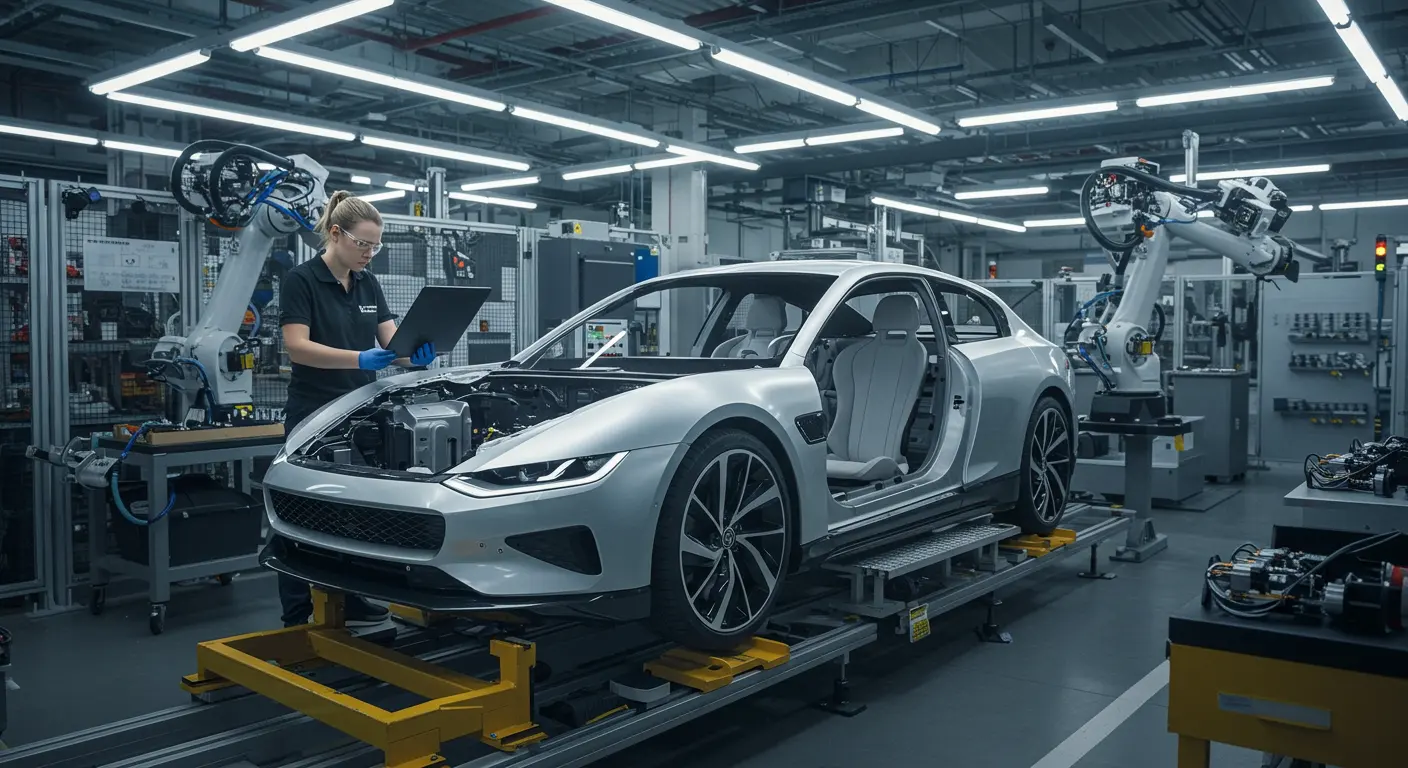
In the manufacturing of vehicle body panels, chassis, or mounting brackets, sheet metal automotive prototyping is durable and functional in the real world. Laser cutting, bending, and welding together can give the engineers a chance to develop steel or aluminum car prototype parts that replicate the final production.
This is a technique that favors low-volume prototype manufacturing, which enables the manufacturer to evaluate assembly fit and crash behavior before scaling.
Automobile Part Injection Molding
In the case of plastic automotive prototype work, injection molding can provide cost cost-effective means of creating parts such as interior trims, lighting housings, switch panels, and vent covers.
Having fast tooling of automotive parts, manufacturers attain short lead times, accurate material efficiency, and cost savings in the course of R&D.
Some of the common polymeric materials include ABS, nylon, and polyurethane, which are lightweight and durable.
Vacuum Casting in Low-Volume Production
Polyurethane vacuum cast prototypes can be used to create automotive prototype designs, especially in design verification, ergonomic testing, and aesthetic testing. This process is used to imitate injection-molded finishes at a very small fraction of the price - ideal on low-volume orders or marketing samples.
Design and Engineering of Prototyping in the Automobile Industry
A car prototype is not only the process of designing parts but also the process of validating design, performance, and user experience. Simulation and prototype optimization are used by engineers to increase the safety, comfort, and manufacturability.
CAD/CAM integration helps them in analyzing stress distribution, thermal performance, and aerodynamic behavior, and ensures that every prototype is of a high automotive standard.
The technology of digital twin and AI-assisted automotive design has become transformative and allows for validation virtually before the creation of physical prototypes.
Prototype Testing and Verification
All automotive prototypes are subjected to:
- Function testing, fit, and form testing.
- Aerodynamic evaluation
- Durability test and fatigue test.
- Aircraft Vibration Analysis.
- Environmental testing and thermal testing.
This guarantees verification of designs, quality control, as well as the ability to adhere to the ISO certified automobile manufacturing standards.
Car Prototyping
The companies of automotive prototyping have multiple applications:
- Prototypical manufacturing of electric vehicle batteries, powertrain, and cooling.
- Sensors, enclosure fabrication, and control unit fabrication: A prototype of autonomous vehicles.
- Dashboard, trims, and seat interior component prototyping.
- Hall lights and taillights. Exterior lighting prototype production.
- Testing ride dynamic prototypes of chassis and suspension.
They are used to speed up R&D development in the automotive industry, and these prototypes allow the companies to save on time-to-market and deliver high quality.
Automotive Prototype Manufacturing Factors on Cost
The automotive prototype cost is dependent on:
- Type of material (metal or plastic)
- Product process (manufacturing, assembling, and packaging)
- Surface finishing and complexity of design.
- Quantity (single or low-volume batch)
- Validation and testing requirements.
In GD Prototypes, we provide clear quotes in the automotive prototyping business, so that you will get the best value on the R&D budgets.
Why Choose GD Prototypes?
Being a professional automotive prototype company, GD Prototypes provides:
- Automotive prototype parts of high quality.
- Quick automotive prototyping response.
- Additive manufacturing and precision CNC machining.
- Professional concept validation.
- Low-volume, low-cost production.
We are your prototype developmental partner, whereby we offer a smooth transition between design and manufacture with tight tolerance machining, ISO-certified process, and lean production technology.
Conclusion
Innovation in current vehicle design is based on automotive prototype manufacturing. It allows engineers to simulate, test, and streamline all the components before mass production. The adoption of technologies, including CNC machining, 3D printing, and rapid tooling, can help a company to gain rapid turnaround, cost reductions, and design perfection. At GD Prototypes, we convert your automotive visions into real-life works- concept modeling, testing of functional prototype, and every single part will match your performance, quality, as well as cost expectations.
