


Automotive Injection Molding Prototypes | Rapid Prototyping
What are the Prototypes of Automotive Injection Molding?
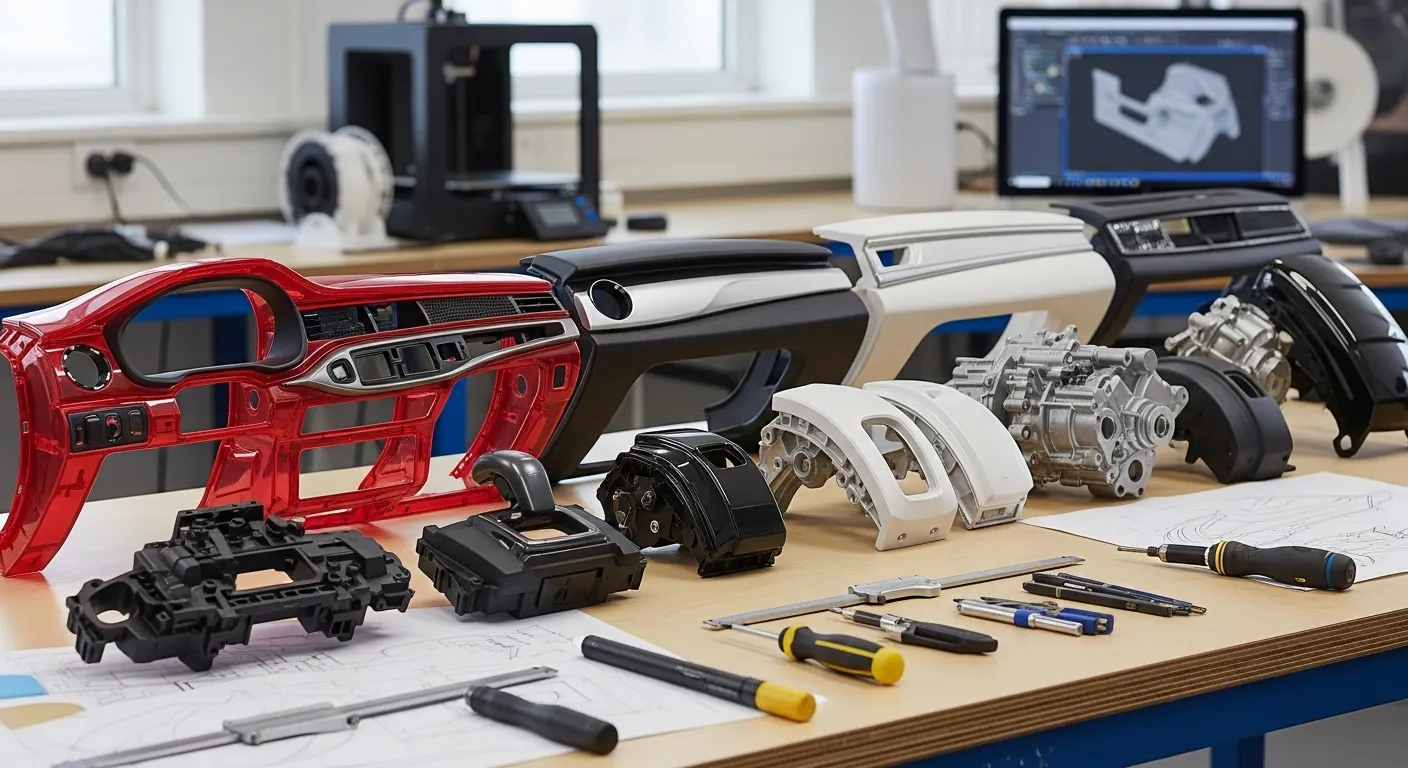
Physical prototypes, injection molding prototypes are Automotive injection molding prototypes physical components produced to test, validate, and iterate designs. These prototypes are not to be used like normal production parts, and are mostly aimed at:
- Mechanical and structural property functional testing.
- Validity of fit, form, and assembly.
- Surface finish inspection and aesthetic inspection.
- Quick design development to enhance design efficiency.
Auto prototype injection molding enables the manufacturer to produce production-grade parts in mini-batches without spending money on costly tools or mass production. This method means that the designers will be able to test the high-precision automotive prototyping in a real-life situation and eliminate the chances of making expensive mistakes when full-scale production is involved.
Automobile Injection Molding Prototypes Technology
Designing an effective automotive molded prototype component is based on advanced production technologies and materials. We believe that the traditional and modern methods work together to create a prototype both functional and visual at GD Prototyping.
Injection Molding Process
Injection molding is a process of making automotive prototypes by injecting the thermoplastic material that is in molten form into a molding cavity that cools down and solidifies to the required shape. Key aspects include:
- Automobile prototype tooling.
- Optimized flow Gate and runner system design.
- Optimization of cycle time to enhance faster throughput.
- To become familiar with material performance, Mold flow analysis.
Clear-Cutting-Edge Rapid Prototyping
In cases where visual clarity or aesthetic inspection of the application is needed, transparent rapid prototyping is essential. Our capabilities include:
Materials: Acrylic (PMMA), polycarbonate (PC), ABS-like transparent resins, silicone-based casting materials.
Technologies: 3D printing, CNC machining, vacuum casting.
Tolerance: +-0.05 mm based on process and size of parts.
Finishes on the Surface: polishing, vapor smoothing, UV coating to promote better clarity.
Single Prototype to Small Batch Production: Batch capability.
These processes enable transparent automotive parts, light guides, display covers, and practical aesthetic prototypes to be made in terms of interior or exterior testing.
Automobile Injection Molding Prototypes Materials
The selection of materials is a very important factor in the functionality and strength of automotive prototypes. GD Prototyping employs various thermoplastics in auto-grade materials to fulfill high-performance specifications:
ABS and Polycarbonate Automotive Prototypes: Light, impact-resistant, heat-tolerant.
Polymer Injection Molding: High-performance: Structural and mechanical testing.
Heat-Resistant Tape Prototype Llastics: These are perfect for engine parts or under-hood applications.
Molded Automotive Impact-Resistant Components: Structural parts with safety-critical requirements.
Dimensional Stability of Injection Molded Auto Parts: Guarantees uniform tolerances and fit in assembly.
Surface Finish of Automotive Injection Molded Prototypes: Aids in visual inspection and testing.
Using the appropriate material, the manufacturers can recreate real-world conditions and optimize prototypes to production-level prototypes.
A Prototype of the Automotive Injection Molding Process
Development of a prototype that works well needs careful planning and implementation. Automobile prototype injection molding process usually incorporates several crucial steps:
Step 1: Design & CAD Modeling
- Create automotive 3D prototypes using CAD.
- Specify critical tolerances, surface finish, and mechanical properties.
- Simulate flow, shrinkage, and assembly fit.
Step 2: Preparation of Tooling and Molds
- Low-volume injection mould design.
- Design gate patterns of the produced auto parts.
- Check the flow of moulds and refine tooling.
Step 3: Injection Molding/ Prototype Production
- Use custom automotive injection molding.
- Manufacture short-run prototyped injection molded models to test.
- Produce fine automotive prototypes that are tight-tolerance.
Step 4: Post-Processing/ Surface Finishing
- Sanding, polishing, painting, or plating, when necessary.
- Use vapour smoothing or UV coating to make it transparent.
- Check dimensional and surface finish.
Step 5: Validation & Iteration
- Mechanical properties of tests, assembly fit, and functional performance.
- Include feedback in design cycles.
- There is a necessity to repeat low-volume production cycles.
This is to ensure that the prototypes are production-ready, and the manufacturers save on the cost of development, enhance quality, and time-to-market.
Benefits of Automotive Injection Molding Prototypes
The prototype injection molding of automotive prototypes is of great benefit compared to conventional methods of prototyping:
High Precision & Accuracy
- Produce like tolerances and surface finishes.
- Serves auto critical purposes like structural parts and interiors.
Cost-Efficiency
- No costly full-scale tooling needed.
- Suitable where automotive injection molding is of low volume or where production in small batches is required.
Rapid Iteration
- Any changes in design can be made quickly.
- Facilitates frequent testing before the final production.
Material Versatility
- Accepts thermoplastics, polycarbonates, ABS, and high-temperature polymers.
- Realistic functional testing.
Complicated Geometry Capability
- Allows the manufacturing of complex shapes and assemblies.
- Less reliance on secondary machining or assembling.
Through automotive prototype injection molding, manufacturers are in a position to be innovative, save on expenses, and produce high-quality products.
Prototypes of Automotive Injection Molding
Applications of automotive molded prototype parts are in a range of applications, including:
Structural Components
- Lightweight load-bearing components, brackets, and chassis mounts.
- Facilitates stress and strain testing in a realistic scenario.
Interior Components
- Dashboards, center consoles, trim panels.
- Practical test: before mass production.
Electronics Housings
- Sensor enclosures, infotainment enclosures, and wiring harness enclosures.
- Provides fit, alignment, and thermal performance.
Functional Prototypes
- Complete assembly or sub-assembly of mechanical validation.
- Accurate automotive injection moulded prototype.
Transparent Components
- Light guides, display covers, and inspection windows.
- It has been made through transparent rapid prototyping to make it clear and easy to see.
Why Choose GD Prototyping?
At GD Prototyping, we offer:
- Prototypes of custom automotive injection molding to design specifications.
- Low-volume and small-scale production to quickly repeat.
- Knowledge in the design of tools, optimization of gates, and analysis of the flow of molds.
- Combine with open-minded, quick, and clear prototyping of visual or functional parts.
- Machined, finished production-quality prototypes that have a smooth surface finish and a stable dimension.
Our team is based on the combination of technical skills and innovative processes that help to achieve both the functional and aesthetic objectives of automotive component prototyping with the help of injection molding.
Conclusion
The prototype of automotive injection molding is transforming the way of designing, testing, and validating vehicles and components. GD Prototyping assists manufacturers by integrating a combination of custom automotive injection molding prototypes, sophisticated materials, and clear rapid prototyping methods.
In the creation of interior, structural, electronics enclosures, or transparent systems, regardless of the scale, our prototype automotive injection molding services provide accurate and cost-effective solutions that can realize concepts at a speed that has never been attempted before.
