


Aerospace Prototyping Solutions | High-Precision Prototypes
Aerospace Prototyping Solutions: Accuracy, Innovation, and Performance
The prototyping solutions in the aerospace industry have gained worldwide recognition and importance in the current world of state-of-the-art aviation and spacecraft development. As aerospace components are becoming more complex, aerospace prototyping is demanding high-precision to ensure that engineers and manufacturers validate designs, test, and accelerate time-to-market. We are GD Prototyping, and we specialize in offering custom aerospace prototypes based on the combination of digital fabrication, additive manufacturing, and the most advanced CNC machining to provide fully functional prototypes with accuracy and aesthetic appearance.
Lawn Care in the Aerospace Prototyping Solutions
Aerospace prototyping solutions include designing, producing, and testing of aerospace parts before their major production. These solutions combine aerospace prototypes driven by CAD with aerospace fabrication layer-by-layer with computer-aided aerospace manufacturing (CAM) in order to give manufacturers a certain idea of component performance.
In contrast to the conventional prototyping processes, the aerospace prototyping takes advantage of the tool-less production process and digital aerospace manufacturing processes to produce functioning aerospace prototypes resembling the finished production component in shape, form, and functionality. With this method, engineers are able to spot design flaws at an early stage and optimize the choice of material and structural integrity validation without the financial and time-related limitations of traditional methods.
The Major Advantages
The aerospace prototyping solutions have several benefits for the engineers and aerospace manufacturers:
Shorter time of Aerospace Product Development: The prototyping process of aerospace products is accelerated through rapid prototyping.
Economical Aerospace Prototype Manufacture: Escapes the tooling cost and encourages the creation of low-volume prototypes.
Optimization of Custom Geometries in Aerospace Components: Additive manufacturing with benchmarking. Layer-based construction of internal geometries is complex.
Freedom of Design and Complexity: Lightweight constructions and load-bearing structures, as well as complex details, are accessible to engineers.
Aerospace Prototype Prototyping Solutions on Demand: Rapid prototype creation guarantees a responsive design reaction.
Minimized Aerospace Manufacturing Waste: Material is added accurately, which minimizes scrap in subtractive manufacturing.
The benefits play a vital role in industries such as aerospace component prototyping, spacecraft prototype development, and aviation prototyping solutions, where precision, performance, and reliability are paramount.
State-of-the-Art Aerospace Prototyping
The current aerospace prototyping is based on a synthesis of rapid prototyping procedures, iterative prototyping, and end-use functional aerospace prototyping to produce technically accurate and manufacturable results.
Aerospace Rapid Prototyping Process
The types of rapid prototyping technologies enable engineers to develop a Chinese model of the CAD information in a short period of time. The FDM aerospace prototype manufacturing, SLA aerospace prototype printing, and SLS aerospace prototype techniques are flexible in materials and resolution and allow engineering prototypes to meet aerospace requirements with mechanical and visual characteristics of the final product.
The Process of 3D Aerospace Fabrication in Layers
Additive manufacturing provides fabrication in layers, and therefore, the designs become significantly more complex compared to traditional machining, which is usually impossible. This is used to aid in metal additive manufacturing of aerospace and polymer aerospace prototyping, whereby accurate replication of functional elements can be achieved to use in performance testing and design validation.
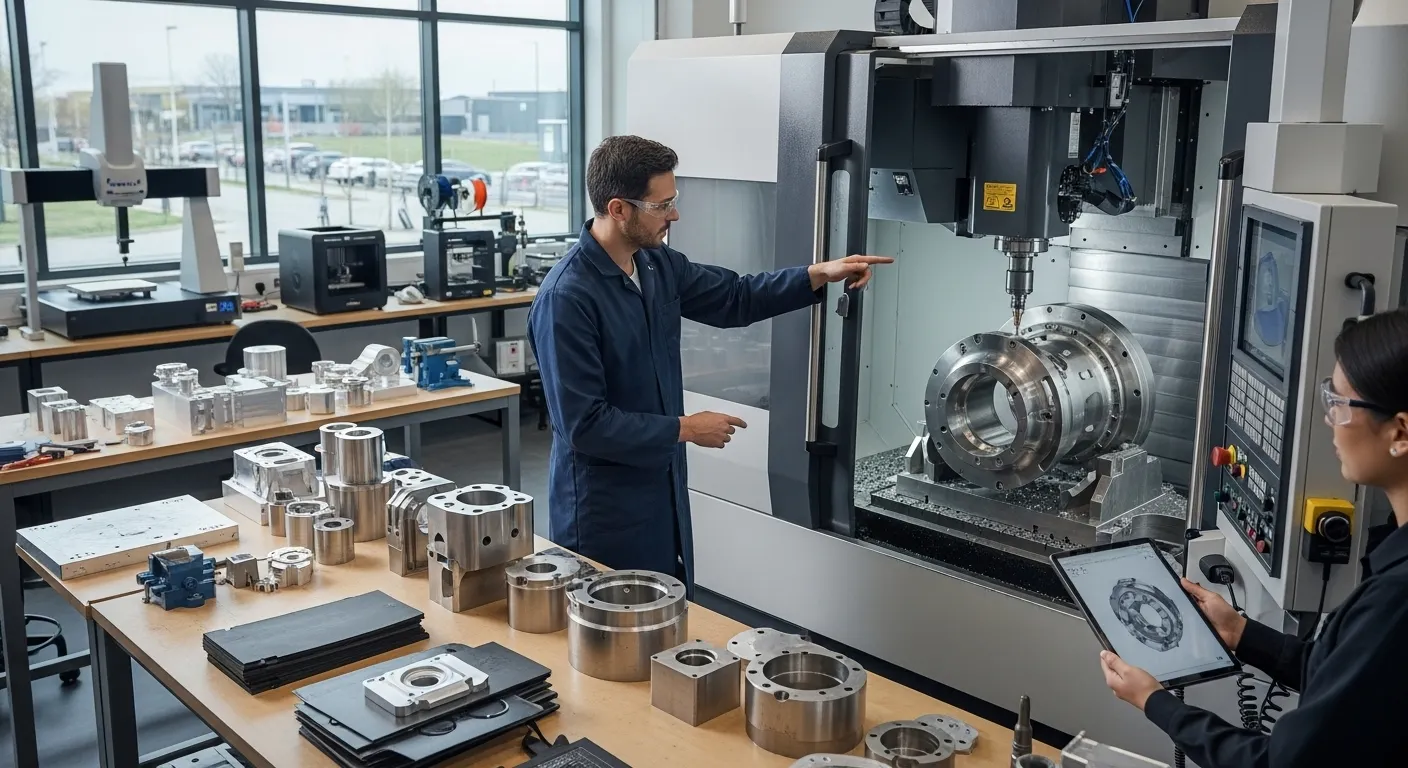
Design-to-Prototype Workflow
Our aerospace prototypes developed on CAD are incorporated into a design-to-prototype process that simplifies the design-to-physical transformation. The combination of digital manufacturing of aerospace, iterative prototyping, and functional testing enables manufacturers to rapidly improve the components in terms of structural integrity and performance optimization.
Resources and Technical Capacity
Aerospace prototyping solutions are not restricted to any specific material. The correct option would be dependent on the functionality and aesthetic needs of the component.
Metals
- Lightweight and load-bearing parts made of aluminum alloys and titanium.
- Stainless steel of high-strength structural elements.
- Aerospace additive metal manufacturing guarantees aerospace prototype parts of high tolerances.
Polymers
- Lightweight aerospace prototype thermoplastics.
- Fine-feature components prototyping requires resin.
- Transparent rapid prototyping polycarbonate and acrylic.
Composites
- High-performance composite material prototypes of aerospace strengths against weight.
- Perfect to serve a purpose in the case of aerospace prototyping, functional testing within the mechanical and thermal conditions.
Clear-Cut Rapid Prototyping in the Aerospace
Some aerospace fittings demand optical capability or optical clarity, like lenses, display covers, light guides, and inspection windows. Transparent rapid prototyping satisfies the following requirements with the help of special materials and processes:
Materials: Polycarbonate (PC), ABS-like transparent resins, silicone-based casting materials, and clear acrylic (PMMA).
Technologies: SLA 3D printing, CNC machining, vacuum casting.
Tolerance: +-0.05 mm depending upon process and part size.
Surface Finishes: polishing, vapor smoothing, UV coating to increase clarity.
Single Prototypes to Small-Batch Production: Batch Capability.
Engineering and Performance Testing
Aerospace prototypes have to be precisely engineered and have to go through rigorous testing to be safe and functional. Our prototyping solutions in aerospace are:
Dimensional Accuracy ptimisation: Ensures that parts are in precisely specified design specifications.
Aerospace Parts Performance Testing: Mechanical: Load-bearing and functional performance validation.
Structural Integrity Test: Checks that it can withstand stress and temperature.
Prototyping Thermal and Stress Testing: Prototyping- High-performance aerospace.
Aerospace Prototype Testing: Makes sure that parts are working as planned under normal operation.
Such measures are essential to aerospace components, in which there is no room to permit failed performance.
Hybrid Solutions: Additive Manufacturing, CNC Machining
At GD Prototyping, additive manufacturing and CNC machining are combined to achieve unsurpassed precision. CNC machining offers close tolerances, smooth finishes, and high repeatability, whereas additive manufacturing offers complex and repetitive geometries and quick iteration. This hybrid method is specifically useful in custom aerospace prototypes, high-precision aerospace prototyping, and low-volume aerospace prototype production.
Application in Aerospace Industries
Aerospace prototyping solutions are applicable in a large variety of applications, including:
Aerospace Prototyping: Lightweight structure parts, engine parts, and airplane parts.
Functional Models: The spacecraft prototype development: To test, assemble, and validate.
Solutions in AviationPrototyping: Interior solutions, cockpit solutions, and display solutions.
Aerospace Engineering Prototypes: To certify and run a functional test.
Trends in the Future of Aerospace Prototyping
The aerospace industry is developing, and digital fabrication in aerospace and additive manufacturing of metals have challenged the limits of possibilities. Emerging trends include:
Generative Design Using AI: Optimizes the geometry of parts in terms of weight, strength, and performance.
Multi-Material 3D Printing Prototypes: Imprint polymers, metals, and composites in one functional testing.
Green Materials: Recycled plastics and light metals save the environment.
Hybrid production Processes: Designing CNC machining with additive manufacturing to be more accurate and flexible.
Conclusion
Prototyping solutions used in the aerospace industry are critical in the quick development of the high performance aerospace components. Through the use of hi-tech aerospace manufacturing techniques, CAD-based aerospace prototypes, and transparent rapid prototyping, manufacturers can now develop faster, at a much lower cost, and test their designs with accuracy never before seen.
When it comes to custom aerospace prototypes, transparent components, functional models with high precision, GD Prototyping is the company that you can rely on, and that is agile and innovative in its prototyping solutions.
