


Aerospace Prototype Injection Molding | High-Precision Prototypes
What is Aerospace Prototype Injection Molding?
- Aerospace prototype injection molding processes are created to manufacture aerospace molded prototypes of high precision that mimic the finished production elements. In comparison to additive manufacturing techniques, such as 3D printing, injection-molded aerospace parts provide better material behavior, dimensional stability, and quality of surface finish that is essential in functional testing, aerodynamic testing, and assembly testing.
- It starts with prototype production of aerospace components with rapid aerospace prototype tooling, which enables engineers to repeat quickly without the cost and time required by traditional production molds. Through high-performance polymer molding (i.e., composite plastic injection molding or aerospace resin injection molding), designers produce parts that are lightweight and mechanically strong.
Aerospace Prototype Injection Molding: Accuracy, Speed, and Innovation
- The demand to have quick, dependable, and precise prototypes has never been higher in the modern competitive world of the aerospace industry. Engineers and manufacturers searching to make complex designs on paper a practical reality are finding aerospace prototype injection molding to be the ideal solution. Using highly developed tooling, aerospace-grade thermoplastics, and rapid prototyping, the companies can create useful aerospace prototypes that are very similar to production-ready parts, less expensive, and less time-consuming to create.
- At GD Prototyping, we are focused on taking innovative aerospace ideas and converting them into high-performance components that are real. From the low-volume aerospace injection molding to the custom aerospace injection molding, our staff guarantees that each part is of the utmost standards of quality, durability, and precision.
Selection of Material: Thermoplastics Aerospace
The issue of material selection is important in the aerospace plastic prototype molding. The aerospace uses require thermoplastics that are impact resistant, tolerate heat, and are also precise in dimension. Common materials include:
- Lightweight Structural prototype ABS and Polycarbonate blends.
- Aerospace electronics: Preparation of high-performance thermoplastics.
- Structural integrity of functional prototypes. Structural integrity with composite thermoplastics.
- Polymers used to make transparent parts that need transmission of light Optical grade.
Aerospace material properties are used to select each material to be injection molded in terms of heat resistance, surface finish quality, shrinkage rates, and machinability. The knowledge of these characteristics will guarantee that aerospace prototype injection molding services will yield components that act like full-sized production components.
- Step 1: Prototype the Mold Fabrication
They are made by an aerospace component molding process, which is commonly in aluminum to allow quick iteration. The mold design uses gate design in molded components of aerospace tools, whereby the flow is uniform, weld lines are minimized, and cooling is maximized.
- Step 2: Material Preparation
The aerospace-grade thermoplastics or composite resin pellets are dried and heated to avoid defects caused by the presence of moisture. This guarantees the dimensions of aerospace plastics and decreases the shrinkage.
- Step 3: Injection and Filling
Injection of the molten polymer is carried out under controlled conditions so that the polymer can flow out of the runner and gate system into the mold cavities. Mold flow analysis, used to predict possible warpage, air traps, or stress concentrations, is added to this step in aerospace prototyping.
- Step 4: Cooling and Ejection
Once filled, the part is cooled as per the specific guidelines of cycle time optimization. Upon its initial solidification, it is forced out to avoid damage to the surface finish and to retain micron-level accuracy of delicate components.
- Step 5: Final Processing and Completion
Such operations as polishing, coating, or heat treatment may be added after processing to produce high-precision aerospace molded components. Finishing the option of anti-reflective coating, mirror finish, and hard coating has been applied on the optical or transparent parts to guarantee the best performance and appearance of the parts.
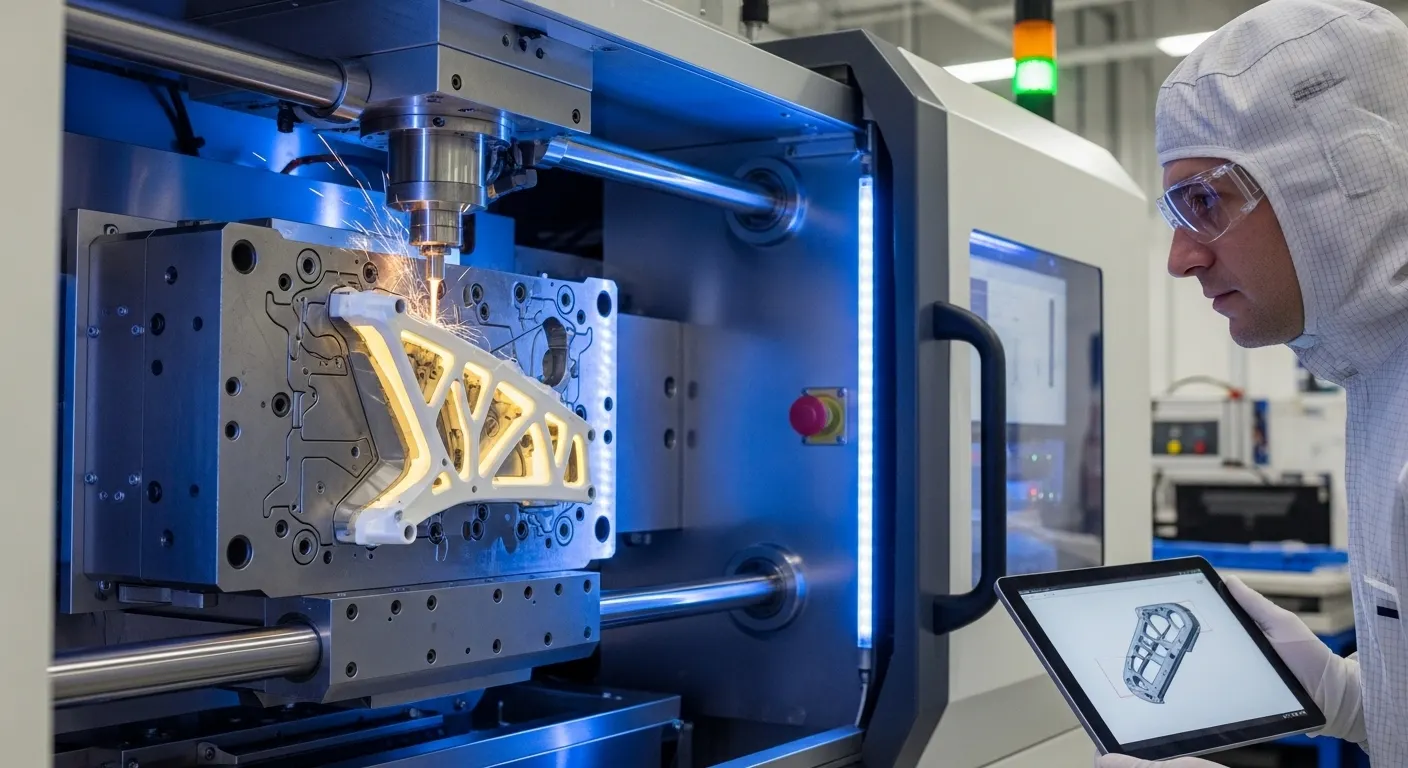
High Speed and Run-to-Run Aerospace Injection Molding
One of the major benefits of rapid aerospace injection molding is that it provides functional prototypes within a very short period. This is suitable in low volume aerospace injection molding projects, where conventional tooling is prohibitive.
Quick aerospace injection molding tooling Rapid aerospace injection molding tooling can be used to perform quick iterations, which enables the engineer to test designs:
- Complex aerospace structures: Fit and assembly
- Stress, heat, and vibration performance of materials.
- Aerodynamic or cosmetic component surface finish.
GD Prototyping offers small-batch aerospace injection molding services to a wide range of customers, including those who need only one prototype or a small quantity, and they do not have to sacrifice any quality.
Aerospace Prototyping Tooling Design and Engineering
The aerospace injection molding tooling design is also extremely important to develop high-quality and reliable prototyping. Key considerations include:
- Optimization of the placement of gates to allow a homogeneous flow of polymer.
- Thermal path design to achieve effective cycle times.
- Ejecting of parts: draft angles.
- Dimensional tolerances to tight aerospace requirements.
Through the integration of prototype tooling verification and mold flow simulation, the manufacturers will be able to eliminate expensive mistakes and minimize the chance of failures in high-precision aerospace molded prototypes.
Optical Prototyping of the Aerospace Industry
In addition to the conventional injection molding, optical prototyping is crucial in aerospace components that demand transparency, clear visibility, or transmission of light. They are aircraft cockpit displays, sensor housings, and lighting systems.
Materials and Processes
- Matter: Polycarbonates, crystal-based polymers, optical glass, acrylic (PMMA).
- Operations: CNC machining, diamond turning, injection molding, polishing, and coating.
- Tolerance Lenses and components are accurate to a micron.
- Surface Finish: Optical polishing with a low degree of roughness.
- Single prototypes to small-batch production: Batch Size.
- Finishing Finishes Anti-reflective finishes, hard finishes, and mirror finishes.
They can be used by the aerospace engineers to test the light transmission, fit, and optical clarity in working models before actual manufacturing.
Aerospace Prototype Injection Molding in the Industry
Aerospace prototype injection molding is important in a variety of aerospace industries:
- Aircraft Structural Components: Prototypes of wings, fuselage brackets, and interior panels are made of high-strength and lightweight materials.
- Aerospace Electronics Housings: Avionics and sensor casings prototypes. Strong prototypes.
- Optical and Transparent Parts: Cockpit displays, lenses, light guides, and check windows.
- Aerospace Components, functional aerodynamic: Lightweight fixtures, composite panels, and assemblies on the move.
With engineering-grade aerospace plastic models, firms will be able to conduct functional tests, aerodynamic tests, and assembly tests before actual production.
Aerospace Prototyping - Quality Assurance
The manufacturing of aerospace components must be of very high quality:
- Dimensional inspection and tolerance checking.
- Surface finish examination and optical clearness examinations.
- Functional prototypes- Mechanical stress testing.
- Checking of material properties such as impact resistance and heat resistance.
In GD Prototyping, the combination of precision aerospace component molding, optical prototyping, and low-volume aerospace injection molding gives rise to parts that perform and look better than others.
Why Should GD Prototyping Be Selected to Do Aerospace Injection Molded Prototypes?
GD Prototyping provides a wide range of services relating to aerospace prototype production, including custom aerospace injection molding through to high precision optical prototyping. Through the use of fast tooling, mold flow analysis, and the best process of finishing, we guarantee:
- Functional and high-accuracy aerospace prototypes.
- Design iterations within a short time.
- Test or demonstration of scalable low-volume production.
A combination of optical and structural prototyping into a workflow.
Conclusion:
Aerospace prototype injection molding continues to form the basis of modern aerospace development. Through the integration of aerospace-grade thermoplastics, accuracy tooling, and optical prototyping, engineers are able to develop functional production-ready prototypes that are a perfect representation of the end products. Be it aircraft structural components, electronics housing, or transparent optical systems, GD Prototyping guarantees that each of the projects has met high-performance, reliable, and accurate visual outcomes.
