


Aerospace CNC Prototyping Services | High-Precision CNC Parts
What is Aerospace CNC Prototyping?
Aerospace CNC prototyping is a high-precision machining of metal and plastic parts in aircraft, satellites, UAVs, drones, and other high-performance applications. With high precision, tight tolerances, and finishes on surfaces, aerospace engineers are able to create the complex parts using high-accuracy 3-axis, 4-axis, 3+2-axis, and full 5-axis CNC milling and turning centers.
Why CNC Machining of Aerospace is Important
- Manufactures aerospace alloys and lightweight materials of high strength.
- Provides fast aerospace prototyping and low-volume manufacturing.
- Allows CNC machining at high tolerance on the critical parts.
- Enables experimentation with working prototypes in the real world.
These advantages render CNC prototyping indispensable during aerospace component prototyping as well as the creation of aerospace prototypes that are production-ready.
CNC Prototyping Services Aerospace: Accuracy, Productivity, and Technology
Precision and reliability are the most important factors in the aerospace industry, which is very dynamic. Bringing complex designs to life and doing so effectively and precisely, aerospace CNC prototyping services allow engineers and manufacturers the tools to do this. CNC prototyping guarantees high-precision aerospace prototyping since the first concept validation to pre-production testing is rigorous in engineering requirements.
In GD Prototyping, we deal in custom aerospace CNC prototyping and CNC machining of aerospace parts. We provide rapid solutions to aerospace components, cost-effective, and high-quality solutions.
The Materials Used in Aerospace CNC Prototyping
The performance and durability of aerospace components are highly dependent on the selection of the appropriate material. At GD Prototyping, we provide aerospace-quality aluminum prototypes, titanium CNC prototypes, and high-tech thermoplastics, and you can be sure your components will pass the strictest standards in the industry.
Common Materials
- Aluminum alloys: Lightweight, high-strength, good for structural components.
- Titanium: Large strength-to-weight ratio and corrosion resistance.
- Aerospace low-strength alloys, high-strength: Optimized structural and functional testing.
- Heat-resistant metals and composites: Suitable for engine and high-temperature parts.
- High-end thermoplastics: Strong and stable thermoplastics to use as a functional prototype or housing components.
With such materials, we will have the ability to create CNC-machined aerospace prototypes that are functional and visually accurate.
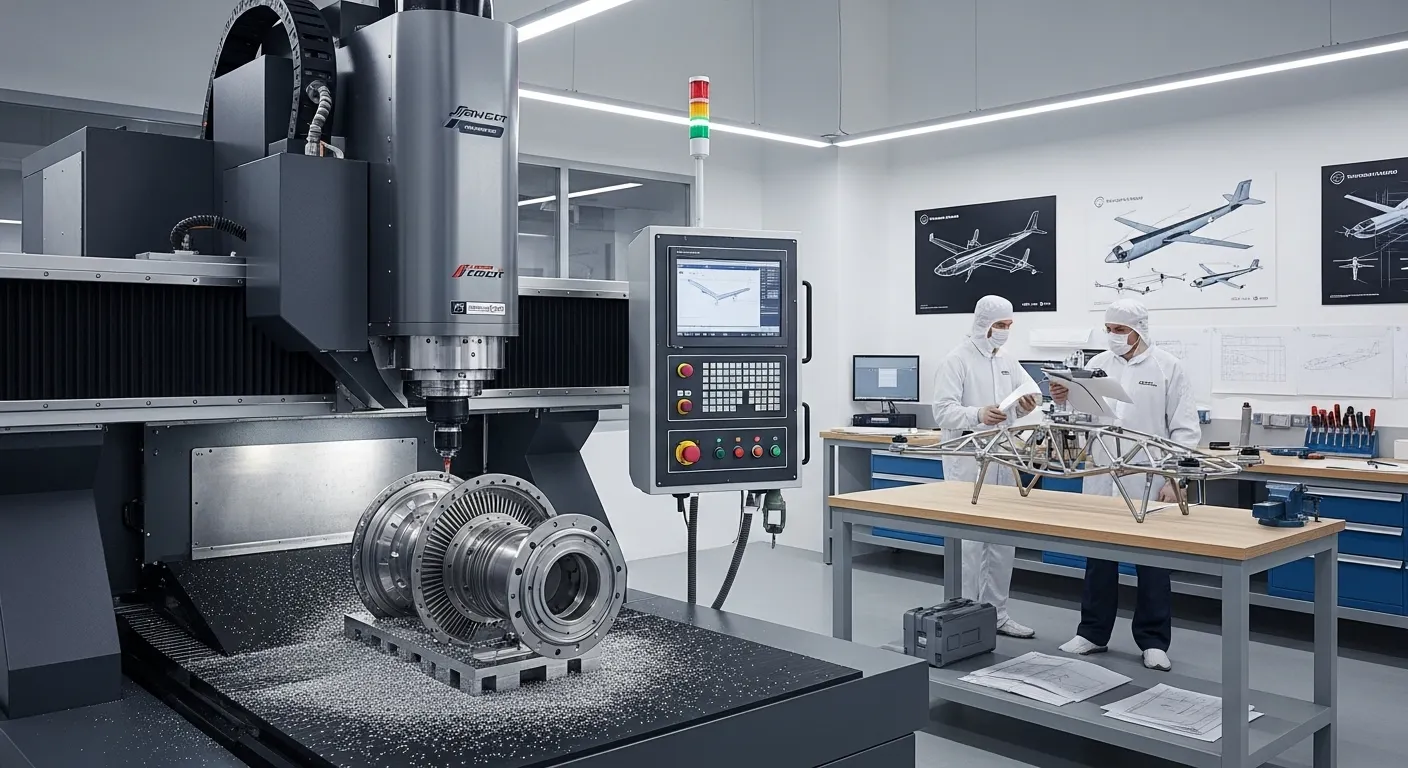
CNC Machining Services Aerospace
We have the CNC machining capacity to support prototyping and the production of a full production run. Through a fusion of versatility and accuracy of engineering, GD Prototyping supplies aerospace parts to the strict industry standards.
CNC Machining Techniques
- 3-axis, 4-axis, 3+2-axis CNC Milling
CNC milling is a multi-purpose method, which is able to make complex and multi-structured plastic and metal components in a relatively short time. It is mostly utilized in both functional and appearance prototypes, which guarantee that your aerospace parts are precise to specifications.
- Concurrent 5-axis CNC Milling
With 5-axis CNC milling centers, we can make high-precision aerospace prototypes with complicated geometries in an efficient manner. All components are produced with a precision of microns, a high quality of surfaces, and a tight tolerance of +-0.05mm, making them ideal in high-performance aerospace work.
- CNC Turning
CNC turning is applied to the production of cylindrical parts, including rods, shafts, and housings, with axial and radial holes, grooves, and slots. It is perfect in functional prototypes and in end-use components, meaning that it can be used to replicate engineering design specifications with precision.
Benefits of Aerospace CNC Prototyping
- Productivity and Efficiency
CNC machines work 24/7, and this has greatly increased productivity and efficiency. The in-house operations enable a fast turnaround, and the quality of every aerospace prototype is consistent.
- Precision and Tolerances are High
CNC machines are operated based on the computing of the digital CAD/CAM, and your designs can be exact copies. Closely tolerated CNC prototypes enable an engineer to check the dimensional accuracy, surface finish, and other results of the prototype before proceeding to the actual large-scale production.
- Scalability and Flexibility
CNC machining also accommodates single prototypes as well as low-volume aerospace CNC parts production. The software is easily reprogrammable to new designs, and this allows quick adaptation to changing project demands and selection of materials.
- Surface Finishes and Versatility of the Material
Our CNC machining is compatible with a large variety of materials, including aluminum, titanium, aerospace-grade alloys, and sophisticated thermoplastics. Surface finishes are available to custom requirements, such as aerospace-level surface roughness, such as Ra0.2mm on high-performance components.
Process Accuracy and Quality Management
There is no compromise on precision in aerospace. The high tolerance CNC machining provides that all parts are produced to high specifications, and quality control systems provide defect-free CNC-machined parts that have the same level of dimensional accuracy.
CNC Machining Tolerances
- DIN 2768-1 fine: When micron-level accuracy is needed on metals.
- DIN 2768-1 medium: Plastic in which the dimensions are strictly measured.
Project managers of GD Prototyping examine all the project details to provide the optimal precision of aerospace components.
Quick Aerospace Prototyping Solutions
The aerospace society requires speed and precision. The prototyping at GD Prototyping enables rapid aerospace prototyping to allow engineers to quickly iterate and efficiently validate the design.
Advantages of Rapid CNC Prototyping
- Rapid aerospace prototyping.
- Checking engineering CNC prototypes on performance and durability.
- Cost-effective low-volume production.
- Aerospace prototyping services on-demand in case of urgent projects.
CNC prototyping Rapid CNC prototyping is necessary in such projects as UAV and drone component prototyping, satellite part metallizing, and aerospace electronics housing prototypes.
Aerospace CNC Prototyping
Aerospace CNC prototyping services are applied in several high-stakes applications, among which are:
- Prototyping components of aircraft: Landing gear, structural frames, and interior components.
- Prototyping of aerospace engine parts: Turbine blades, housings, and mounts.
- Prototypes of satellite and space components CNC: Lightweight structural and mechanical components.
- UAV and drone development: Airframes: Light and strong.
- Aerospace electronic enclosures: defensive and operational.
Through CNC-machined aerospace prototypes, engineers can test their form, fit, and performance before mass production, reducing risk and assuring performance quality.
Conclusion
The aerospace CNC prototyping services are necessary to bring the cutting-edge aerospace designs into reality. With aerospace CNC prototypes of the highest precision and custom low-volume production, CNC machining provides the highest level of quality, performance, and reliability of the components produced. GD Prototyping has a long history of partnering with aerospace engineering firms to provide prototype equipment services, including custom CNC prototyping, rapid prototyping, and high precision prototype solutions to bridge the gap between concept and production success in aerospace applications.
