


Aerospace 3D Printing Services | High-Precision Manufacturing
What are Aerospace 3D Printing Services?
Aerospace additive manufacturing, also known as 3D printing of aerospace, transforms the methods of component construction. Additive manufacturing uses layers to build parts as opposed to subtractive manufacturing, which is used to remove material from a solid block, allowing complex geometries, optimum structures, and cost-efficient design. This method is especially beneficial to 3D printing of aircraft parts, jet engine parts, and spacecraft parts, where quality and performance are not negotiable.
3D Printing Services in Aerospace: Transforming the Future of Aerospace
- Aerospace is an industry that is experiencing an incredible revolution, and this is as a result of the advanced technologies that are revolutionizing the way aircraft, spacecraft, and satellite components are designed and produced. Aerospace 3D Printing Services are one of these innovations and are leading the pack as they are the fastest, most accurate, and most flexible in the prototyping and production of their products.
- At GD Prototyping, we are the company to provide the hi-tech 3D printing solutions in the aerospace industry, where all the components are of flight readiness, structural integrity, and performance.
Benefits of Using Aerospace 3D Printing
- Weight Reduction: 3D printers with aerospace-grade materials enable lightweight aerospace 3D printed components, which means more fuel efficiency and improved performance of the aircraft.
- Complex Geometry: With complex geometry aerospace parts capability, it is now easy to be able to produce components that previously could not be manufactured.
- Rapid Prototyping: Rapid prototyping in the aerospace industry enhances design validation speed and shortens the time-to-market of innovative solutions to the aerospace industry.
- Part Consolidation: 3D printing can consolidate multiple parts into a single consolidated unit, and this prevents complexity in assembly and possible sources of failure.
- Material Efficiency: Aerospace 3D printing ensures that the material is fully used, particularly with high-value materials such as titanium and Inconel.
Technologies in Aerospace Additive Manufacturing
In the GD Prototyping 3D printing center, we use various technologies to provide high-performance products to the aerospace industry. These include:
- Direct Metal Laser Sintering (DMLS)
Aerospace uses of DMLS permit titanium, aluminum, stainless steel, and Inconel metal to be 3D-printed. The technique offers aerospace-level 3D printing at high temperature, thus the components can endure the severe working conditions.
- Selective Laser Melting (SLM)
SLM is meant to print aerospace parts of high density and structure that are flight worthy and with high density. Its accuracy enables it to be ideal for jet engine and turbine components and other critical aerospace parts.
- Stereo Lithography (SLA)
SLA is a fast-prototyping method, which is excellent at creating high-precision aerospace additive manufacturing prototypes with smooth finishes on the surfaces and complex geometries.
- Multi Jet Fusion (MJF) & Selective Laser Sintering (SLS)
These technologies are lightweight structural optimization specific and generate robust polymer-based components of UAVs and drones, tooling, and fixtures.
- Binder Jetting and Electron Beam Melding (EBM)
The techniques increase the material flexibility and provide flexibility in the design and production of both metals and polymers due to their capability to manufacture aerospace parts layer by layer.
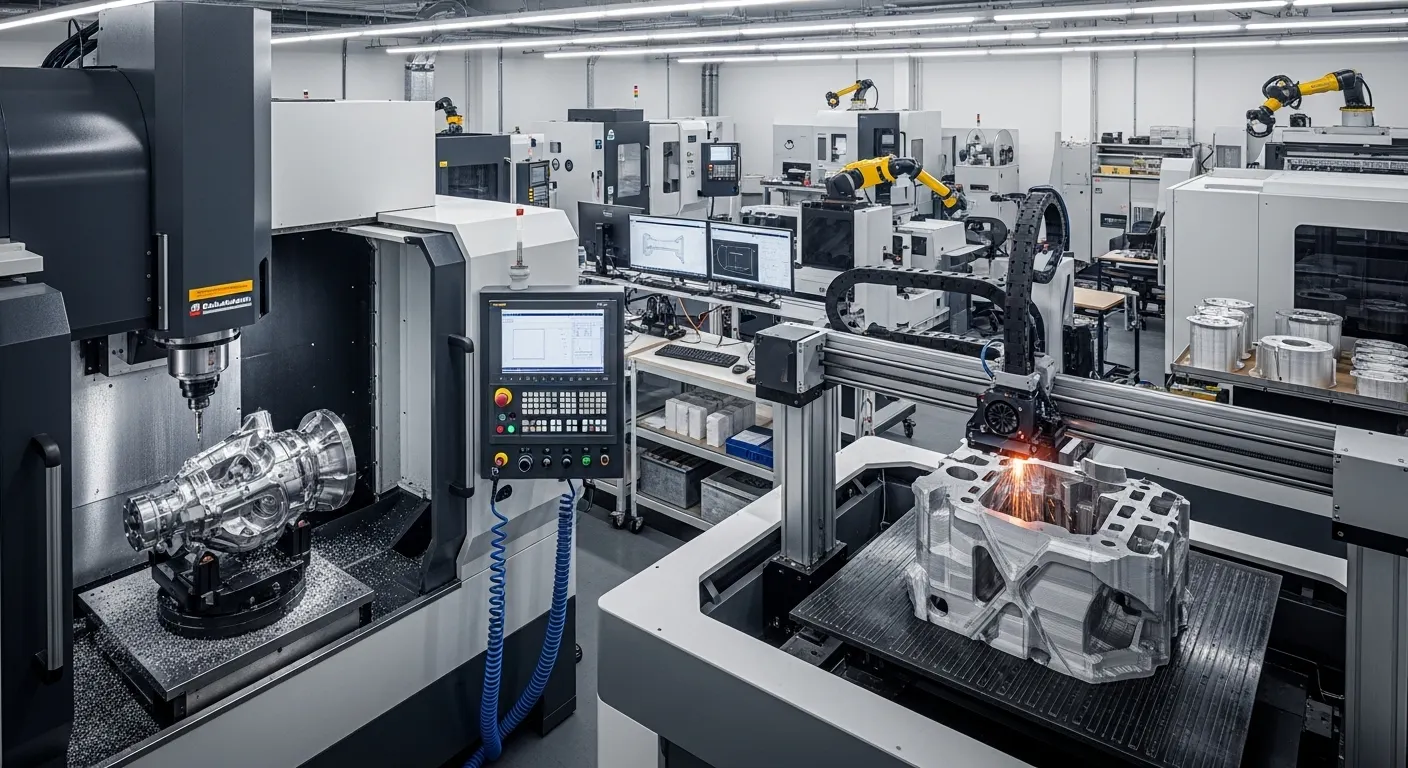
Aerospace 3D Printed Components Materials
The choice of materials plays a very important role in the manufacturing of aerospace. GD Prototyping uses aerospace-grade metal alloys and high-performance aerospace polymers to assure optimum performance:
- Titanium Alloy Aerospace Products: High-weight structural aircraft parts and high-performance products.
- Aerospace 3D Printing with Aluminum: Perfect for the weight reduction of aerospace parts and complicated frame structures.
- Inconel High-Temperature Aerospace Components: 3D printing is suitable for applications of parts in jet engines and those subject to extreme temperatures.
- Aerospace Manufacturing of Stainless Steel: Structural and mechanical components, both durable and anti-corrosive.
- High-Performance Polymers: Lightweight, fatigue-resistant material to use in UAVs, drones, and interior aerospace.
Having a broad material range, GD Prototyping makes sure that both plastic and metal aerospace 3D printed components are functional, thermal, and meet mechanical needs.
Aerospace 3D Printing Services Uses
Aerospace component 3D printing and its applications are numerous, and both the commercial and defense industries can create new things more quickly:
- Aircraft Parts 3D Printing: Fuselage and interior parts. Flight-qualified parts with optimized mass and performance can be manufactured with 3D printing.
- Jet Engine Component 3D Printing: Additive manufacturing of key components, such as turbine blades and fuel nozzles, that need a high-temperature aerospace 3D printing is aerospace-approved.
- Spacecraft/Satellite Hardware: 3D printing. Lightweight satellite parts are precision-engineered, which provides the durability needed in extreme space conditions.
- Components of UAV and Drone: 3D printing enables rapid aerospace prototyping for manufacturers, enabling them to test and learn more quickly.
- Aerospace Tooling & Fixtures: The use of aerospace components with digital manufacturing simplifies the manufacturing process, which leads to a decrease in lead time and cost.
Design and Engineering Concerns
Aerospace 3D printing services need design for additive manufacturing (DfAM). Key considerations include:
- Multifaceted Geometry Aerospace Components: Liberty to create the unattainable in the old ways.
- Topology Optimization Aerospace: Eliminates weight without compromising strength.
- CAD-to-Print Aerospace Workflow: Efficient bridging of digital to physical component.
- Lightweight Structural Optimization: Important to fuel efficiency and payload capacity.
These technological designs will be crucial in the manufacture of structural aerospace 3D printing structures that are efficient and durable.
What is So Special About GD Prototyping as an Aerospace 3D Printer?
In GD Prototyping, the 3D printing services are a blend of innovation, precision, and speed. This is why the makers of aerospace can depend on us:
- Large Material Choice: Suitable with both plastics and metals, and therefore, durable and performance-based.
- Quick Response: Prototypes within 1-2 days, developing faster.
- Design Flexibility: Simple manufacturing of complicated shapes, intricate geometries, and lightweight buildings.
- Economical: Reduced tooling and assembly costs, high-value solutions.
- State-of-the-Art Technologies: SLA, SLS, MJF, and DMLS to do rapid prototyping and small-scale production.
Aerospace production Aerospace 3D printing service provider, our team fuses next-generation aerospace production processes with a precision manufacturing approach, which makes us the preferred aerospace 3D printing service provider.
Conclusion
The Aerospace 3D Printing Services are not a new concept of the future anymore, but it is a necessary component of the modern aerospace production. Through integrating a combination of innovative aerospace production technologies, accurate engineering, and quality materials, GD Prototyping provides flight-ready solutions that are cost-effective and performance-based. Whether it is in rapid prototyping or in small-scale production, our services allow aerospace companies to go through innovation much quicker, lower their costs, and obtain outstanding outcomes.
