


What Is Metal Casting? A Complete Guide for Manufacturers and Engineers
Explore the fundamentals, processes, types, and industrial applications of metal casting for high‑quality parts
Metal casting is one of the most enduring and versatile manufacturing processes in human history. Still widely used in modern industrial production, it allows manufacturers to produce complex metal parts in a cost‑effective and efficient way — from automotive housings to machinery components, aerospace parts, and more.
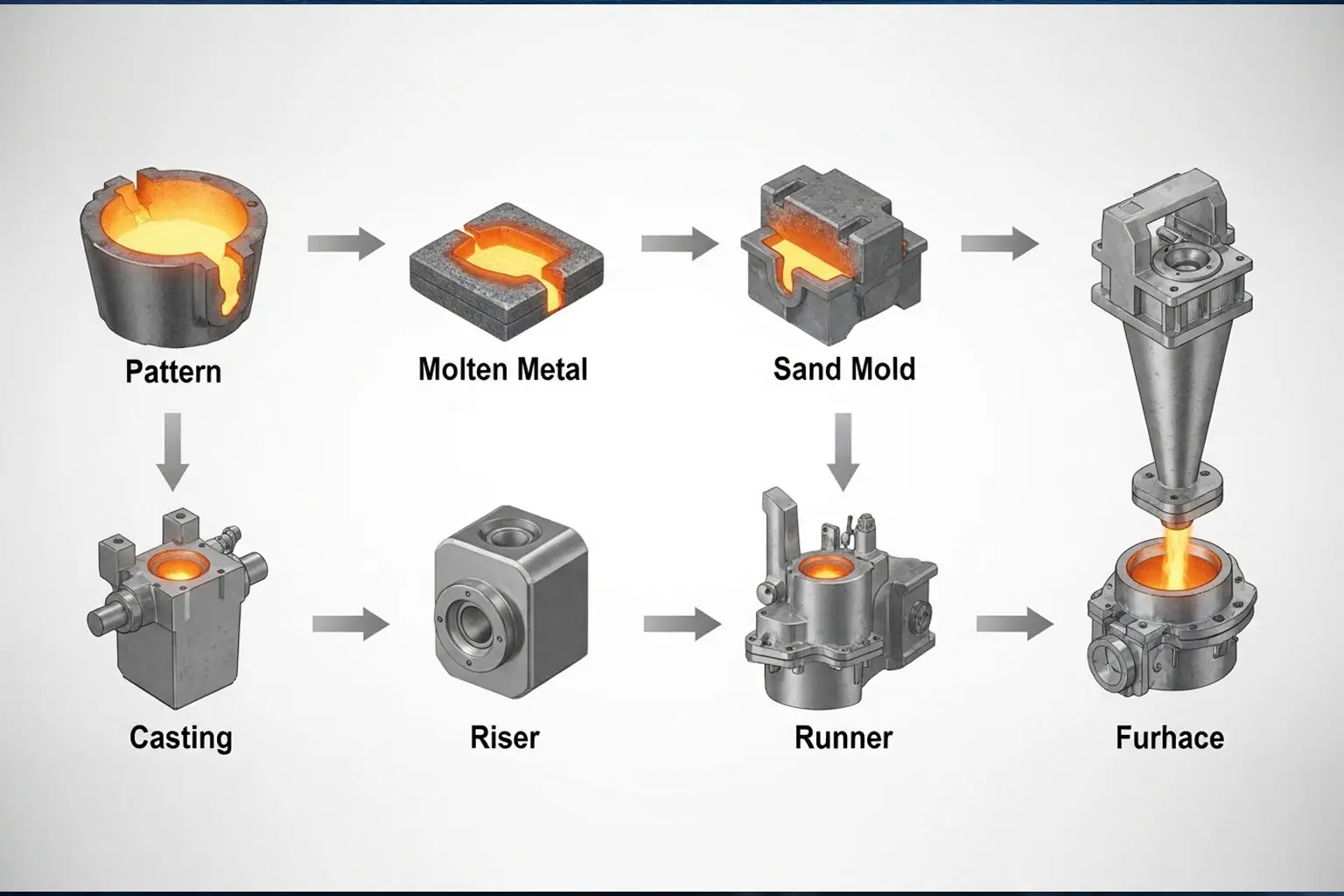
In this guide, we’ll walk through what metal casting is, how it works, the key process steps, common casting types, material considerations, and why casting remains relevant for precision manufacturing partners like GD Prototyping Technology in Dongguan, China.
What Is Metal Casting?
Metal casting is a manufacturing method in which molten metal or metal alloys are poured into a mold cavity containing the desired 3D shape and allowed to cool and solidify into a solid part. The resulting solid metal part — the casting — closely reflects the geometry of the mold.
This process enables the production of parts that are difficult or expensive to create through other manufacturing methods such as machining alone. Casting can accommodate large or highly intricate geometries, making it suitable for both functional and structural components.
Why Metal Casting Is Important in Manufacturing
Metal casting is foundational in sectors like:
-
Automotive and transportation
-
Aerospace and defense
-
Heavy machinery and construction
-
Industrial equipment
-
Energy generation
-
Consumer goods
Because casting allows complex shapes and diverse material choices — including iron, steel, aluminum, copper alloys, and more — it plays a key role in economies of scale and versatile part design.
Casting also reduces material waste compared to subtractive methods and can offer cost advantages for medium to high volume production when paired with sound tooling design.
The Metal Casting Process: Step by Step
Although different casting methods vary, most metal casting workflows include these core stages:
1. Pattern and Mold Design
Patterns are the physical or digital templates used to shape the mold. They define the negative cavity that molten metal fills. Modern foundries often use CAD and 3D printing to create precise patterns that improve dimensional quality.
2. Mold and Core Making
Molds are built from materials such as sand, ceramic, or metal depending on the casting process. For hollow parts, cores create internal voids or passageways that become part of the finished casting.
3. Melting and Pouring
Metal is heated in a furnace until it reaches its molten state. Once fully molten, it is carefully poured into the prepared mold cavity through channels called sprues and runners.
4. Cooling and Solidification
After pouring, the metal cools and solidifies, conforming to the shape of the mold. The cooling rate affects grain structure, mechanical properties, and residual stresses within the casting.
5. Mold Removal and Cleaning
Once solidified, the mold material is removed. For expendable molds like sand casting, the mold is broken away. For permanent molds, it can be reused. The cast part is cleaned of sand, scale, gates, and excess flash.
6. Finishing and Inspection
After cleaning, castings may undergo grinding, machining, heat treatment, or surface finishing to meet required specifications. Rigorous inspection ensures dimensional accuracy and mechanical quality.
Types of Metal Casting Processes
Casting is not a single technique — it is a family of processes, each optimized for different part types and production goals.
🔹 Sand Casting
One of the oldest and most widely used casting techniques where sand molds form a cavity around a pattern. Sand casting is adaptable, cost‑effective, and suitable for large and complex parts.
🔹 Die Casting
Die casting involves forcing molten metal under high pressure into reusable steel molds (dies). This method delivers high dimensional accuracy, smooth surface finish, and is ideal for high‑volume production. Common materials include aluminum, zinc, and magnesium alloys.
🔹 Investment Casting (Lost Wax)
Investment casting produces highly detailed and complex parts by coating a wax pattern in refractory materials then melting the wax out (lost wax) before pouring metal. It’s excellent for aerospace and precision components.
🔹 Permanent Mold Casting
Here, molten metal is poured into reusable metal molds. Because the molds are robust, the process suits medium to high volume production with consistent part quality.
🔹 Centrifugal Casting
In this process, molds rotate during pouring, and centrifugal force spreads molten metal outward, making it perfect for cylindrical parts like pipes and bushings.
Each casting method offers specific advantages, and the right choice depends on part geometry, material type, volume, and end‑use requirements.
Materials Commonly Used in Casting
Metal casting supports a wide variety of materials, including:
-
Ferrous alloys: Iron, steel
-
Non‑ferrous alloys: Aluminum, copper, brass, bronze, magnesium
-
Special alloys: Nickel and cobalt‑based materials
This flexibility makes casting suitable for both structural and lightweight components used in manufacturing and engineering applications.
Casting in Modern Industrial Production
Despite new manufacturing technologies emerging — such as additive manufacturing and CNC machining — casting remains indispensable due to its efficiency in producing complex forms and scalable production. When combined with post‑processing techniques like machining and surface finishing, cast parts can achieve the precision and performance required for demanding engineering applications.
At GD Prototyping Technology, we integrate casting with precision CNC machining and quality inspection to deliver parts that meet tight tolerances and application‑specific requirements for industries such as automotive, aerospace, industrial equipment, and more.
Conclusion
Metal casting is a foundational manufacturing process that enables the transformation of molten metal into functional, high‑value components. From traditional sand casting to modern die casting and investment casting, this process provides unmatched versatility and scalability for both prototype and production parts.
Understanding casting fundamentals helps engineers and buyers make informed decisions about material selection, production costs, lead times, and performance expectations. And when paired with an expert manufacturing partner like GD Prototyping Technology in Dongguan, China, your parts are crafted with precision, quality control, and production efficiency.
