


CNC machining service for medical devices
To the millions of individuals receiving a hip replacement a perfect fit is a prerequisite to success. The metal parts should be flawlessly smooth and exactly shaped, such that they can be used without problems in decades. But have you ever wondered how medical inventions are so finely accurate in making such complicated machines?
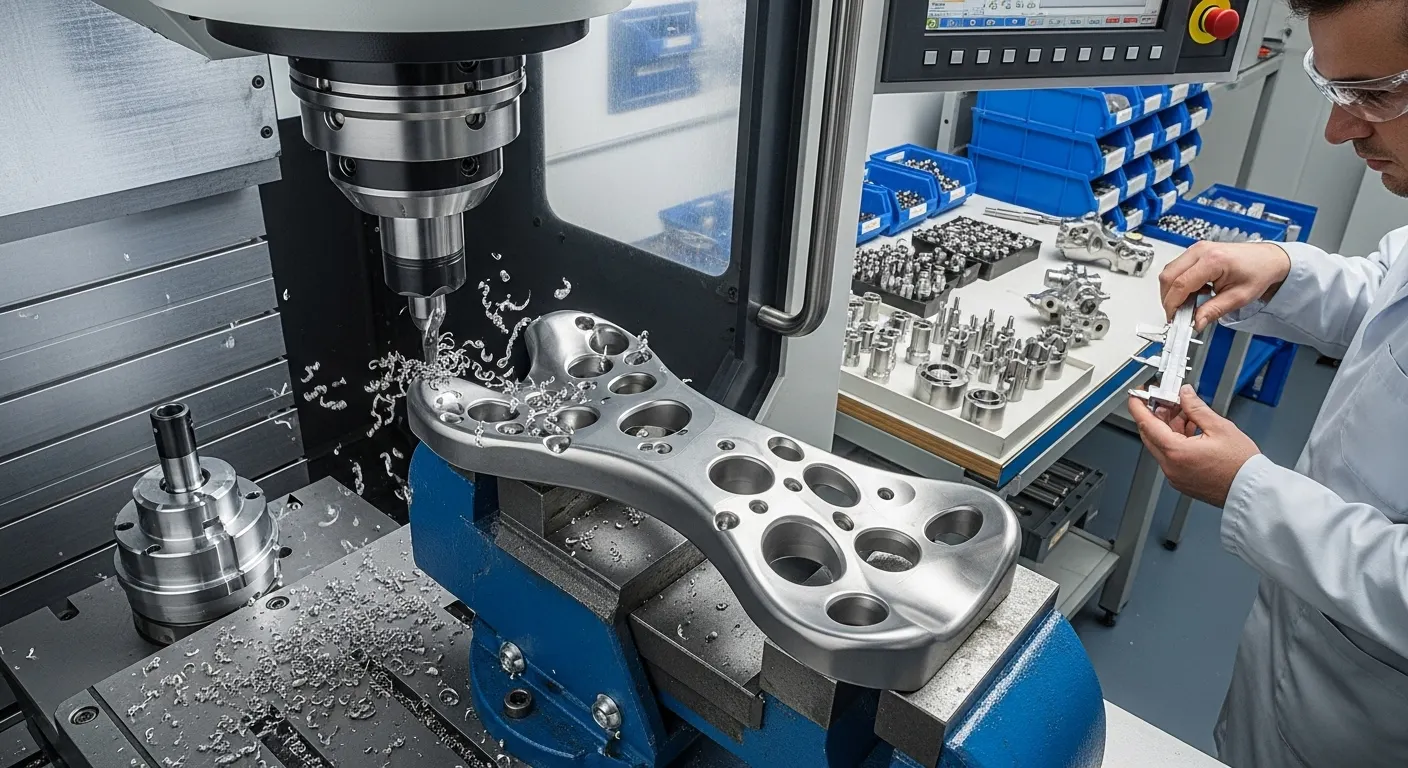
This solution is to a process which is bit a robot sculptor, a bit a computer genius: CNC machining. Consider a classic sculptor chiseling a sculpture, except that there is no chisel, rather there is an impeccably accurate digital blueprint guiding the tools. And this is the essence behind CNC machining of medical equipment- a process that is used to cut blocks of solid material such as titanium into ideal parts, in a microscopic layer at a time.
Reliance on machines that make us healthy implies the knowledge of the technology behind them. This degree of accuracy is a matter of life or death with dental implants or life-saving surgical equipment. This insider tour of medical device prototyping and production reveals the secret society behind these components, with perfection being driven by computers that guarantee the safety of patients.
What is CNC Machining? A Sculptor Guided by a Computer
It is like a sculptor beginning with a solid block of marble, and slowly chiseling away until a statue is seen inside. It is on this principle that machining is performed. It involves a piece of solid block of a super high performance material, such as biocompatible titanium, and incredibly sharp tools to cut away all that is not the final piece. In this technique the original material is solid and uninterrupted in its strength which is passed to the completed piece.
But, imagine now, that the sculptor is a robot, controlled by an ideal digital model. This robot is able to repeat the movements with a precision of microscopes and a million times without any mistake or fatigue. That’s the “CNC” part.
CNC stands for Computer Numerical Control, which is a simple way of saying a computer is in whole mastery over the carving. It guides the instruments in a precise direction so that each and every part, be it the first one or the thousandth, is a perfect and exact duplicate of its creation.
This is a complete contrast to such a process as 3D printing which add parts at a time. Using a solid block as the starting material, CNC machining service of medical devices produces parts with the inherent strength and integrity required to work in challenging environment such as a hip implant or a bone screw, where there is no room to fail.

Why Does Precision Matter? The Risk of a Microscopic Mistake
In a medical implant, such as a knee or hip replacement, two part components have to slide over each other millions of times. Whether there is a microscopic gap or a flaw, even in the form of a strand of silk, it can cause friction. This friction will result in wear, inflammation and possible implant failure over the course of time. To avoid it, all the components should be produced to very high precision, which is referred to as tight tolerances. This will result in an ideal flawless fit that can withstand decades.
Here the robotic excellence of the CNC machining is crucial. A computer is able to do this due to its microscopic precision in every cut, which it is capable of maintaining. One part is not enough; the process should ensure that the ten thousandth part is as faultless as the first one. Such accuracy and repeatability cannot be compromised at all in the process of manufacturing orthopedic implants.
Accuracy machining is not only necessary in components that are not removed. Think about the fine surgical tools of brain surgery or spinal surgery. A surgeon needs his or her equipment to be just in form and weight to conduct his or her work without causing any harm unintentionally. In their case, accuracy is not on the durability of wear but on the instantaneous safety and outcome of a life-threatening operation.
What Body-Safe Materials Are Used for Medical Devices?
The shape that a device is made out of is as important as the perfect shape of a device. It is not any metal or plastic; it must be biocompatible, and this word implies that the human body will not react to it in a harmful manner. Imagine it is an extreme allergy- when the body perceives the material as something that is alien, it is able to become inflamed and result in the implant collapsing. Medical grade is specifically selected as it is made in such a way that the body is unable to detect their existence in the body and therefore it can safely serve as many years.
A titanium alloy that is body-safe is frequently the star when it comes to the metal implants such as hip joints and bone screws. It is selected due to its rare mix of high power, light weight and unbelievable ability to be resistant to corrosion within the body. But it is very hard to cut and shape, which is the fault of this toughness. To carve out portions of a solid block of medical titanium, one needs robust and hard CNC machines because the material is hard to cut, which is a major challenge that can be solved only by the use of specialized technology.
It is not everything metal, but everything. PEEK -high-performance polymer- is an ultra-strong type of plastic implemented more and more often in devices such as spinal implants. PEEK is stiff enough to support yet has an added advantage of being clear to X-rays to allow physicians to keep track of the progression of the bone around it. CNC machining offers the flexibility in working with hard-to-cut materials such as titanium, as well as high-performance plastics such as PEEK, to create life-saving parts. However, what is the mechanism through which the process generates the complex, cage-like structures required to make a modern spinal implant?
How Are Extremely Complex Shapes Like Spinal Implants Made?
The solution to this is to go a step further and make the concept of computer-guided carving a reality. Where basic CNC machining is similar to the sculptor, cutting at the top and working down, multi-axis machining is similar to providing that sculptor with a robotic arm. It has the capacity to tilt and turn the block of material, and the cutting tool can approach it through any imaginable direction without ever halting. The secret of this constant action is to produce flowing, organic forms and of very complex internal contours that would otherwise be impossible to cut out of a piece of solid material.
One such machine as the sophisticated spinal cage depicted here is an ideal demonstration of this technology at work. The lattice, and so complex, design is not created merely to be attractive, but is also designed to be light but remarkably strong and make the patient own bone grow through the openings to form a natural and permanent fusion. This cage can be cut in a single block of titanium or PEEK making the entire cage perfect with the idea of multi-axis CNC. This results in seamless section without welds and joints creating any weak areas and giving the highest level of safety once implanted in the body.
It is such remarkable accuracy in terms of larger implants. Micromachining is another process done on the same principles but at an almost invisible level. or consider parts of a life-saving pacemaker or a miniature neurostimulator, smaller than a grain of rice, but still needing only perfect surfaces and precise dimensions. This is where micromachining comes in and offers the reliability on a microscopic level. However, to create unique prototypes or test parts, is block carving always the most appropriate choice? It is at this point that another technology known as 3D printing comes in.
Is CNC Machining Better Than 3D Printing for Medical Prototypes?
Whereas CNC machining removes material in the style of a sculptor, its well-known cousin, 3D printing, adds it. Just imagine drawing a complex form by using a very fine hot glue gun by adding the material a single microscopic layer at a time. It is a great way to come up with a prototype in a hurry, a cheap, rapid, physical design of a new device. It enables the surgeons and engineers to have an idea in their hands to get a feel and look at it well before investing in a final design.
Such speed is what allows 3D printing to be used during the initial design stages. A team can overnight print a plastic copy of a new spinal implant to check the fit. But since these parts are made in layers they do not have the same internal strength as one made out of a solid block. In the last implant which should perform many decades within the body, or the surgical instrument which should resist a great force, manufacturers resort to the CNC machining as the strongest and with the best surface finish.
Finally, the two technologies are not rivals, but collaborators. 3D printing is used to refine the concept, and CNC machining is used to make the final, reliable reality. The durability of a machine made out of a single, solid piece of medical grade material is beyond price when the health of a patient is at stake.
How Can We Trust These Medical Parts Are Safe?
What has appeared as a mere object of a polished metal is made known as the creation of an invisible world of accuracy, where computers are the controlling devices of robotic tools that are precisely controlled down to a microscopic level. The design of a hip joint to fit perfectly or the quality of a pacemaker to be as reliable as possible is not a coincidence but rather a very sophisticated process that is meant to achieve perfection.
This quality is given serious consideration. Standards such as ISO 13485 which is the official seal of approval of medical manufacturing guarantee this. Consider it as the stringent checkup procedure in the kitchen of a five star restaurant except that it involves life saving components. To the ISO 13485 certified machine shops, all the processes involved in the production of the orthopedic implant are recorded and checked so that the final product is impeccable.
The outcome is a deep level of confidence in the current medical equipment. This high technology has resulted in the massive consideration that is incorporated in every element. It is not only about the process of creation of a component; it is also about the promise of safety of medical devices, of each part being created to heal, to last, and to save lives.
