


9 Essential Machining Processes Every Modern Manufacturer Should Know
Your Complete Guide to Precision Machining Technology for Prototyping & Production by GD Prototyping Technology (Dongguan, China)
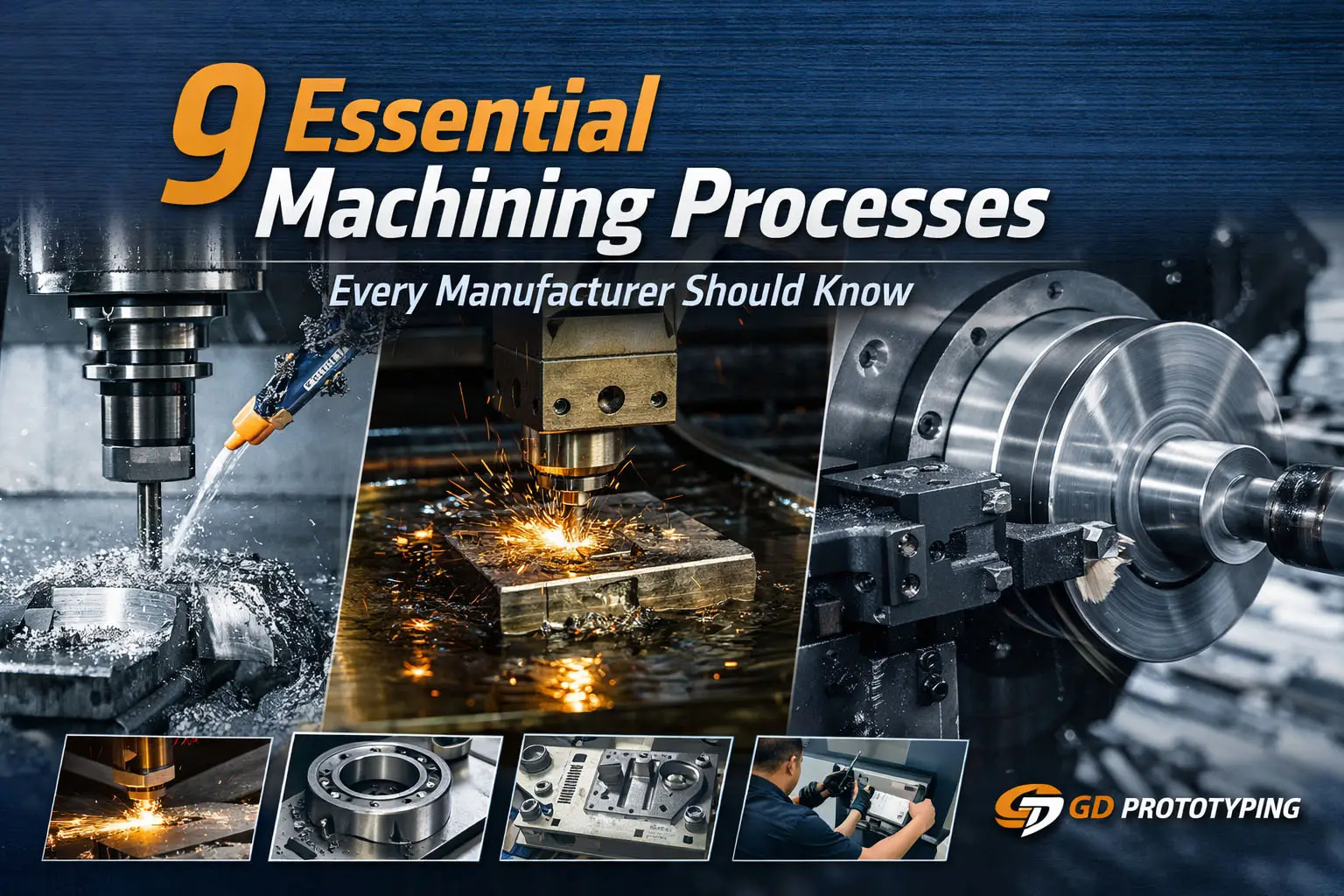
Machining is the cornerstone of modern manufacturing and plays an indispensable role in transforming raw materials into high‑precision, functional parts. At GD Prototyping Technology, we specialize in a wide range of machining techniques that enable complex geometries, tight tolerances, and consistent repeatability — from prototype proof‑of‑concept to small or mid‑volume production.
This comprehensive guide introduces the 9 core types of machining processes that engineers, product designers, and manufacturing buyers need to understand when selecting the best approach for their components. Each process delivers unique strengths, cost implications, and application scenarios, making it vital to align your design requirements with the right machining technology.
1. Turning — Precision Cylindrical Shaping
Turning is one of the most foundational machining processes. In this operation, the workpiece rotates while a stationary cutting tool removes material to produce cylindrical shapes, symmetrical features, or contours. Lathe machines, including CNC turning centers, enable precise diameters, threads, grooves, and profiles for parts such as shafts, spacers, and bushings.
Key benefits:
-
Ideal for round or tubular parts
-
Excellent surface finish and dimensional accuracy
-
Flexible for both prototypes and batch production
Typical Applications: Shafts, studs, flanges, threaded components.
2. Milling — Complex Surface Removal
Milling uses rotating cutting tools to remove material from a stationary workpiece. Unlike turning, where the workpiece spins, milling machines move the cutter along multiple axes (often X, Y, and Z) to create complex shapes, slots, pockets, and flat surfaces. CNC milling machines are versatile and widely used in precision fabrication.
Advantages:
-
Supports complex 2D and 3D geometries
-
Multi‑axis machining for intricate contours
-
High repeatability and precision
Typical Applications: Housings, brackets, engine components, jigs and fixtures.
3. Drilling & Boring — Holemaking with Precision
Drilling is used to create accurate round holes in a part, typically using helical drill bits under controlled rotation and feed. For deeper or larger diameter holes, boring can refine initial holes to achieve tight tolerances and surface quality.
Benefits:
-
Fast holemaking for assembly and fit‑up requirements
-
Adjustable for different diameters and depths
Typical Applications: Mounting holes, alignment features, assembly points.
4. Grinding — Superfinishing and Tight Tolerances
Grinding is a finishing process that uses abrasive wheels to remove small amounts of material, achieving extremely fine surface finishes and tight dimensional control. It is critical in parts requiring high precision beyond what standard milling or turning can deliver.
Strengths:
-
Exceptional surface smoothness
-
Sub‑micron tolerance capabilities
-
Ideal for hardened materials
Typical Applications: Bearings, precision shafts, sealing surfaces, finished tooling.
5. Broaching — Internal Feature Cutting
Broaching is a specialized process where a toothed tool, called a broach, is pulled or pushed through a workpiece to create internal shapes like keyways, splines, or holes with non‑round profiles. It provides efficient and repeatable results for profile features that are difficult to machine otherwise.
Benefits:
-
One‑pass cut for precise internal geometry
-
High production consistency
Typical Applications: Keyways, splines, slots inside bushings or gears.
6. Boring & Reaming — Refining Existing Features
Boring enlarges a pre‑existing hole to achieve greater accuracy of diameter and alignment. Reaming follows drilling to improve surface finish and ensure tight tolerance fits. Both processes enhance hole quality and functional performance.
Advantages:
-
Superior hole diameter control
-
Excellent surface finish
Typical Applications: Engine cylinders, bearing housings, precision mechanical assemblies.
7. Sawing & Cutting — Material Division
Sawing is a straightforward process used to divide raw stock material into manageable blanks or approximate shapes before further machining operations. Precision cutting, including band saw, circular saw, laser cutting, or waterjet cutting, prepares stock with minimal distortion.
Benefits:
-
Cost‑effective pre‑machining step
-
Suitable for a wide range of materials
Typical Applications: Bars, plates, tubes, preforms for further machining.
8. EDM (Electrical Discharge Machining) — Hard Material Machining
Electrical Discharge Machining (EDM) removes material using electrical sparks, making it ideal for extremely hard or complex geometries that are difficult to machine with traditional cutting tools. EDM excels in precision cavities, intricate features, and sharp corners.
Advantages:
-
No mechanical force on workpiece
-
Capable of tight tolerance and deep shapes
Typical Applications: Mold cavities, hardened tool steel profiles, deep slots.
9. Multi‑Axis & Combination Machining — Next‑Level Precision
Multi‑axis CNC machining (such as 4‑axis or 5‑axis machining) concurrently moves tools and workpieces on multiple coordinate axes, enabling complex part geometries to be machined efficiently in fewer setups. This approach enhances precision, minimizes repositioning errors, and accelerates production cycles.
Key advantages:
-
Reduced cycles and setup time
-
Complex contours without multiple fixtures
-
High precision finish
Typical Applications: Aerospace components, medical implants, automotive parts with undercuts and complex profiles.
How to Choose the Right Machining Process
Selecting the most suitable machining process depends on several factors including:
-
Material Characteristics — Metals, plastics, composites all have distinct machinability profiles.
-
Part Geometry & Tolerance Requirements — Complex features or tight tolerances may necessitate advanced or multi‑stage processes.
-
Surface Finish Needs — Some applications require mirror‑like smoothness, influencing process choice.
-
Production Volume & Cost Target — High‑throughput operations might favor automated methods, while low‑volume prototypes prioritize flexibility.
A thoughtful selection process not only ensures quality and performance but also optimizes manufacturing cost and turnaround time.
Why GD Prototyping is Your Precision Machining Partner
At GD Prototyping Technology (Dongguan, China), we leverage advanced CNC machining centers, multi‑axis capabilities, and deep manufacturing expertise to provide comprehensive prototyping and custom manufacturing solutions. Our machining services are designed to meet exacting standards for industries such as aerospace, medical devices, automotive, and high‑tech electronics.
Core strengths include:
-
International‑standard precision machining
-
Flexible prototyping to mid‑volume production
-
Engineering collaboration on DFA/DFM review
-
Integrated surface finishing and inspection
By combining cutting‑edge equipment with experienced engineers, GD Prototyping ensures your parts are produced precisely, on‑time, and cost‑effectively — every time.
Conclusion
Machining remains a fundamental pillar of modern manufacturing. Whether you are developing prototypes or preparing for production, understanding the nuances of these nine key machining processes empowers you to make smarter design and production decisions. Paired with a trusted partner like GD Prototyping Technology, you can confidently bring your most demanding designs to life with precision and consistency.
