


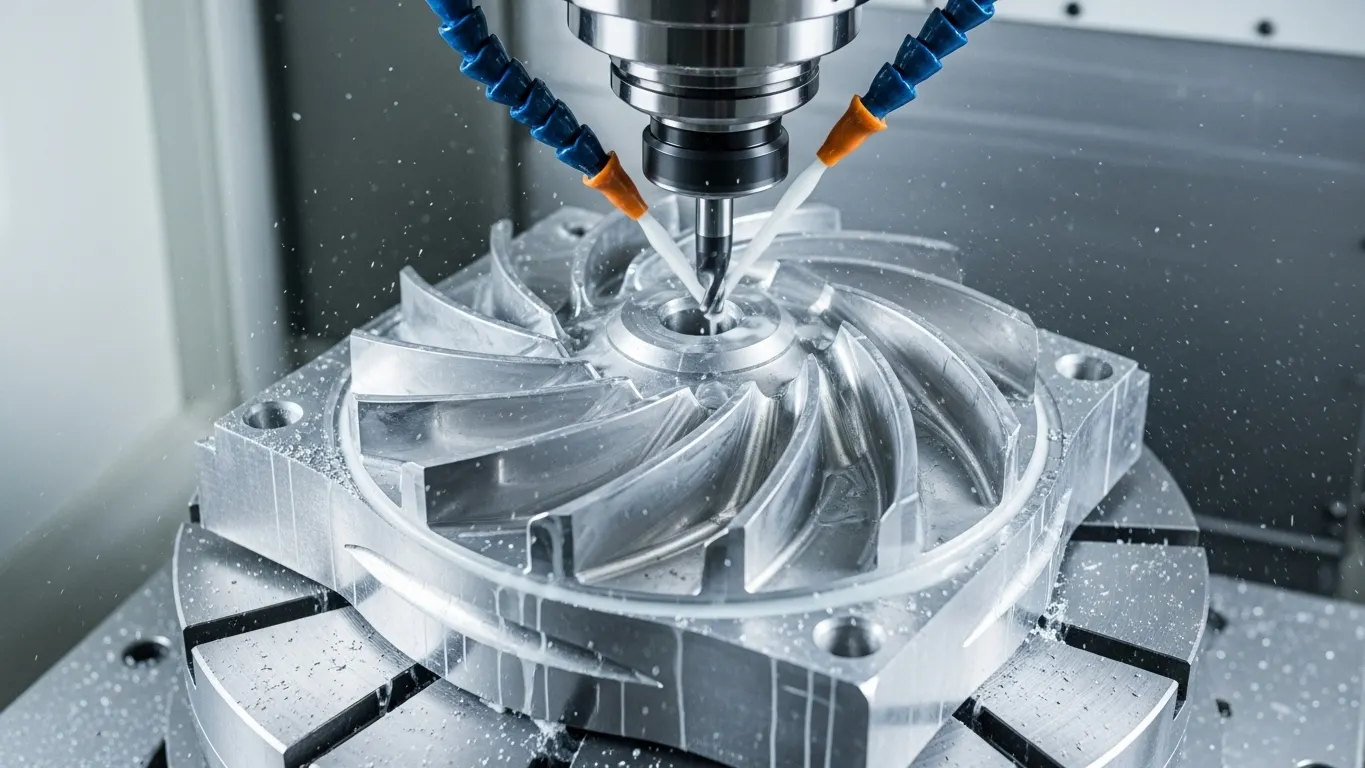
5-axis CNC milling impeller prototype
Have you ever wondered how they make those unbelievably shaped fan blades which are placed on the front of a jet engine? A lot of these vital components are not bended or welded. They are in reality shot out of a single, solid block of metal by a machine as precise a surgeon.
The impeller is a key to the power of deep inside engines and high-performance pumps. This is an extremely important centrifugal compressor part essentially a super-fan, but with greatly detailed twisted blades, which cause the movement of air or fluid with an incredible power. Its complicated geometry is not a coincidence, because all curves are carefully designed to be as powerful and efficient as possible.
This poses an interesting manufacturing quandary; how do turbine impellers get made out of a solid block of material? Attempting to form those deep, undercut curves is as much like trying to cut a spiral shell of seashell with a straight knife; it just does not reach the inside areas. When a machine is merely a simple one, which is not moving about on all four sides, it will be stumped.
It is a robotic sculpting type of solution that provides a cutting tool with the dexterity of a human wrist. The tool can then dancers around the metal by tilting and rotating it to the digital blueprint that will cut away all the metal that is not the final part. It is during this 5-axis CNC milling of an impeller that it becomes possible to make these impossible shapes, a transformation of an ordinary block of material into an engineering marvel.
Why a Simple Robot Can't Carve a Complex Impeller
An example of a traditional arcade game is to imagine your character being able to move left-right and up-down to see the challenge. The most widespread computer-controlled carving machines introduce a third axis which is the straight in and out movement of a spinning tool. It is referred to as 3-axis movement, which is effective in cutting flat signs or a piece of material with a simple shape. It operates on three straight lines, namely X, Y and Z.
But anything but flat is an impeller. It has graceful blades which are heavily curved and twisted to direct the air or liquid flow with a flawless accuracy. A machine which can only move in three directions is only pushed to a great physical limit--it is as though an attempt were to paint the inside of a wavy vase with a strictly straight rigid brush. The tool can solve the problem by approaching straight up, but it is unable to tilt to cut under the blades in order to carve their complicated and winding surfaces.
It is at this point that the simple robot collapses. It is not possible to simply attempt the multi-axis impeller manufacturing process with 3-axis movement only; the tool will even hit the very blades it is attempting to cut. This points out one of the big problems of machining in modern times: how do you cut what you can not actually touch? The answer involves providing the machine with a new aspect of dexterity like a human wrist.
The 'Human Wrist' Advantage: What Makes 5-Axis Machining So Special?
The answer to cutting those inimitable curves is to provide the machine with that dexterity lacking. Besides the three straight-line movements with which are combined 5-axis machines, another two essential axes, the rotational ones, are added. Imagine that you have added a human wrist: the machine can now tilt its cutting tool (how an object bends its wrist) and can turn the entire block of material (how an object turns its hand). This merger opens an entire world of movement.
Having this freedom, the cutting tool no longer simply arrives at some point above. It is able to dance gracefully round the part, leaning to the deepest part under the blades of the impeller, and running smoothly through every intricate contour. Such is precisely the reason why 5-axis is indispensable in multi-axis impeller production; the tool can always maintain the ideal angle to the material and carve surfaces which are not only incredibly strong, but also aerodynamically flawless.
This method also has an enormous benefit in precision. Instead of pausing to physically turn the part over (which exposes it to small misalignments each time a new setup is applied) the machine takes care of all this. This rotation of the part on itself will allow it to machine virtually the whole impeller in a single operation so that all the individual features of the impeller are centered on the next.
These two rotating axes eventually make a mere carving robot a master sculptor, and bring the agility necessary to make a form previously considered impossible to hewn out of a single piece of metal.
From Solid Block to Perfect Prototype: Witnessing an Impeller Take Shape
Any great sculpture shows that it has started with a block of raw material and this applies to the advanced manufacturing. It begins with a solid metalbillet which is either a cylinder or cube of solid metal. This is a rough, thick object of high-grade aluminum or titanium that harbors the intricate shape of the impeller that is locked inside it awaiting disclosure. The initial part of the process is meticulous carving off all that is not the final part by the machine.
It begins with a step that is referred to as roughing. The brute-force stage is this one, during which the machine applies aggressive cuts to the billet using high power in order to extract large portions of the material within the shortest possible time. This is not created to look elegant, but to work efficiently to cut away the waste material and display a rough and stepped version of the impeller. It is like a sculptor working with a big chisel and a mallet to quickly create the general shape of his or her statue and then to pick up more finer instruments.
After the rough form has been revealed, the strategy of the machine is changed altogether. The next stage, the finishing stage is more of accuracy and art. The cutting tool has become much slower and more deliberate in its movement, skittering across the part. In this case, it is the 5-axis or a wrist motion that is essential as it enables the tool to tilt and follow the intricate curves of each blade. This flowing action flattens the roughing-out surfaces of the steps, forming the last and most aerodynamically perfect form, which has a near polished appearance.
Within a few hours, a bland metal block is changed into one, perfect part of unbelievable intricacy. The completed impeller is a monolithic work, without the welds or joints which might form a weak point. But what could be the question, why bother? Why not simply melt the metal and pour it in a mold?

Why Not Just Melt and Pour? CNC Milling vs. Casting for Impellers
It is a terrific question, and the answer is what makes this process so great. The process known as casting is referred to as the melt and pour technique and is similar to the creation of ice cubes: in this process, one pours liquid metal into a mold and leaves it to solidify. It is a practical and useful solution to most of the common things.
But in the case of a high-performance component such as an impeller casting is a serious hazard. During the melting and solidification of metal, the internal grain structure may become discontinuous, with microscopic pores, or impurities, being trapped. Consider the comparison between a beam of hardwood solid and a scrap of particleboard composed of compressed sawdust; one of these is naturally stronger and more reliable than the other.
In an impeller that rotates tens of thousands of times per minute in a jet engine or a turbocharger of a car, that possible weakness of a potential particleboard is not an option. The huge rotating forces would continuously seek any minute blemish and this blemish may result in a disastrous breakdown. The segment ought to be impeccable.
The impeller of the engine is made by hewning a single, solid block of pre-tested metal, and hence its original, forged strength is retained in its purest form. Not only does this process make the material have the correct shape, but it also ensures that the material is capable of withstanding extreme stress. It is this perfectionism that gives reliability and strength which we rely on in our day-to-day lives.
What a Perfectly Smooth Impeller Means for Your World
All this consideration on a perfectly smooth surface may appear as an obsession, but the effects on efficiency are immense. Consider that a smooth racing boat sails on water so much faster than a coarse, wooden raft--air and water act in the same way. The smooth surface of a milled impeller is mirror-smooth to make the blades cut through the air with minimum drag or turbulence. In the case of a car turbocharger or a jet engine, it is directly translated into the savings of wasted energy as well as improved fuel economy.
In addition to smoothness, the process provides almost perfect balance. You have probably heard an unbalanced washing machine begin to shake and bang; time to think of it dozens of thousands of times in a minute. It is really amazing how accurate 5-axis milling can be where all of the blades are carved in the same direction in one step to end up with a perfectly balanced impeller. This enables it to spin at tremendous speeds without any harm, and provides tremendous power without shaking itself to pieces.
The outcome is, after all, much more than a beautiful and sculpted object. It is the combination of material strength that is purist, a drag-free surface, and perfect high-speed balance that gives us the more powerful, reliable and efficient machines. This physical masterpiece, though, does not happen on its own; it is initially a mere set of instructions that is purely digital.

The Digital Blueprint That Becomes Physical Power
The fan that seemed strange to look at before is now shown to be a piece of genius. A digital concept is sculpted by a 5-axis CNC machine into a solid block of metal to create one of the most important connections between fantasy and a concrete, high performance object using robotic sculpting.
The initial step is easy, you have to begin to notice. The next time you happen to see a jet engine, a turbocharger, or even a medical implant, you find those impossible smooth, wretched curves. The question is, How did they carve this? That is the framework you now have on which to admire the hidden dance of multi-axis manufacturing that makes it possible.
It is the magic that used to be lying right before our eyes. The world is an exhibition of unseen craftsmanship, starting with an early prototype of an impeller, up to the elements that are critical in our contemporary life. It is not merely the last object that you see but the fantastic contrivance needed to make it.
